

built
Repurposing Payphones
The Washington Post reports on the demise of the payphone:
“In Washington, as in other parts of the country, pay phones are disappearing from the landscape. The number of them across the country has dwindled from a high of 2.7 million in the mid-1990s to about 1.9 million now, supplanted by the more personal wireless phones that fit in a pocket. The small companies that maintain them are pulling out of the business. Even at the higher price of 50 cents a call, many phones run at a deficit — it costs more to clean, maintain and service them — so people like [technician Andres] Castro are yanking them from their sockets, cutting the lines, and pulling them from shopping centers, gasoline stations, restaurants and street corners where they used to turn a booming profit.”
The Globe and Mail reports that instead of dismantling its pay phones, Bell Canada has started adding WiFi capabilities:
“Aimed at business customers, the service is free until late March and available at several sites in Montreal, Kingston, Ont., and Toronto. The project will also include service at Air Canada airport lounges in Calgary, Montreal, Toronto and elsewhere. The pilot project is intended to measure how customers use the service and how much to charge for it, although some observers wonder if service providers will be able to make much money from so-called wireless fidelity or wi-fi hot spots. For Bell’s hot-spot trial, it’s mostly setting up wi-fi nodes where it has payphones, effectively ‘reinventing’ the payphone business.”
In the United States, massive amounts of cash are being thrown at building a nationwide wireless infrastructure. Adding WiFi to payphones is picks up on an exisitng infrastructure. From Bell Canada’s press release:
“The plan calls for payphones in high traffic areas to be fitted with Wi-Fi technology; typical locations include airports, train stations, hotels, convention centers and corporate campuses.”
Adding WiFi to payphones would be a good way of brining WiFi to underserved neighborhoods — the same neighborhoods that rely on pay phones rather than cell phones.
From the Post again:
“It is much easier — and cheaper — to dial from a cell phone for customers who can afford one. However, pay phones are still profitable in the lowest-income areas of a city, said Terry Rainey, president of the American Public Communications Council Inc., an industry group representing independent pay phone operators around the country.
‘There are a great number of people in this country without a phone,’ Rainey said — 4 and 5 percent, which is more than the 1 or 2 percent of the U.S. population that lacks television sets.
‘Some lower-income areas rely on [pay phones] for regular communications, as well as, in some cases, emergency calls,’ said Mason Harris, president of Robin Technologies and of the Atlantic Payphone Association.”
Compare this map of median household income from the 1990 U.S. Census with this 2002 map of WiFi hotspots in Manhattan. From the Public Internet Project:
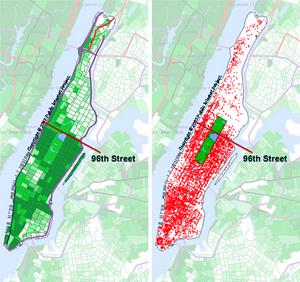
Click here for a larger version.
Update: On May 10, 2003, the New Jersey Star-Ledger reported that Verizon plans to put WiFi transmitters in pay phones across New York City. No mention of how much it will cost to use.
Also of note is this May 5 article from the International Herald Tribune which describes plans by the city of Paris to build a WiFi network along the subway system. Two or three antennas could be places outside each of Paris’s 372 Metro stations.
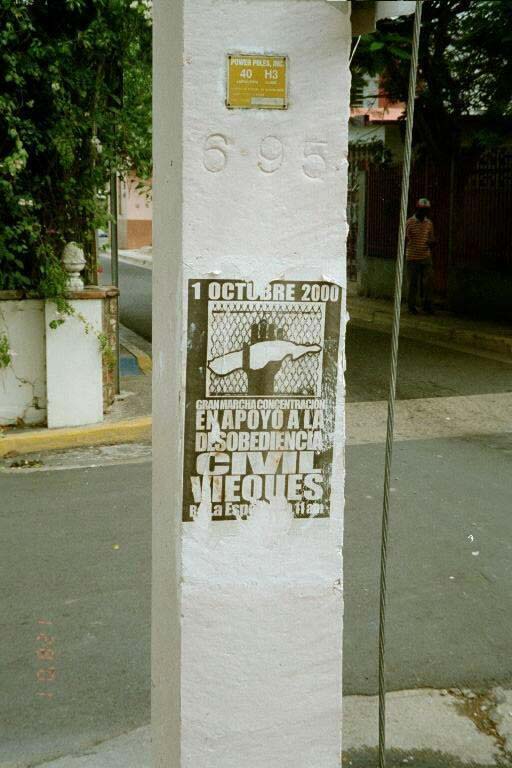
Viéques Libre!
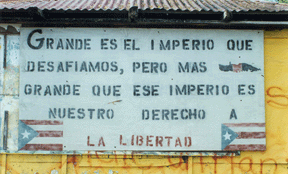
“Great is the empire that we defied, but greater than this empire is our right to freedom.”
Happy May Day and saludos to the people of Puerto Rico and all who struggled to push the U.S. Navy out of Viéques. At midnight last night, the Navy formally turned over its territory on the island to the U.S. Department of the Interior who will turn the bombing range and base into a wildlife refuge.
|
|

Tomorrow morning the people of Viéques will place a large cross on the former bombing range to commemorate those who have died as a result of illnesses related to the contamination of the site.
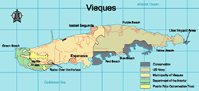
This 2000 UCLA map shows the geographic extent of the Navy’s territory on the island. Much of the west end of the island was transferred to the Viéques Municipality and the U.S. Fish and Wildlife Service in 2001, though this 2003 Navy map still minimizes their apparent footprint. “Live impact” in a “conservation area”?
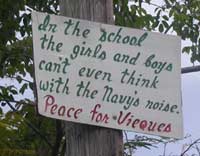
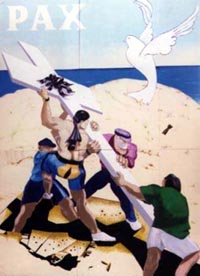
Some images of resistance from around the Web:

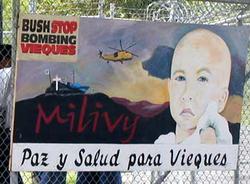
Mural of Milivy Adams Calderón, a boy from Viéques whose death of cancer is widely seen as a result of the military’s contamination of the water.
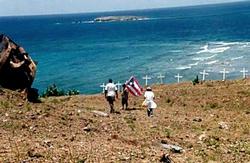
View of crosses and sea from Monte David.

Mural at the University of Puerto Rico-Mayaguez. Photo by Javier Gonzalez Rivera.
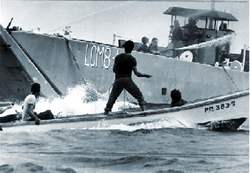
Fishermen blocking US Navy military maneuvers off of Viéques.
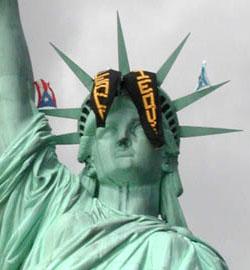
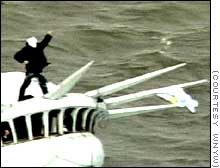
Protestors hang banners from the Statue of Liberty, November 6, 2000.
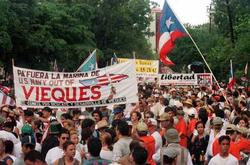
March for the release of political prisoners, September 29, 1999.
Toppling
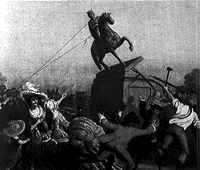 King George III
|
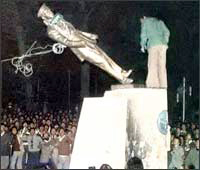 The Shah of Iran
|
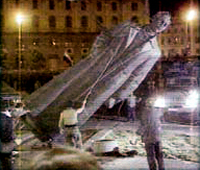
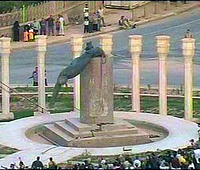
Unable to anticipate a clear surrender by the Iraqi government, on April 4 the Bush administration announced it’s vision of a “rolling victory,” “a strategy to declare victory in Iraq even if Saddam Hussein or key lieutenants remain at large and fighting continues in parts of the country.” Days later, the media run images of a statue of Hussein being toppled by U.S. marines and jubilant Iraqi’s.
...
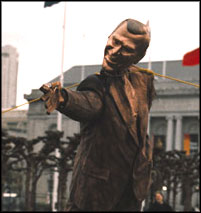
A week later, protestors in San Francisco stage their own toppling of their own. A popular protest mimicking the Marines mimicking a popular protest, the protestors pull down a makeshift statue of President Bush in the style of Saddam Hussein’s.
...
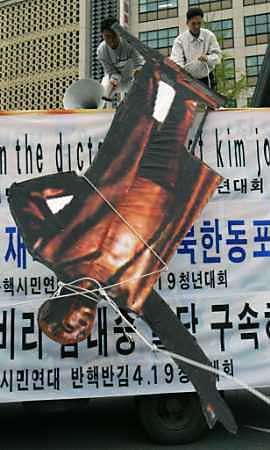
And a week after that, protestors in South Korea topple a cardboard cutout of a statue of Kim Il-Sung.
...
Update: On July 3, 2004 the Los Angeles Times confirmed that it was Army psy-ops that toppled the statue of Saddam Hussein, not the Iraqi civilians shown on television.
Design Against the War
Over a year ago I attended a lecture on design at the Cooper Union. The speaker projected a series of slides illustrating his minimalist design philosophy. One of the images was of the B-2 bomber. I was shocked and disturbed that a design philosophy would fail to take into account social, political, and economic contexts. Particularly of an object which, when used as intended, delivers massive death and destruction.
It prompted me to dig deeper into design and the public interest. And to start this Web log.
On evening of April 16, I arranged a panel discussion at Cooper titled “Design in the Public Interest / Design Against the War.” I invited three panelists to speak about their work as designers involved in the anti-war movement.
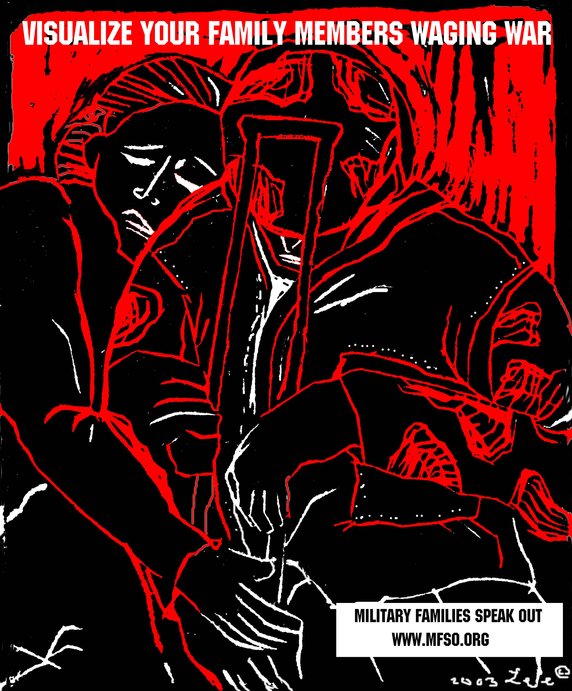 First up was Lee Gough, a printmaker, anti-war activist, and graphic artist based in Brooklyn, NY. She showed a series of prints from a portfolio-in-progress on the Iraq invasion and the war at home, called “The War Went Well.” Some of the images have been used in posters on the Web site Who Dies for Bush Lies“ and for Military Families Speak Out, an organization of people who are opposed to war in Iraq and who have relatives or loved ones in the military.
One image “Fight the War at Home” was inspired by a subway ride home from lower manhattan on September 11. Even as the towers had just been destroyed, there were still, as there had been for many years, homeless persons on the subway appealing to cityfolk to remember them, and to give. The image is a graphic reminder that some have been under domestic attack in our country for a long time, and that funds for the war on poverty pale in comparison to our “defense” budget. Another image, “Visualize Your Family Members Waging War” depicts a despondent soldier with a crutch being embraced by a woman. Lee’s expressive linocut style brings a gravity to the subject matter.
Lee commented on the challenges of choosing one’s message, for instance, noting the different context of “Bring the Troops Home” for troops that have been drafted vs. those who enlisted voluntarily.
One member of the audience raised the question of why U.S. flags and “being American” were the province of the pro-war movement, when large numbers of U.S. citizens were opposed to the war. I noted that I’d seen many anti-war demonstrators holding up flags and patriotism at rallies. On the Web, Who Dies for Bush Lies? effectively tackles effect of the war on U.S. soldiers and U.S. civilians, in addition to Iraqi soldiers and civilians. The danger was raised, though, of the rhetorical trap: the argument over who is “more American” can go back and forth forever, and quickly turning attention away from the crisis at hand.
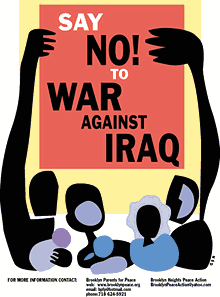 Nancy Doniger has worked as an illustrator for almost 20 years, producing art work for newspapers, magazines, books, posters and T-shirts for both for-profit clients and not-for-profit groups. She is currently a member of Brooklyn Parents for Peace, for whom she created the “Say No to War Against Iraq” poster.
She also helped organize a community/family oriented workshop that gave kids and parents an opportunity to make anti-war art for protest marches. Adults and kids made signs and worked with a puppeteer to create a large paper mache dove, and lots of little doves held aloft on cardboard tubes.
Nancy showed some earlier examples of her work, including a forceful image against the FTAA, a stark two-color poster for a conference on the conflict in Israel and Palestine, and a bright, celebratory “Welcome Back to Brooklyn” poster.
She also showed a couple of iterations of the “Say No to War” poster. One implied the damage of war with flames, but the final version ultimately centered on the mass mobilization. She noted that, in contrast to other illustrations, her work on this piece progressed from representation to geometric abstraction to make the poster more inclusive, using large blocks of color instead of specific depictions of race and gender. She is currently working on a “Hate Free Zone” poster.
Nancy noted the effect of the “Say No to War” poster on her block. The block appeared to be a very pro-war, where “the flags are quick to come out.” But over time, the “Say No to War” poster began to appear in windows and doorways. I certainly noticed it up and down the block where my step-sister lives.
Nancy is also involved in upcoming anti-war event “WEARNICA.” Sponsored by Brooklyn Parents for Peace, on May 3, 2003 a group of artists will present original anti-war art executed on the backs of white cotton dress shirts. The shirts will be worn in public spaces around New York and the world. The event was conceived by Works on Shirts Project whose inspiration for the event came after Colin Powell insisted upon covering the tapestry of Picasso’s Guernica during his warmongering speech to the General Assembly of the United Nations on February 5, 2003.
L.A. Kauffman is a staff organizer for United for Peace and Justice and designer of materials to promote the February 15 and March 22 marches in New York City. Her sticker and poster designs United for Peace and Justice can been seen on the streets across the New York City.
Leslie arrived at design through her work as editor of a progressive journal. She was inspired by the bold, clear graphics of Gran Fury and ACT-UP, and the use of those graphics on the street and at demonstrations, stage managing the events to push its imagery into the mainstream media. She claims she can not draw, so uses clip art in her graphics. The image of the blue pennant flag and black group have become a ubiquitous the city streets.
The idea behind a worldwide day of anti-war marches came out of the European Social Forum held in Florence this past November. At the Forum, the date February 15 was chosen as a date for anti-war demonstrations “in every capital.” What transpired was unexpected and unprecedented.
United for Peace and Justice had only just formed in the November of 2002, but it wasn’t January the group started working on the February 15 march. 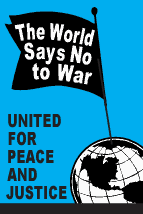 “The World Says No” was the headline of the February 15 flyer design, accompanied by a list of cities taking part in the event. As news of the event travelled across the Internet, marches were planned in more and more cities. Leslie held up various versions of her February 15 design with more and more cities added. Ultimately, marches were held in 793 cities around the world on February 15. Of particular note is virtual absence of communication or coordination between the participating cities.
Leslie spoke of the focused purpose of the posters produced for the event: not to educated, but to mobilize. The flyers lack all superfluous text or argument, just the headline, time and place. The posters and stickers were not trying to change people’s minds, instead to reach out to people who were already against the war but had not yet taken action.
In addition to sticker and flyers, palm cards cut from 1/4 page xerox copies on blue paper were popular and successful. They are both cheaper and more effective — easier to stuff in your pocket, less burdensome on the counter tops of sympathetic shopkeepers.
For the February 15 march, 200,000 stickers were distributed in 5 weeks. For the March 22 march, 200,000 stickers were distributed in 3 weeks. Astonishing numbers, posted around town by a continual flow of volunteers through the office. It’s also a useful bench mark: this is how many it takes to spread the message. A month later, I’m still finding remnants of UPfJ stickers on walls and phone booths. Leslie noted the effect of thousands of little acts of civil disobedience for the spirit of protestors, slowly bolstering a spirit of resistance around in the City and specifically, against the police department ban on marching past the U.N. on February 15.
In total, 1.1 Million pieces of literature distributed. Almost all of the printed materials were bilingual: English on one side, Spanish on the other. However, materials were also produced in Korean, Spanish, French, Creole, and Chinese. Quite a few donations for all these production expenses came online via paypal.
The question was raised about the environmental impact of producing all those printed materials. Her response: it’s also better for the environment if the war is prevented.
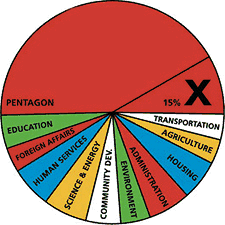 Other examples of design projects were raised by members of the audience: a “Do Not Bomb Iraq” sticker to replace the “Do Not Lean On Doors” sticker in NYC subway cars; colorful logos, charts and imagery designed by Stefan Sagmeister for “Move Our Money,” a campaign to reallocate 15% of the U.S. military budget for education; and flyers handed out to tourists at ground zero with a graphic representation of the number of teachers aides that will be cut from City’s budget. The image leaves it to the viewer to make to the connection to the military expense of a war in Iraq.
Many spoke of the importance of New Yorkers being seen as against the war. September 11 was an attack on New York, and the war is being waged in our name. Others spoke of the urgency of independent media, and the challenge of reaching out beyond “preaching to the converted.”
Overall, I was struck by how spontaneous the designers’ actions were. In almost every case, the designers simply stepped forward and got involved: signs made for a rally were eagerly snapped up; hundreds of thousands of stickers eagerly taken and distributed; and, “Say No to War” posters popped up on an otherwise apparently pro-war street. It seems that one doesn’t necessarily have to change everyone’s minds. There are more “converted” than you think. They just don’t have the graphic materials to display yet.
About 50 people came to the event, a decent turnout despite the announcement from the Pentagon the previous day that “the major fighting” in Iraq was over... and the fact that I’d scheduled the event on the first night of Passover. (Such a Jew am I.) The arc of the event could have used a better closing at the end, as well as a better transition between panelists. I also noted the lack of diversity in the audience. I think next time, I should hold it at different time and place. I’m also quite pleased with the invite design. Peel off the event description and you’re left with an anti-war sticker. Many thanks to Photobition for helping hammer this out in time.
One purpose of the event was to connect artists, designers, and activists. I’m disappointed more Cooper students didn’t show, but after the event quite a few people milled around having these intense little conversations until I kicked everyone out to close the room and return the lights. And quite a few people asked me what was next. Perhaps the start of a new Committee to Unsell the War?
 21 April 2003 | LINK | Filed in
built, housing, iraq, israel, nyc, posters, print, stickers, subway, ufpj, war
21 April 2003 | LINK | Filed in
built, housing, iraq, israel, nyc, posters, print, stickers, subway, ufpj, war
SILENCE = DEATH
 From the Encyclopedia of AIDS:
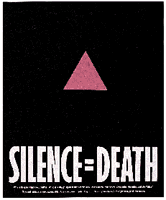
“The pink triangle was established as a pro-gay symbol by activists in the United States during the 1970s. Its precedent lay in World War II, when known homosexuals in Nazi concentration camps were forced to wear inverted pink triangle badges as identifiers, much in the same manner that Jews were forced to wear the yellow Star of David. Wearers of the pink triangle were considered at the bottom of the camp social system and subjected to particularly harsh maltreatment and degradation. Thus, the appropriation of the symbol of the pink triangle, usually turned upright rather than inverted, was a conscious attempt to transform a symbol of humiliation into one of solidarity and resistance. By the outset of the AIDS epidemic, it was well-entrenched as a symbol of gay pride and liberation.
In 1987, six gay activists in New York formed the Silence = Death Project and began plastering posters around the city featuring a pink triangle on a black background stating simply ‘SILENCE = DEATH.’ In its manifesto, the Silence = Death Project drew parallels between the Nazi period and the AIDS crisis, declaring that ‘silence about the oppression and annihilation of gay people, then and now, must be broken as a matter of our survival.’ The slogan thus protested both taboos around discussion of safer sex and the unwillingness of some to resist societal injustice and governmental indifference. The six men who created the project later joined the protest group ACT UP and offered the logo to the group, with which it remains closely identified.
Since its introduction, the ‘SILENCE = DEATH’ logo has appeared in a variety of manifestations, including in neon as part of an art display and on a widely worn button. It was also the forerunner of a range of parallel slogans such as ‘ACTION = LIFE’ and ‘IGNORANCE = FEAR’ and an entire genre of protest graphics, most notably including a bloodstained hand on a poster proclaiming that ‘the government has blood on its hands.’ Owing in part to its increasing identification with AIDS, the pink triangle was supplanted in the early 1990s by the rainbow as the dominant image of ‘gay pride.’ By force of analogy, however, the rainbow itself has, in some countries, become an image associated with AIDS.”
via ACT UP NY:
“There was also the SILENCE=DEATH Project, which was a group of men who had started meeting a year and half before [ACT UP was started], including Avram Finklestein, Oliver Smith, and Chris Lione. They were a whole group of men who needed to talk to each other and others about what the fuck were they going to do, being gay men in the age of AIDS?! Several of them were designers of various sorts—graphic designers—and they ended up deciding that they had to start doing wheat-pasting on the streets, to get the message out to people: ‘Why aren’t you doing something?’ So they created the SILENCE=DEATH logo well before ACT UP ever existed, and they made posters before ACT UP ever existed, and the posters at the bottom said something like, ‘What’s really happening in Washington? What’s happening with Reagan and Bush and the Food and Drug Administration?’ It ended with this statement: ‘Turn anger, fear, grief into action.’ Several of these graphic designers were at that first evening that Larry spoke.”
Big ’up to v-2.
Hoodies
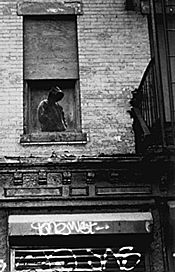 “Last summer I postered the Lower East Side where I live with a series of faceless sweatshirt-hooded grim reaper figures. Lately heroin trafficing down here has reached epidemic proportions. Several of my close friends and colleagues have died from overdoses or HIV infections from dirty needles. Late at night, in an operation resembling a guerilla raid, I installed the Hoody posters on the perimeters of the drug copping zones. Besides the ominous ‘pause’ given passersby, I intended the Hoody posters as warning signs, promoting awareness about a deepening problem in my own neighborhood.”
Dan Witz, “Sending a message through Hummingbirds and Hoodies,” Public Art Review Spring/Summer 1995
Under the Asphalt, the Cobblestones
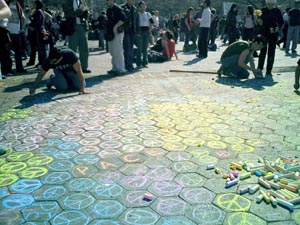
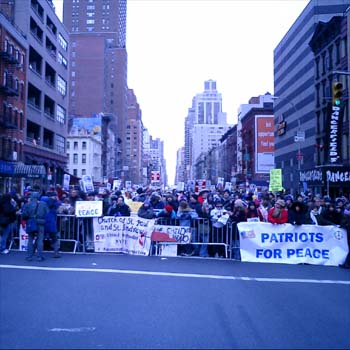
Protestors after the march in New York City yesterday chalked messages around Washington Square Park.
As the U.S. invades Iraq and activists around the world take to the streets, here in New York I’m noticing how the city itself is increasingly used as a medium by the anti-war movement.
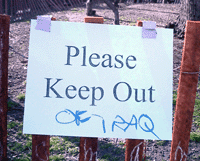 Much of this is nothing new. City streets have always been checkered with posters, graffiti, flyers, and stickers. Subway ads are often annotated with running commentary, sometimes sexual but just as often critical of the ad and advertiser itself (or just blacked out teeth on a too-cheerful model.)
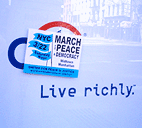 The anti-war movement has taken advantage of all of this. United for Peace and Justice stickers seem to be everywhere — on pay phones, mailboxes, street lamps, walls, and signage. The letters “STOP BUS” on the street are altered to read “STOP BUSH.” In the Baghdad Snapshot Action activists have simply postered ordinary snapshots from Iraq: “Quiet and casual, the snapshots show a part of Baghdad we rarely see: the part with people in it.”
And then there was the march of over 200,000 people down midtown Manhattan yesterday.
But as the war escalates, so do the protests. And so does the reconfiguring of public space. Activists in San Francisco last week shut down traffic throughout the city with autonomous direct actions coordinated online. Activists hauled newspaper kiosks, cafe chairs and tables, and other street furniture into the streets. [article and photos]
What will be the government’s response? Some communities are all too familiar with locked down, fenced in, and video monitored public spaces. Once considered an invasion of privacy, cameras and other measures are increasingly justified as a legitimate response to terrorism. In the name of anti-terrorism, the City recently sought and won a loosening of the law that restricted on police surveillance of political groups. The restrictions were imposed by the settlement of a 1971 lawsuit over harassment of political advocacy groups by the Police Department’s so-called “Red Squad.”
Public amenities and the details of public life are being reshaped elsewhere in the fight against terrorism. In Israel, seating at bus stops is often bolted to the wall (no chair legs to hide things behind), every turnstile will soon have a metal detector installed, and every trash can on the street will be replaced with see-through plastic and wire receptacle. In Washington, D.C., subway trash cans are being replaced with bomb-resistant models. In the Tokyo subway, there are no trash cans at all anymore.
Not to mention Israel’s wall.
This week New York City announced Operation Atlas, additional security measures to try to protect us against terrorist attack during wartime. I’m not opposed to greater inspection of cargo entering the City, but have no doubt that the NYPD will use their new powers to target activists and political dissent. I also note that the plan, which costs $5 million a week comes at a time of severe budget cuts in NYC — and a deficit of nearly $4 billion. Was factored into the costs of the war?
Literature on cities is replete with the metaphor of public space as the site and the physical embodiment of democracy. In the weeks and months ahead, I wonder how our public space will change.
See NYC IndyMedia and Gotham Gazette’s page on New York City and the War.
23 March 2003 | LINK | Filed in
built, graffiti, iraq, israel, nyc, nypd, posters, public space, stickers, subway, ufpj, war
Under Orders
“Today, in Venezuela, the uniformed Armed Forces build housing and infrastructure. It’s interesting; one of the key demands of the ‘opposition’ is to prohibit the army from building houses! The poor cheer when the military enters their neighborhoods, because they’re usually coming to build some houses. Not, like before, when they came to round up the dissidents and repress the social movements.”
This interview on Indymedia prompted me to do a little googling.
President Chavez’s Plan Bolivar 2000 is part public works administration, part poverty reduction plan, part fight against corruption. Despite Venezuela’s immense oil reserves, 80% of the population lives in poverty. To execute the plan, Chavez brought in military officers to bypass civilian agencies he considered corrupt. The military are working with communities and civilian engineers to build and repair roads, schools, housing, and medical centers around the country.
Critics charge that the plan has just shifted the corruption to the military. Chavez has acknowledged incidents of corruption and has ordered the Auditor-General of the Republic to investigate. Other internal investigations have taken place, though are staffed by military officers investigating other military officers. In response to charges, Chavez announced he will reduce ‘secret’ military spending and that more expenditures will be made public.
I’m having a hard time finding data on the status of the project, but one Captain estimates that Bolivar 2000 has already rebuilt or refurbished some 4,000 schools, clinics and hospitals.
Delirious New York
Twin Towers steel set for US warship:
“Steel salvaged from the wreckage of the World Trade Center in New York has been sent to a Mississippi shipyard to be used in the construction of a new US warship.
According to reports, a massive structural beam which supported the south tower will be used to build USS New York, an amphibious vessel capable of carrying more than 1,000 soldiers.”
The $800-million vessel should be ready for active duty in 2007.
Camp
While browsing the DefenseLINK site looking for some good public domain photos, I found a bunch the Pentagon had recently released of the new U.S. detention center at Guantanamo Bay.
The United States was harshly criticized for the brutal, crude design of Camp X-Ray. Photos were widely circulated of prisoners at squatting in their chain-link cells in the blazing Cuban sun.
Five miles down the road, Camp Delta is now open for business. Photos of a detention block and spotless
cells make it seem like an improvement. (Even the name “Camp Delta” reads like a hokey PR move.) Camp Delta has indoor plumbing, each unit its own flush toilet, metal bed-frame and a sink with running water. None of this was available at Camp X-Ray where buckets and portable toilets were used. No detainees in any of  the new photos, though.
The $9.7 million dollar contract for the construction of the camps went to Brown and Root, a subsidiary of Halliburton. The contract could eventually total as much as $300 million if additional options are exercised. Vice President Dick Cheney is the former chief executive officer of Halliburton.
In addition to the new cells, Camp Delta has its own recreation and exercise area, library, outdoor shower, hospital and ward. “Comfort items” distributed to detainees including a prayer mat, cap, flip flops and two-piece suit.
And, dental care is provided at the detainee hospital.
Free dental care? It’s more then most Americans get.
But then another look at that chair and the skin starts to crawl. One suspects the U.S. isn’t terribly concerned with the beautiful smiles of its “enemy combatants.”
Indeed, this morning’s Washington Post describes secret overseas CIA interrogation facilities where detainees are
being tortured. The same torture techniques are of course denounced by the U.S. State Department in its annual survey of human rights violations in other countries. In fact its in some of those very countries where the CIA is setting up shop. Says one U.S. official, “If you don’t violate someone’s human rights some of the time, you probably aren’t doing your job.”
Says Human Rights Watch:
“Direct involvement or complicity in torture, as well as the failure to prevent torture by subordinates, may subject U.S. officials to prosecution under international law. Such acts are ‘grave breaches,’ or war crimes, under the 1949 Geneva Conventions. In addition, the Convention against Torture [which the U.S. has ratified] obligates all countries to prosecute persons within their jurisdiction who are implicated or complicit in acts of torture. Any competent court anywhere in the world is required to prosecute violations of the prohibition against torture.”
According to U.S. officials, nearly 3,000 suspected al Qaeda members and their supporters have been detained worldwide since September 11, 2001.
page 20 19 18 17 16 15 14 13 12 11 10 9 8 7 6 5 4 3 2 1 Older »