



built
Code is Wall
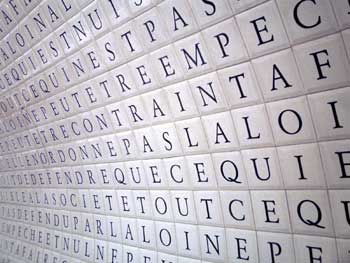
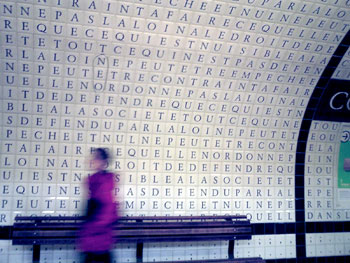
In the Concorde station of the Paris Métro, the tunnel for line 12 is decorated with tiles spelling out the text of the Déclaration des Droits de l’Homme et du Citoyen, the Declaration of the Rights of Man and Citizen, a foundational document of the French Revolution. See more photos on Flickr or this panorama.
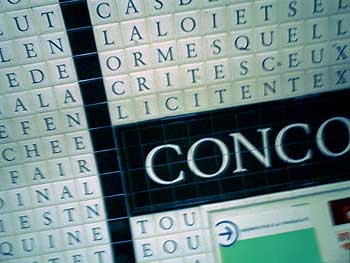
This works in so many ways: as a beautiful display of public typography; as a visualization of the correspondence between human rights and public transit, between policy and infrastructure, between theory, practice, and everyday life. In its deadpan presentation, there’s also something of a memorial to it which seems appropriate given its proximity to Place de la Concorde, previously Place de la Révolution, the site of the guillotine.
Not to mention a passing resemblance to The Matrix.
 20 December 2008 |
 Errata
In January 2008, I published an article in Communication Arts on grassroots design initiatives effecting civic change. I wrote about the Gowanus mural commemorating the deaths of three young boys killed in traffic, and a public pledge at the mural’s unveiling by the New York City Department of Transportation to put $5 million towards improvements in downtown Brooklyn in FY08. This was August 2007, after 10 years of advocacy since the outraged community first took to the streets in 1997 over pedestrian deaths.
A year later the promised safety fixtures are nowhere to be found.
We regret the error.
Forms of Control
From Jan van Toorn, Introduction, Design beyond design: critical reflection and the practice of visual communication:
“Design has become the instrument par excellence for the achievement of social cohesion through form — form as surface, a casing in which an apparent social consensus is created that hides the reality of the cultural condition in a reassuring and entertaining manner.…
In the case of visual journalism and communication design, this means adaptation to the social relations of power, collaborating with and promoting the depoliticization of the media through the primacy of aesthetics as beauty, of visual and other rhetoric that erodes the promise of democracy and participation. The main consequence of all this is that we live in a world in which, to quote Rem Koolhaas, ‘the reality of the socio-economic condition is camoflaged by the decorative glorification of the inevitable.’”
Do Artifacts Have Politics?
After much searching I finally found an electronic version of this essay via a dead link and archive.org. I’m posting here to save it from the memory hole — and have fixed the HTML formatting in the process.
By Langdon Winner, from The Whale and the Reactor: A Search for Limits in an Age of High Technology. Chicago: University of Chicago Press, 1986. 19-39. This essay first appeared in Daedalus 109 (1980): 121-36.
No idea is more provocative in controversies about technology and society than the notion that technical things have political qualities. At issue is the claim that the machines, structures, and systems of modern material culture can be accurately judged not only for their contributions to efficiency and productivity and their positive and negative environmental side effects, but also for the ways in which they can embody specific forms of power and authority. Since ideas of this kind are a persistent and troubling presence in discussions about the meaning of technology, they deserve explicit attention.
Writing in the early 1960s, Lewis Mumford gave classic statement to one version of the theme, arguing that "from late neolithic times in the Near East, right down to our own day, two technologies have recurrently existed side by side: one authoritarian, the other democratic, the first system-centered, immensely powerful, but inherently unstable, the other man-centered, relatively weak, but resourceful and durable."1 This thesis stands at the heart of Mumford’s studies of the city, architecture, and history of technics, and mirrors concerns voiced earlier in the works of Peter Kropotkin, William Morris, and other nineteenth-century critics of industrialism. During the 1970s, antinuclear and pro-solar energy movements in Europe and the United States adopted a similar notion as the centerpiece of their arguments. According to environmentalist Denis Hayes, "The increased deployment of nuclear power facilities must lead society toward authoritarianism. Indeed, safe reliance upon nuclear power as the principal source of energy may be possible only in a totalitarian state." Echoing the views of many proponents of appropriate technology and the soft energy path, Hayes contends that "dispersed solar sources are more compatible than centralized technologies with social equity, freedom and cultural pluralism."2
The Erased
From January until June 2008, Slovenia holds the EU presidency. It’s an opportune time to spotlight the country’s own human rights record.
On the February 26, 1992, six months after Slovenia declared independence from Yugoslavia, the Ministry of the Interior erased 18,305 legal inhabitants from the Permanent Population Register. With a stroke of the pen, 18,305 individuals became stateless “residents without status,” unable to work legally, losing their drivers licenses, passports and other legal papers. Many were permanent residents of Slovenia who had emigrated elsewhere in Yugoslavia. Some were married to citizens or other residents and had raised families in the country. Suddenly thousands of breadwinners were unable to earn an income. Some were deported, some unable to leave the country — trapped in poverty and bureaucratic limbo. See some of their stories here.
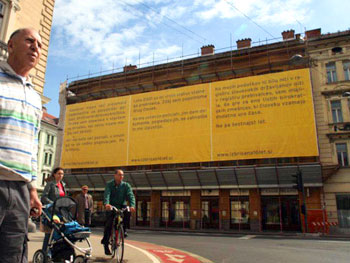
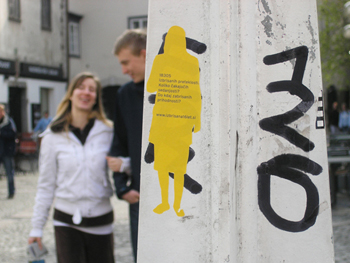
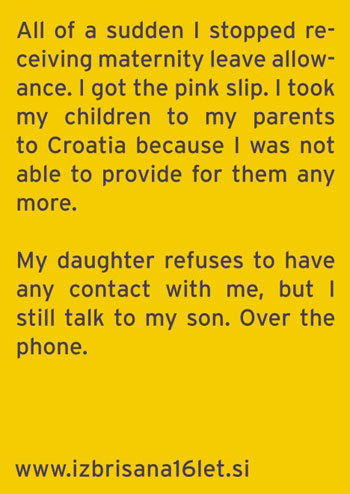
Marc at Osocio sends word about a public, citywide campaign in Slovenia’s capital city Ljubljana to shine a light on The Erased and their ongoing plight. The design studio Poper has postered the town in partnership with Amnesty International Slovenia, the Peace Institute and the city government, rendering the stories of The Erased throughout the city. The campaign’s goal is to raise awareness of the issue, the State’s arbitrary response and blatant disregard of Constitutional Court rulings.
Listen to the last segment of this CBC podcast for more on the issue or read this FAQ on the campaign’s web site: http://www.izbrisan16let.si
page 20 19 18 17 16 15 14 13 12 11 10 9 8 7 6 5 4 3 2 1 Older »


