



product
Flow Lamp.  A self-powered lamp post for illuminating public spaces in developing countries, this bamboo wind turbine charges LEDs, and is both cheap and recyclable. What started out as a graduate thesis will be going into production soon.
A self-powered lamp post for illuminating public spaces in developing countries, this bamboo wind turbine charges LEDs, and is both cheap and recyclable. What started out as a graduate thesis will be going into production soon. 15 March 2010 |
 Clothing Slashed. “It is winter. A third of the city is poor. And unworn clothing is being destroyed nightly.” Brief NY Times piece exposes big clothing retailers, particularly H&M, destroying clothes before discarding instead of donating or recycling.
Shop. “Banksy doe not endorse or profit from the sale of greeting cards, mugs, photo canvasses or Tshirts. Images on this site are provided at high resolution so you can make your own, but only for non-commercial purposes, thanks.”
Design to Improve Life. Winners of the 2009 Index Award have been announced. On top of the list are the wind-up fetal heart rate monitor and an efficient, smokeless indoor stove. See the complete list of finalists for lots of social design product ideas.
Speaking Books. 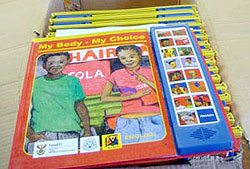 “Books of Hope partnered with the South African Depression and Anxiety Group, to design and produce interactive, multilingual Speaking Books that can be seen, read, heard and understood by the reader regardless of their reading ability.
The Speaking Book combines the latest sound chip technology featuring a sound track read by well-known local celebrities in the local language, with a durable laminated hard backed book, to take the reader on a step-by-step guide to wellness. Books of Hope has successfully created an effective means to present complex health care issues by adapting to the culture, skills and needs of communities while encouraging them to build self confidence with a simple action plan.”
“Books of Hope partnered with the South African Depression and Anxiety Group, to design and produce interactive, multilingual Speaking Books that can be seen, read, heard and understood by the reader regardless of their reading ability.The Speaking Book combines the latest sound chip technology featuring a sound track read by well-known local celebrities in the local language, with a durable laminated hard backed book, to take the reader on a step-by-step guide to wellness. Books of Hope has successfully created an effective means to present complex health care issues by adapting to the culture, skills and needs of communities while encouraging them to build self confidence with a simple action plan.”
Down the Toilet.  “More than 98% of the toilet roll sold in America comes from virgin forests.… Extra-soft, quilted and multi-ply toilet roll made from virgin forest causes more damage than gas-guzzlers, fast food or McMansions.… In Europe and Latin America, up to 40% of toilet paper comes from recycled products. Greenpeace this week launched a cut-out-and-keep ecological ranking of toilet paper products.”
“More than 98% of the toilet roll sold in America comes from virgin forests.… Extra-soft, quilted and multi-ply toilet roll made from virgin forest causes more damage than gas-guzzlers, fast food or McMansions.… In Europe and Latin America, up to 40% of toilet paper comes from recycled products. Greenpeace this week launched a cut-out-and-keep ecological ranking of toilet paper products.”Heel the World
“This is a farewell kiss, you dog. This is from the widows, the orphans and those who were killed in Iraq.”
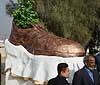 On January 29, 2009, sculptor Laith al-Amiri unveiled an outsized monument of a shoe in Tikrit to commemorate journalist Muntadhir al-Zaidi who hurled his shoes at President George W. Bush. The sculpture was unveiled on the grounds of an orphanage and constructed with the help of the kids. Officials removed it the following day. The local deputy governor told CNN: “We will not allow anyone to use the government facilities and buildings for political motives.”
- On February 3, 2009, a protester was arrested in the UK for throwing a shoe at the Chinese premier, Wen Jiabao, at a lecture at Cambridge University. As he threw the shoe, the man shouted, “How can you listen to this unchallenged?”
- For every pair purchased, TOMS Shoes donates a pair of shoes to a child in a developing country. From May 2006 through December 2008, TOMS distributed 115,000 pairs of shoes worldwide. Shoes prevent Podoconiosis, a disease caused by absorption of silica through the feet, particularly from volcanic soil. The symptoms are swelling, ulcers, and ultimately deformity in the feet and legs. The disease is 100% preventable by wearing shoes.
- The Shoe Bank collects used shoes at schools, gyms and stores around Texas and redistributes them at shelters in Texas and to natural disaster victims abroad. The organization provides shoes for twenty thousand people every year. In September 1991, The Shoe Bank was officially recognized by President George H. W. Bush.
Shoes flown round the world.  “Protests were held in Britain, France, Germany, Greece, Ireland, Italy, the Netherlands, Spain and Turkey as the Israeli offensive entered its second week...In many cities people waved shoes — recalling the action of an Iraqi journalist who hurled footwear at U.S. President George W. Bush in Baghdad last month in a symbolic insult. British demonstrators threw dozens of shoes into the street as they passed the gated entrance to Downing Street, where Prime Minister Gordon Brown lives, and shouted angrily at a line of 40 police officers on guard there. ‘Come to get your shoes Gordon,’ one woman shouted as other marchers directed chants of ‘Shame on you’ at Brown.”
“Protests were held in Britain, France, Germany, Greece, Ireland, Italy, the Netherlands, Spain and Turkey as the Israeli offensive entered its second week...In many cities people waved shoes — recalling the action of an Iraqi journalist who hurled footwear at U.S. President George W. Bush in Baghdad last month in a symbolic insult. British demonstrators threw dozens of shoes into the street as they passed the gated entrance to Downing Street, where Prime Minister Gordon Brown lives, and shouted angrily at a line of 40 police officers on guard there. ‘Come to get your shoes Gordon,’ one woman shouted as other marchers directed chants of ‘Shame on you’ at Brown.”Negotiating Dominance and Submission Through Industrial Design. “Like interactions between people, every dialogue between user and product can be framed as an exchange of power as well as meaning. Products like erasers and hammers submit to our intentions, while cell phones, books, and subways make us submit, either by seduction or force.”
Commodify Your Dissent, 3. Screw the Flash game, since a pair was hurled at President George W. Bush the Model 271 shoe is flying off the shelf. “Baydan Ayakkabicilik San. & Tic. has received orders for 300,000 pairs of the shoes since the attack, more than four times the number his company sold each year since the model was introduced in 1999.... ‘Model 271’ is exported to markets including Iraq, Iran, Syria and Egypt. Customers in Iraq ordered 120,000 pairs this week and some Iraqis offered to set up distribution companies for the shoe, Baydan said.” More on The NY Times.
Screw the Flash game, since a pair was hurled at President George W. Bush the Model 271 shoe is flying off the shelf. “Baydan Ayakkabicilik San. & Tic. has received orders for 300,000 pairs of the shoes since the attack, more than four times the number his company sold each year since the model was introduced in 1999.... ‘Model 271’ is exported to markets including Iraq, Iran, Syria and Egypt. Customers in Iraq ordered 120,000 pairs this week and some Iraqis offered to set up distribution companies for the shoe, Baydan said.” More on The NY Times.

