



product
Sanitize that Sponge
I’m not sure this counts as ‘Social Design’ — but then the sickness it can spread. And I love simple solutions like this.
If you’re a busy designer, you probably don’t change your kitchen sponge very often. When things start to smell, it’s seriously past time to do something about it. From Cook’s Illustrated:
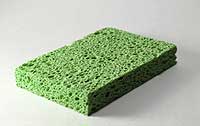 Safer Kitchen Sponges
“Sponges kept by the sink are wet and warm, which makes them attractive hosts for bacteria. We investigated various home-style disinfecting methods used by readers and test kitchen staffers — microwaving, freezing, dishwasher, bleaching, boiling, and washing with soap and hot water — to see which were effective. After counting bacteria both before and after testing, numbers showed that putting the sponge in rapidly boiling water for 3 minutes was the most effective disinfection method, reducing bacteria counts from millions to only 1,000. Soaking the sponge for ten minutes in a solution of 1/4 cup bleach and 4 cups water was the next best alternative.”
 16 April 2005 |
 Retool
Folks in Maine have a plan to fight the war by saving jobs — and the environment.
 Christie Toth reports in the April 1, Portland Phoenix about a statewide, grassroots campaign to convert Maine’s military manufacturing infrastructure to environmentally sustainable, non-military manufacturing:
“A year ago, Bath Iron Works, Maine’s largest private employer, had a contract to build seven DD(X) Destroyers for the United States Navy.
Now, the president’s budget proposal has slashed the destroyer order by more than half, and the Navy is considering giving the entire contract to a shipyard in Mississippi. As the Maine delegation fights what may be a losing battle on the Hill, economic conversion is beginning to look like more than an idealistic pipe dream. It is beginning to look necessary for Midcoast Maine’s economic survival.
With more than 6200 employees, BIW is Maine’s largest private employer; however, despite a robust shipbuilding schedule, the yard has been hemorrhaging jobs for years. Over the last six months, with 51 layoffs here, another 137 there, BIW has eliminated nearly 500 positions. And those layoffs barely register compared to what the company, a subsidiary of the Virginia-based General Dynamics Corporation, may be facing in the near future....
The Maine congressional delegation is doing everything in its power to push against the carrier-like momentum of Donald Rumsfeld’s vision for leaner, meaner armed forces. Senators Snowe and Collins warn of the grave dangers of single-source destroyer construction in Mississippi, citing everything from terrorist attacks to hurricanes. Congressman Tom Allen rails about the costs of the Iraq war, which he says could purchase a destroyer a week. None of Maine’s elected representatives has been above a little fear-mongering about China....
Peace Action Maine (PAM) is a nonprofit activist organization working to provide ‘a voice of education and a center for all people committed to disarmament and creative responses to conflict.’ On April 1, they will launch a two-year campaign to shift Maine’s manufacturing base away from reliance on military industry. While PAM would support the introduction of any socially responsible, ecologically sound nonmilitary manufacturing in Maine, their most treasured vision is to make Maine a national leader in the production of sustainable energy technologies, such as solar panels and wind turbines.
Domestic demand for windmill equipment is growing. ‘Maine’s going to be left behind,’ says Gagnon, ‘because the Maine delegation is clinging to a sinking boat.’”
The campaign kicked off with a parade in Portland, a traveling art exhibit, public presentations, and the commission of a feasibility study from Economists for Peace and Security.
Bruce Gagnon is blogging the campaign at Organizing Notes.
Pushing Back
 A shareholder resolution to block Caterpillar from selling D-9 bulldozers to Israel picks up momentum.
Commodify Your Dissent
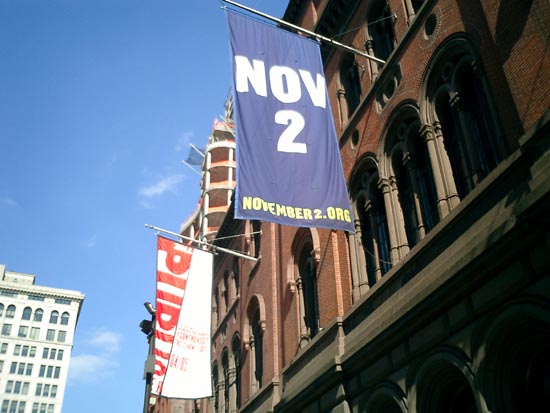
Walking around downtown, I’m noticing a number of businesses flaunting their politics. Below are a few random snapshots.
In New York City, where registered Democrats outnumber registered Republicans by 5 to 1 it probably does not harm your business much to wave a Democratic flag.
But what’s notable is that these banners do not seem to be branding or trying to create a niche. I don’t think these businesses are trying to position themselves as responsible corporate citizens. It seems more like someone wearing a political pin, though for each the context is a bit different.
Click on a thumbnail to view a larger image.
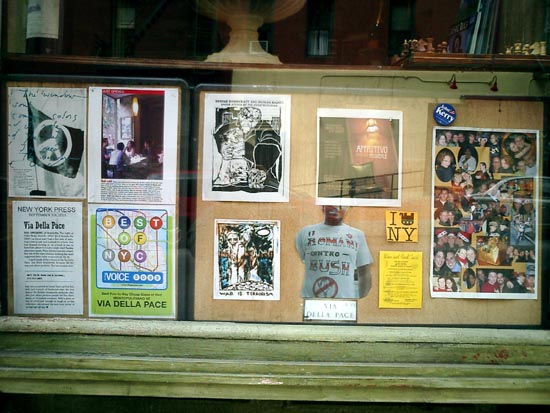 Via Della Pace, Italian café The T-shirt reads “Romani Contro Bush.” |
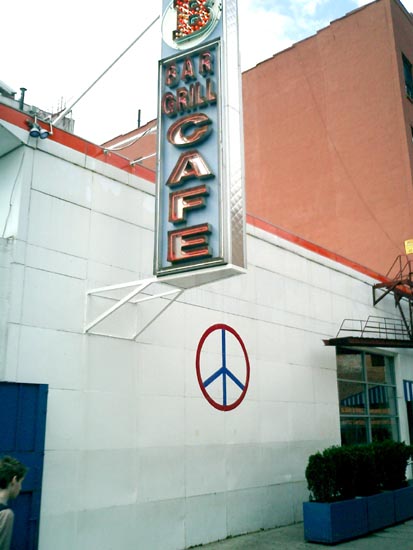 Bowery Bar and Grill Who also pioneered the gentrification around Cooper Square 10 years ago. |
|
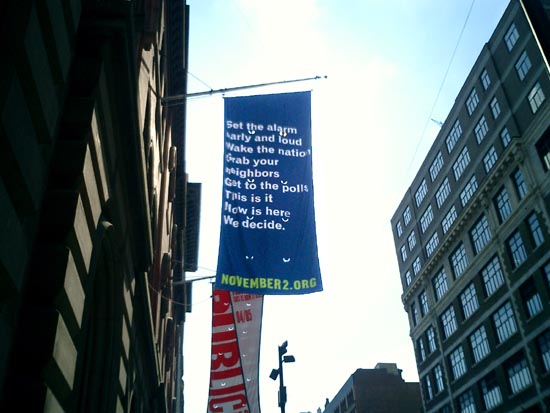 Banners outside the Public Theater |
 | |
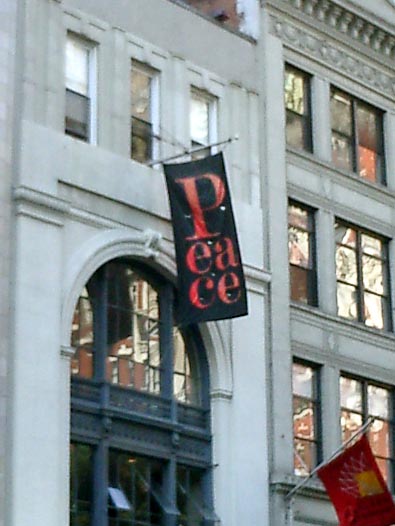 Pentagram, a design studio They usually hang a banner with a big red P. |
 Ben & Jerry’s They actually did have voter registration forms. | |
 Cookies at Once Upon a Tart “After all,” says the owner, “we’re French.” | ||
On a related note, a year ago a handful of lefty bloggers were abuzz about this:
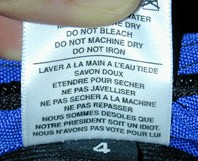
a label from a bag designed by Tom Bihn, an American company located in Port Angeles, Washington. The French repeats the English care and handling instructions, with an additional two lines:
Wash with warm water.
Use mild soap.
Dry flat.
Do not use bleach.
Do not dry in the dryer.
Do not iron.
We are sorry that Our President is an idiot.
We did not vote for him.
Few bloggers followed up to point out that the grassroots buzz actually produced record sales for the company.
From AFP, April 26, 2003:
Handbags insulting “president” in French sell like hot cakes in US
“There is no doubt that sales are hot for handbags bearing an insult — in French — aimed at ‘our president.’ The question is: Which president?
The bag’s designer Tom Bihn never guessed that purses with the message, ‘We’re sorry our president is an idiot. We didn’t vote for him’ — inscribed in French — would be blowing out of the stores.
‘It is a mystery, but since we launched the bags with the label sewn, sales have doubled,’ said Bihn, 43. ‘It is a record in the history of the company.’
He denies the message is targeting US President George W. Bush.
‘It depends on either your nationality, or the president you think is an idiot; you choose.’
Clients throughout the United States have flooded his offices in Seattle and Port Angeles with calls and e-mails to order for the bags, he said.
The company received ‘varied reactions’ including ‘hate mail from a French citizen who thought the label was addressed to (French President) Jacques Chirac.’
But 80 percent of the Americans think it is an amusing message, he said.
On his company’s website, he said: ‘Everyone seems to have a ‘president’ that they think is an idiot. Take your pick: Jacques Chirac, Bill Clinton, George Bush.’
Neither Bihn nor his 10 employees have yet taken the situation seriously, but have launched a series of T-shirts, selling at 20 dollars each, with the same message, with funds to go to a war veterans’ center in Seattle.”
Free as in Voice Mail
Here’s a happy story of humanitarian gadgetry. From CNN:
Free voice mail helps the homeless
“The nonprofit Community Voice Mail project provides homeless people with a way for potential employers, social service agencies and relatives to contact them. It also enables them to apply for a job without having to tell a prospective employer they are living on the streets....
Hilary Terlouw, a 45-year-old woman from Bellingham, Washington, said she was living in an abandoned trailer with no electricity when she learned about Community Voice Mail three summers ago. She lives in subsidized low-income housing and has a service dog and even a computer, she said.
‘It just saved my life,’ said Terlouw, who battles mental illnesses and physical disabilities. ‘It really did. If I didn’t have a telephone number to have doctors’ offices or clinics call me back, I don’t know what I would have done. I was truly at the end of my rope at that time.’...
Larry Sykes, Community Voice Mail director at The Stewpot, which hopes to offer more than 2,500 voice mail lines in Dallas within three years, [notes] ‘Unless they tell somebody they’re eating at The Stewpot or sleeping under a bridge, nobody knows it.’”
Illuminati
In June, CNN and others aired video footage showing a Los Angeles police officer beating a suspect with a 2-pound metal flashlight.
The response?
Redesign the flashlight.
From the Los Angeles Daily News, Thursday, August 05, 2004:
LAPD panel may design flashlights
“Two days after announcing that LAPD officers will stop carrying heavy metal flashlights that can inflict serious injuries, Chief William Bratton said Thursday that his officers will design their own rather than buy off-the-shelf models.
 Bratton estimated that it would take a committee several months to design a device that’s lightweight, bright and virtually incapable of causing serious injury. He didn’t know how much it would cost to develop. ‘We’re not aware of any flashlight that meets the training and multiple needs of our officers,’ Bratton said.
Bratton announced Tuesday that the Los Angeles Police Department will phase out the use of 2-pound metal flashlights, such as the one an officer used June 23 to strike car-theft suspect Stanley Miller 11 times. The widely publicized incident underscored the perilous potential for using flashlights as weapons rather than light sources.
If the LAPD follows through on its plan, it would be the only U.S. police department with its own brand of flashlight. Bratton said the LAPD might be able to license the device and sell it to other agencies.
LAPD officers have had discretion to choose from a variety of flashlights -- from penlight models to the foot-long metal light.
Officers have used flashlights in 15 serious use-of-force incidents since 2001.
New York police officers are allowed to pick their own flashlights as long as the models don’t use more than three D-cell batteries. Chicago police are issued a standard flashlight that fits in the palm of the hand.
Police in San Diego are issued foot-long metal flashlights. In San Francisco, officers can choose between larger and smaller models.
Chicago and San Francisco officers buy their flashlights from Streamlight Inc., a Pennsylvania company that advertises its flashlights as bright, durable and versatile enough for police and firefighters. The most common Streamlight flashlights are rechargeable and cost $100 to $200 each.
But Bratton said LAPD officials were unable to find a light that can be recharged in a police car, has extended battery life and can be easily used in one hand while the officer holds a gun in the other.
The Los Angeles Police Protective League, which represents officers, said the current metal flashlights meet officers’ needs.
‘Improvements are always welcome, but it is going to take a long time and a lot of money to make the chief’s new concept a reality,’ the union said in a statement. ‘Once the custom lights are designed, the league has questions regarding who is going to pay for this new required equipment.’”
Switching every flashlight on the force to a rechargeable model would eliminate an awful lot of disposable batteries.
However, the announcement is chilling. With officers riding around with a 2-pound metal club at their side, it seems the temptation to use it as a weapon is just too great. By redesigning the tool, the brass hope to remove this. A kind of “gun control” for people who carry guns.
A good thing to do, but it does seems like the flashlight design is being blamed for a lack of discipline on the force, and for a law enforcement environment in which beating suspects is suprisingly common. The redesign announcement seems to admit that the beatings are normal and will continue — though perhaps just a little less brutally.
Extrapolating a bit, this points to the huge potential for abuse of so-called “non-lethal” weapons. In such a law enforcement environment, I imagine the temptation will be just as great.
Green or Black?
“Do you want green tea or black tea?”
In Uzbekistan, tea is the drink of hospitality. Community is all about hanging out in the choyhona (teahouse), talking and drinking tea while sitting on topchan, a kind of raised platform bed with a pad to sit on and a small table in the middle. (Thus, choyhona is also the name of a popular Internet chat network.)
 So which tea do you choose?1 The question seems simple, but the answer is fraught with political significance, identifying you as sympathetic to either ethnic Russians or ethnic Uzbeks.
One of the legacies of the Soviet occupation in Central Asia is a population of ethnic Russians living there. Born in Central Asia and raised under Soviet culture, when the USSR fell and the borders rolled back, these ethnic Russians remained. This piece in Slate describes the predicament.
“Clara was a Soviet. Today, she must search for a new vocabulary to define her identity. She has no ties to the land of her ancestors and is neither Kazakh nor Russian.
This search for identity is mirrored in millions of ex-Soviet people of all ethnic groups. One of the more interesting cultural shifts in post-Soviet Central Asia is the status and identity of ethnic Russians. During Soviet rule, the Russians comprised more than half of the population in Kazakhstan, exiled by Stalin during the 1950s and ’60s mass migration under the ‘Virgin Lands’ campaign, when Russians were encouraged to cultivate northern Kazakhstan’s pastures.
So where does this leave ethnic Russians with no ties to the new but living in the place of their birth? Rootless.”
Ethnic Russians used to be identified with the power elite, but are no longer. Since Central Asian independence they are in some ways second-class citizens. Political leaders now promote a form of nationalism using ideas of ethnic authenticity — for instance, promoting local languages and literature supressed under Communism, or in the most extreme example, the President of Turkmenistan has banned all “non-Turkmen” cultural institutions.
In this climate, signs that might otherwise seem insignificant become significant cultural markers.
In Uzbekistan, conventional wisdom holds that Russians drink black tea and Uzbeks drink green tea. When with one group or another, drinking the appropriate tea identifies one as part of the “in group.” The sign, though, can be waved by anyone — an ethnic Russian among Uzbeks may choose green tea to signify that he or she is down with the group.
Ironically, the political leaders pushing the nationalism are often themselves the products of Soviet education and the Soviet system. They speak fluent Russian... and though they’d never admit it, might even prefer black tea.
1 Choosing neither will win you a stern lecture on the important health benefits of tea.
Allergic Reactions
Next week the House of Representatives will vote On the evening of July 21, the House of Representatives approved a law requiring new package design standards that may save lives.
From The New York Times, July 10, 2004:
 “Each year, some 30,000 Americans are rushed to emergency rooms because of severe allergic reactions to food. Roughly 200 people die yearly from such reactions. Sound public health legislation passed by the Senate, and heading for House action before the Congressional recess, aims to lessen that toll by requiring that food labels clearly and accurately disclose the presence of the eight most common allergens in various additives: peanuts, eggs, milk, soy, tree nuts, fish, shellfish and wheat.
The bipartisan measure fills a hazardous gap in Food and Drug Administration rules, which do not require that these allergens in spices, flavorings, coloring and other additives be listed on labels even though ingesting the slightest amount can be fatal for some people. And the allergens that are listed on a label are frequently identified only by their formal names instead of in everyday English — as ‘whey’ instead of ‘milk product,’ for example.
The food industry adopted voluntary guidelines to try to fend off legislation. But although some companies now list allergens in clear terms, others still don’t. The government needs to make compliance universal.
First introduced four years ago by Representative Nita Lowey, Democrat of New York, and championed in the Senate by Edward Kennedy, a Massachusetts Democrat, and Judd Gregg, a New Hampshire Republican, the measure also has important backing from the Bush administration. Its expected passage by the House this week, and subsequent signing by the president, will give food manufacturers until 2006 to refashion their labels to list allergens more clearly. It will also give Americans an all too rare example in this election year of bipartisan cooperation to serve the public good.”
The FDA publicly recognized fatal food allergies in 1994, and in 1996 acknowledged the need to label foods containing allergenic substances. However, they were unable to require the labeling because
“Section 403(i) of the [Food, Drug, and Cosmetic Act] provides that spices, flavorings, and colorings may be declared collectively without naming each one. Secondly, FDA regulations (21 CFR 101.100(a)(3)) exempt from ingredient declaration incidental additives, such as processing aids, that are present in a food at insignificant levels and that do not have a technical or functional effect in the finished food.”
The new bill is the result of grassroots pressure and several medical and academic studies on the effects of allergens and interpretations of commercial food labeling.
This study on label interpretation is even cited in the text of House bill.
The Center for Science in the Public Interest also takes some credit, remarking that:
“A major impetus for the legislation was a 2001 article in CSPI’s Nutrition Action Healthletter that publicized a study by the Food and Drug Administration showing that about 25 percent of candy, ice cream, and baked goods from plants in Minnesota and Wisconsin had products with undeclared egg or peanut ingredients.”
I note that the CSPI’s influential document was in part a repackaging, redesign, and republishing of information already available from the FDA.
The Food Allergen Labeling and Consumer Protection Act (FALCPA, or S. 741) was approved by the House Energy and Commerce Committee on June 24, 2004. It was passed by the U.S. Senate on March 8, 2004. The bill now goes to President Bush for his signature.
The new allergen info is likely to be added to the Nutrition Facts label.
Updated July 21, 2004
Fashion Statement
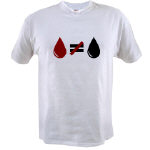
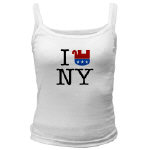
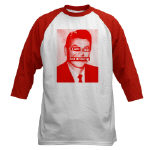
OK, OK, OK.
So, every time I show someone a graphic idea for a flyer or something they inevitably say, “You know, that would make a great T-shirt.”
Alright, then. I’ve created a few at CafePress. You can order them online at http://cafeshops.com/nornc
For sale: T-shirts, tank tops, posters, postcards, and stickers to welcome the Republicans in style.
Only three designs so far, but let me know what you think and I might make more.
Note, all prices shown are CafePress’s base prices. I’m not making any money here. I just want to get the word out.
---
And by the way, if you want to design some T-shirts yourself, CafePress makes it fairly easy. Basically, you upload a high resolution graphic through your Web browser to their Web site, select the product, and order it online. Voila! They handle the payment processing, printing, shipping, and customer service. You can put your design onto T-shirts, hoodies, lunch boxes, frisbees, postcards, and more. (See for instance, this lovely turntable mousepad I made.) Setting up a basic store online is free.
No Future
From Cute, by Kitty Hauser in the London Review of Books, Vol. 26 No. 8, April 15 2004.
“It is characteristic of subcultural style that it should resist the interpretations of outsiders. The signs emblazoned across the bodies of these Japanese teenagers speak in code to those who inhabit the same world of meaning; that, in one sense, is the point. But more than this, the broader ‘meaning’ of style is not something that can be read off its surface. If cute means anything, it isn’t going to be what it seems to mean. It isn’t, for example, necessarily juvenile to dress like a child. Nor does dressing up at the weekend necessarily betray a desire to be ‘someone else’. Most important, the deliberate dumbness of many of the youngsters in Fruits doesn’t necessarily mean they have nothing to say, or that they are saying nothing by acting dumb.
 Cute culture has thrown [Donald] Richie and other writers off track because it doesn’t conform to what the baby boomer generation expects of youth culture. Cute is not rebellious — at least not in any obvious way. It isn’t cool. It doesn’t seem to be about sex. It doesn’t want to overthrow capitalism — cute is hooked on brand-names. It is cosy, not angry. And despite the apparently unique get-ups in Fruits, it isn’t really about individuality: Richie points out with a triumphant air that the most outlandish sartorial affectations are widely copied, as if this were proof of a lack of imagination in this nation of conformists, rather than simply in the nature of subcultural style the world over. Cute is evidently rather disappointing and embarrassing to writers such as Alex Kerr, who, in Dogs and Demons (2001), sees it as one of many depressing symptoms of Japan’s decline. Whatever we might think of grown women in lacy ankle-socks and Barbie handbags or young men wearing tiny school uniforms, we ought to take them seriously, not least because cute culture is spreading. Sanrio, the company responsible for Hello Kitty, Little Twin Stars and a host of other cuties, has a billion-dollar turnover, much of it derived from the lucrative licensing of products from T-shirts to sex toys. These characters have a huge demographic appeal in many parts of the world, with or — increasingly — without the gloss of camp irony which justifies their consumption in some quarters. And it must mean something when large numbers of young people dress in ways which twenty years ago would have been considered more suitable for children.
Richie would have done well to read the work of Sharon Kinsella, whose writing on cute is free from the preconception that youth culture ought to be an authentic expression of individuality. On the contrary, according to Kinsella, cute style betrays a lack of confidence in the very notion of the individual, and cannot muster the energy and optimism necessary for rebellion. It is a soft revolt. It seems that becoming an adult is not an attractive option to these burikko (‘fake children’) when it is associated with the responsibilities and obligations of work and family. This is a generation of ’freeters’ (the word comes from ’free arbeiter’) who have rejected the stringent work patterns of their parents, even when they are available, as they often are not in the current economic climate. Acting and dressing like children represents their refusal of the adult world: as Kinsella writes, cute style ‘idolises the pre-social’. Cute is a kind of rebellion, then, but its retreat to the imagery of childhood indicates that there is no alternative to the adult world except a deliberate regression to this one remaining realm of freedom. Seen in this way, cute style is bleak: it allows no looking forward to a future, either for individuals or for society. In this sense it is far darker than punk, which had an energy and rage that promised action, if not social change. Cute disguises its pessimism and political inertia as winsomeness.”

