



product
Testing cigarette warning labels. Keep it graphic and change it often. “In a multi-country study published in the March 2007 issue of the American Journal of Preventive Medicine, researchers found that more prominent text messages were more effective and graphic pictures even more so in affecting smokers’ behaviors. Recent changes in health warnings were also associated with increased effectiveness, while health warnings on US packages, which were last updated in 1984, were associated with the least effectiveness.”
The published study, “Text and Graphic Warnings on Cigarette Packages Findings from the International Tobacco Control Four Country Study,” is available as a 2.4MB PDF from researcher David Hammond’s site.
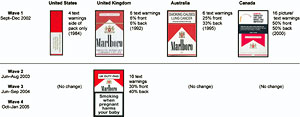
The published study, “Text and Graphic Warnings on Cigarette Packages Findings from the International Tobacco Control Four Country Study,” is available as a 2.4MB PDF from researcher David Hammond’s site.
 14 February 2007 |
 New cement aborbs pollution. Powered by titanium dioxide, the same stuff in the paint that absorbs pollution. As long as it creates less pollution when produced...
Architectures of Control. A blog of structures and designs intended to control or limit the user’s actions. (A kind of “anti-social design notes”?)
’Til You Drop
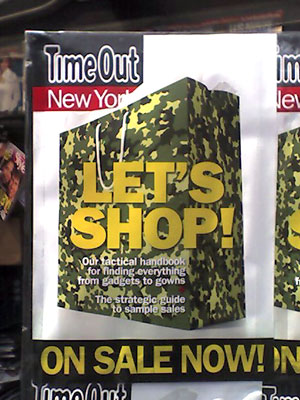
Now on newsstands across NYC is the cover of this week’s Time Out New York, an events and listings rag. The camouflage shopping bag is intended to evoke martial metaphors: tactical tips for your bargain hunting strategy inside.
But it struck me as quite an elegant, visual link between War and The Market!
Commodify Your Dissent, 2
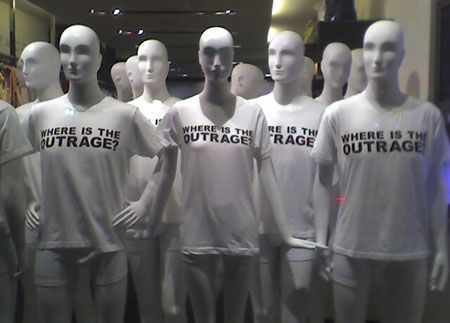
Saw this tonight on Bleeker Street.
Where is the outrage? It’s for sale at Marc Jacobs in the West Village.
There’s also a joke in here about white people, but I can’t seem to find it at the moment.
Otherwise, I do appreciate the sentiment and the public display.
See previous post: Commodify Your Dissent

HauteGREEN.  “HauteGREEN will showcase a collection of the best in sustainable contemporary design for the home. HauteGREEN will take place in Williamsburg, Brooklyn May 20-22, 2006, during the International Contemporary Furniture Fair.”
I was put off by the chicy angle (why does sustainability always seem to be a class privilege?) — but a member of o2, one of sponsoring organizations, explained that the initiative is intended to attract the interest of designers participating in and visiting the fair.
“HauteGREEN will showcase a collection of the best in sustainable contemporary design for the home. HauteGREEN will take place in Williamsburg, Brooklyn May 20-22, 2006, during the International Contemporary Furniture Fair.”I was put off by the chicy angle (why does sustainability always seem to be a class privilege?) — but a member of o2, one of sponsoring organizations, explained that the initiative is intended to attract the interest of designers participating in and visiting the fair.
Coco Net.  In 1995, Philippine inventor Justino Arboleda devised a method to turn coconut husks into useful fiber. In the Bicol region of the Philippines where he lived and worked, most farmers live below the poverty line and discarded coconut husks are the largest waste product. Arboleda set up a factory to mill the fibers and employed local workers to weave the fiber into netting. The nets replace plastic and steel one on slopes and riverbanks to prevent erosion. Arboleda even found a way to use the dust created by the milling process to create a fertile, soil-like “coco-peat.”
Coconets is the winner of the 2005 BBC World Challenge, which lists other interesting environmentally friendly inventions and business initiatives. (Sponsored by Shell Oil!)
Update 3/26: Evan responds:
In 1995, Philippine inventor Justino Arboleda devised a method to turn coconut husks into useful fiber. In the Bicol region of the Philippines where he lived and worked, most farmers live below the poverty line and discarded coconut husks are the largest waste product. Arboleda set up a factory to mill the fibers and employed local workers to weave the fiber into netting. The nets replace plastic and steel one on slopes and riverbanks to prevent erosion. Arboleda even found a way to use the dust created by the milling process to create a fertile, soil-like “coco-peat.”Coconets is the winner of the 2005 BBC World Challenge, which lists other interesting environmentally friendly inventions and business initiatives. (Sponsored by Shell Oil!)
Update 3/26: Evan responds:
“I know in India they have been turning coconut husks in to rope and other fibers for a few thousand years... It takes a Development Bank to take traditional products, ignore the history, and create them again as an amazing new revolutionary product!”
Numbers of Fruit.  “Here in the US, fruit often comes with stickers on it, sometimes telling you where it’s from and/or what it is. There’s also a number, but I never paid attention to that. But on p. 72 [of April’s Food & Wine] I spotted this interesting bit of information:
“Here in the US, fruit often comes with stickers on it, sometimes telling you where it’s from and/or what it is. There’s also a number, but I never paid attention to that. But on p. 72 [of April’s Food & Wine] I spotted this interesting bit of information:‘[T]he sticker labels on fruit: The numbers tell you how the fruit was grown. Conventionally grown fruit has four digits; organically grown fruit has five and starts with a nine; genetically engineered has five numbers and starts with an eight.’”(via)
How Islamic inventors changed the world. Brief summaries of 20 influential inventions. (via)

