



posters
Little by Little
 18 October 2008 |
 Ateliers Populaires
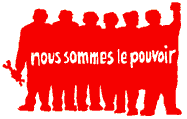
Anti-Nazism and the Ateliers Populaires: The Memory of Nazi Collaboration in the Posters of Mai ’68 is an excellent essay on the origins and context of the Ateliers Populaires, a collective poster workshop supporting the striking students and workers in France. Among the things I learned:
- There were several Ateliers Populaires in several cities in France. Paris alone had 6.
- The posters appeared in something of a vacuum, and were all the more shocking because of this. Political posters had not been seen on the streets in 20 years.
- The first posters were originally intended as fine art prints for sale to raise money for the striking workers, not as street art, and were originally printed by offset lithography, a more labor intensive process. These were taken out to the streets by popular demand where they inspired others to do the same.
- The style and simplicity of the designs was a function of both the medium and the conditions of production: the low-tech, improvised silkscreen apparatus and the incredible speed at which they were produced.
- The cheap newsprint paper they printed on were remnants donated by newspaper printers, who couldn't use the last bits of their paper rolls.
- Anyone could submit a design or slogan and designs were argued over collectively.
- Despite the progressive politics, the role of women in the studios was rather regressive.
- In some cases, the artists chose a more provocative poster idea over a more politically sensitive one. The posters comparing the French security apparatus to the Nazis and their tactics were particularly problematic and incendiary.
Alaska Women Reject Palin
There’s a special zing to criticism from “one’s own:” veterans against the war, 9/11 families critical of the memorial and investigation, or, say, Alaska women rejecting Sarah Palin.
Some are calling last week’s 1,500 strong protest in front of the Loussac Library in Anchorage the biggest political rally in the history of the state. The protest has reverberated throughout the Internet as well, forwarded by email and blog. As of this writing, Google turns up 19,100 hits. Propelling it along are photos of the cheeky, hand-made posters used at the event.
The protest started with a small group of women, talking over coffee. They printed up flyers, posted them around town, and sent notices to local media outlets. Word was also spread by a conservative radio host who mocked them on the air. No doubt the free publicity helped. Read more about the protest here.
Opland
It’s among the most recognizable images in Holland. The poster below was drawn by Opland, the pseudonym of Rob Wout, one of Holland’s most popular political cartoonists in the second-half of the twentieth century. For 53 years, from age 19 until his death in 2001, Opland drew caricatures and political cartoons for De Volkskrant and De Groene Amsterdammer. In 1981, at a high point in his career, Opland contributed this cartoon to the anti-nuclear movement. The slogan reads ‘No new nuclear weapons in Europe.’ It became one of his most famous images in the peace movement outside the Netherlands, as well. The image is a nice mix of humor and outrage, clarity and simplicity, with a dash of familiarity. How could you say no to her?
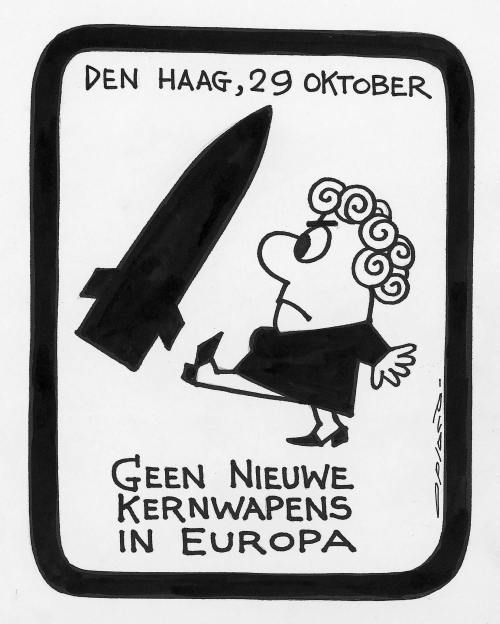
The anti-nuclear movement in Holland had been active through the late-1970’s and in 1978 an unexpected coalition of Communists, leftists, and religious groups organized nation-wide protests and petitions that successfully pressured the center-right government to disallow U.S. neutron warheads in the Netherlands. However, a year later Prime Minister van Agt endorsed NATO plans to deploy additional U.S. nuclear warheads to Holland, though in deference to domestic pressure, postponed a final decision. Citizens were outraged and took to the streets, holding one of Amsterdam’s largest protests ever in November 1981. American pundit Walter Laqueur coined the term Hollanditis to describe the movement and its influence on other European countries, particularly West Germany. Around a quarter of the population of the Netherlands signed a petition against the deployment and the movement culminated in a record-breaking one million strong demonstration in The Hague in 1983. In May 1984, a nation-wide week of protest was held and 900,000 people participated in a 15-minute general strike.
Still, on November 1, 1985, after the Soviet Union failed to comply with a Dutch ultimatum and in a period of escalating cold war tensions, the Dutch parliament voted to allow 48 American missiles on Dutch soil, to deploy by 1988. In the end, the new warheads never arrived. In 1987 the Presidents Reagan and Gorbachev signed the Intermediate-Range Nuclear Forces Treaty to eliminate intermediate range missiles.
Call for Entries: Grafica Politica #2
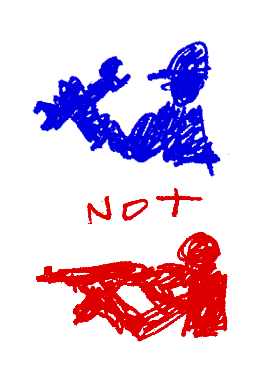
Work! Not War!
We All Teach All the Time

Méndez was a founder and leader of the Taller de Gráfica Popular.
page 19 18 17 16 15 14 13 12 11 10 9 8 7 6 5 4 3 2 1 Older »

