



posters
Now What?
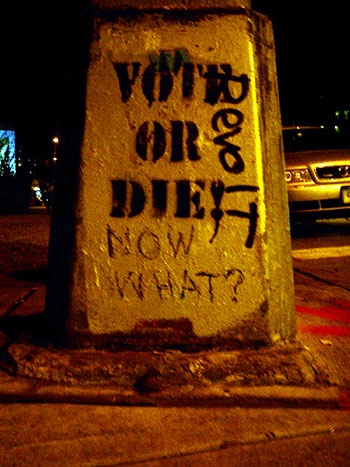
A public conversation on Bowery and 4th Street.
 2 March 2005 |
 Carlos Cortez Presente!
From the Center for the Study of Political Graphics:
“Carlos Cortez was an extraordinary artist, poet, printmaker, photographer, songwriter and lifelong political activist. His mother was a German socialist pacifist, and his father was a Mexican Indian organizer for the Industrial Workers of the World (IWW), also known as the Wobblies. Carlos was a Wobblie until he died. He spent two years in prison for refusing to “shoot at fellow draftees” during World War II.
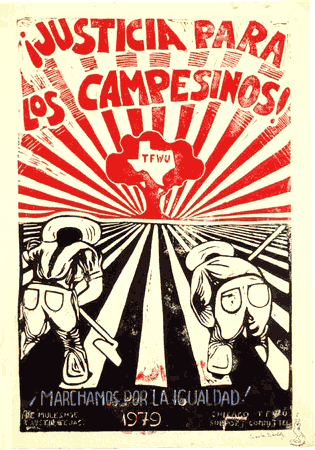 After his release, Carlos took a series of jobs: in construction, in a small imported foods shop, in a chemical factory. He also started drawing cartoons in 1948 for the Industrial Worker, the IWW newspaper, but soon learned to do linoleum block prints.
‘Many radical papers—not having advertising, grants or angels who are rich radicals—operate on the brink of bankruptcy. So Industrial Worker couldn’t afford to make electric plates out of line drawings. I saw that one of the old-timers was doing linoleum blocks and sending them in because the paper was being printed on a flatbed press. I started doing the same thing, and each issue would have one of my linocuts.’
When the price of linoleum became too steep, Carlos started using wood. Used furniture was easy enough to find in any alley. ‘There’s a work of art waiting to be liberated inside every chunk of wood. I’m paying homage to the tree that was chopped down by making this piece of wood communicate something.’ Carlos later became an accomplished oil and acrylic painter, though he always preferred the woodcuts because they were reproducible and affordable.
When the Industrial Worker switched to offset in the 1960s, Carlos began drawing pen-and-ink cartoons. He has also served as editor of the newspaper and on the union’s General Executive Board, and was one of the IWW’s most popular public speakers. In 1985, to commemorate the union’s 80th anniversary, he organized an important exhibition, ‘Wobbly: 80 Years of Rebel Art,’ featuring original works by many IWW cartoonists. Carlos was probably the only IWW artist whose work was exhibited at the Museum of Modern Art in New York. His art is exhibited throughout the United States, Europe and Mexico.
In the 1960s, Carlos married Marianna Drogitis, and in 1965 they moved to Chicago where he became involved with the local Mexican and Chicano mural movement.
‘I’ve always identified myself as a Mexican. I guess this was a result of my early years in grammar school. Even though I resembled my German mother more than my Mexican father, being the only Mexican in a school full of whites made me mighty soon realize who I was. But it was my German mother who started my Mexican consciousness. She said, “Son, don’t let the children at school call you a foreigner. Through your father you are Indian, and that makes you more American than any of them.”’
Inspired above all by the work of José Guadalupe Posada, printmaker of the Mexican Revolution, and the German expressionist Käthe Kollwitz, Carlos blends the techniques and styles of the German expressionists with themes from the ancient Aztecs and modern Chicanos. He made countless images support striking workers, from miners in Bolivia to farm workers in California, though he is best known for large linocut poster-portraits of activists and labor organizers such as Joe Hill, Ricardo Flores Magón, Lucy Parsons and Ben Fletcher.
‘After some 40 years of construction labor, record salesman, bookseller, factory stiff and janitor, I no longer punch a clock for some employer and have entered the most productive phase of my life where I do what I want to do and not what some employer wants me to do for him... As I keep working out ideas, I keep getting more ideas. So I’m going to go out kicking and screaming.’
He passed away last month in Chicago at age 81.
CSPG has posted a couple of images.
See also this interview and remembrance.
War is Not Healthy
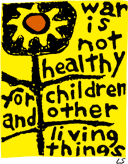 In 1965, Lorraine Schneider, an activist and mother, created the original art for “War is Not Healthy.” She entered the 4" by 4" print into a design contest. Her image was seen as too simplistic and did not win.
In an introduction to a book of Schneider’s art work, Barbara Avedon wrote:
“On February 8, 1967, fifteen friends met at our house to discuss ‘doing something’ about the war in Vietnam. We wanted to do something that would communicate our horror and disgust to our elected representatives in one concerted action. We were not ‘bearded sandaled youths,’ ‘wild-eyed radicals’ or dyed in the wool ‘old line freedom fighters’ and we wanted the Congress to know that they were dealing with an awakening and enraged middle class — voters, precinct workers, contributors. We decided to send a Mother’s Day card to Washington. We would print and distribute one thousand — one thousand letters of protest that said in a very ladylike fashion:
For my Mother’s Day gift of this year,
I don’t want candy or flowers.
I want an end to killing.
We who have given life
must be dedicated to preserving it.
Please talk peace.
Lorraine had given our family an etching of ‘Primer’ some months prior to that meeting. Its eloquent, irrefutable, sunflower truth said it all for us. I called Lorraine and asked if we could use ‘Primer’ on the face of the card. She said, yes, and one thousand became two hundred thousand cards. And because of her genius Another Mother for Peace was born.” [source]
Another Mother for Peace was founded to “educate women to take an active role in eliminating war as a means of solving disputes between nations, people and ideologies.”
The overwhelming success of the Mother’s Day card led to the creation of the AMP newsletter, filled with anti-war editorial and reports on the stances of lawmakers on issues related to war and peace. Each newsletter contained a number of action items called ‘Peace Homework’ that encouraged readers to make their voices heard by organizing, educating and communicating with other citizens and their elected representatives.
Thirty-six years later, concerned about the human costs of America’s “war on terror” Joshua Avedon, Barbara Avedon’s son, and Carol Schneider, Lorraine Schneider’s daughter, began to consider — separately — how to revive AMP.
Schneider’s image has become an international icon for the anti-war movement. Supporters of Another Mother for Peace display the image around the world. A simple yet powerful statement of conscience, the sunflower logo helped make Another Mother for Peace a visible anti-war voice.
In cooperation with Another Mother for Peace, the Center for the Study of Political Graphics has reproduced the War is Not Healthy poster, the first edition available since the Viet Nam War. Stickers, pins, and other materials are avaialble from Another Mother for Peace.
Celebrate People’s History
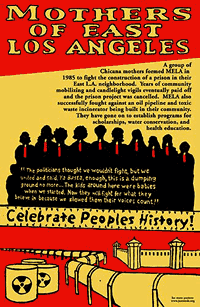 The Celebrate People’s History poster series is a series of linocut and silkscreen prints on important moments in ‘people’s history:’
“These are events, groups, and individuals that we should celebrate because of their importance in the struggle for social justice and freedom, but are instead buried or erased by dominant history. Posters celebrate important acts of resistance, those who fought tirelessly for justice and truth, and the days on which we can claim victories for the forces of freedom. In the past 5 years over a dozen posters have been produced on a variety of subjects, from the Battle of Homestead to Fred Hampton, Malcolm X to Jane, an underground abortion collective.”
The posters appear in storefront windows, homes, and classrooms, and are wheatpasted by street teams to public spaces around the U.S.
Nearly seven years old, the project has also created a loose network of artists interested in creating radical public art and showcasing the work of unknown artists who want to create art that is functional, carries a social message, “and doesn’t get buried at the bottom of the heap of the capitalist ‘art world.’”
Images are visible here and on this brief interview with Josh MacPhee one of the organizers.
The project is always looking for new artists to design posters, so if you or anyone you know might be interested, just get in touch.
See also this post on the Northland Poster Collective Posterfolio.
Voter Turnout
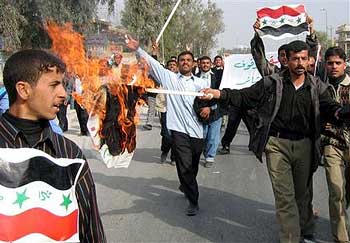
“Iraqi policemen burn election posters of Interim Prime Minister Allawi, as they rally through the streets of Najaf, some 160 kilometers (100 miles) south of Baghdad, Monday, Jan. 17, 2005. Policemen demanded their salaries for last several months. (AP Photo/Alla al-Marjani)”
How quickly propaganda is turned on itself.
Drop the Debt for the Tsunami Victims
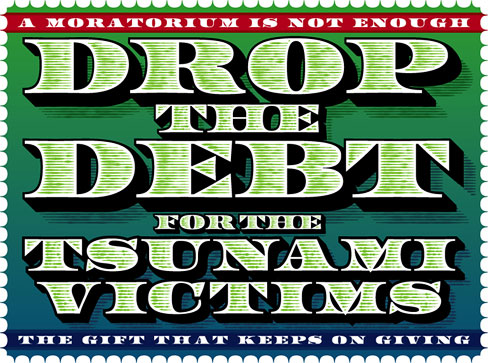
Download as PDF (88 Kb)
See Time To Cancel Tsunami Countries’ Debt, January 10, 2005.
via Anarchogeek
Tree Trimming
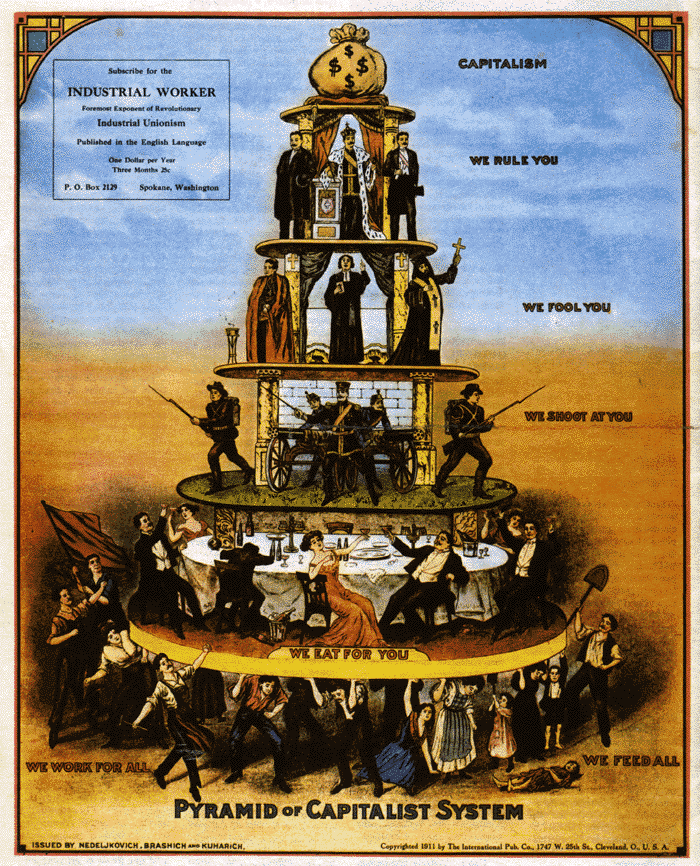
Pyramid of Capitalist System, issued by Nedeljkovich, Brashich, and Kuharich in 1911.
Just one of the graphics available at http://www.iww.org/graphics/
Support Our Tropes
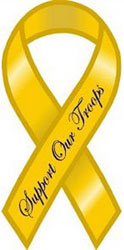
Those little yellow magnets seem to be everywhere. Not quite posters, it’s a regular grassroots movement of car signage, marking the public space in the bumper-to-bumper gaps between the private. (And what better place to support a war for oil?)
The NY Times has a brief story on the origins of the current magnet ribbon, while Design Observer digs up a broader history of the yellow ribbon symbol.
Since the civil war, the ribbon has been used to welcome home loved ones who had been away at war or in prison. The popular 1973 song was loosely based on the story of a soldier returning home from the Civil War. It was a number one hit in April 1973, at the height of the Vietnam War — a time when many veterans ambled to a less than friendly welcome.
But the meaning of the yellow ribbon has shifted over time. Do the current ribbons encourage support of those broken and maimed veterans showing up at homeless shelters? I presume not. I read the symbol as more than just a welcome home, but sign of “loyalty,” not just a show of concern for U.S. soldiers at war, but to admonish those who are not sufficiently supportive — for instance, who oppose the war.
Which is why I’m inclined towards the more specific version produced by United for Peace and Justice:
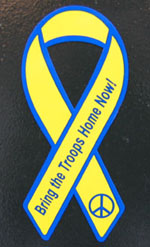
And the more oppositional styling of the duct tape version:
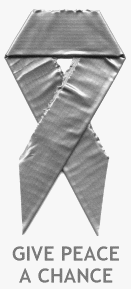
See also previous posts on freeway posters, orange, red, and blue ribbons.
Solidarity on Seventh Street
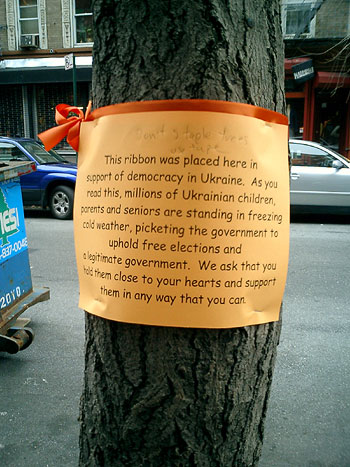
Spotted in the East Village, home of a Ukrainian diaspora community for over one hundred years.
Rock the Vote
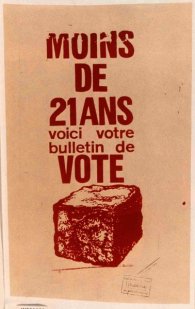
Some excellent images of May 68 leaflets from an exhibition by National Library of France on the sources of Utopias.
See also, posters produced by the Atelier Populaire.
page 19 18 17 16 15 14 13 12 11 10 9 8 7 6 5 4 3 2 1 Older »

