typography

Type and Nation, 2

“Euskara - which means Basque in the Basque language - refers to all kinds of characters you can find in the Basque country. Indeed each of the seven French and Spanish Basque provinces has its own geographic and cultural characteristics. For instance, those who live on the seaside - itsasoan - differ from those who live in the mountain - itsasmendi. These differences can also be felt from one valley to the other.”

Thierry Arsaut


Modern Basque nationalism emerged at the end of the 19th century, marked by the formation of the Basque Nationalist Party in 1895. Part of the political and cultural program of the Party was a revival of a unified Basque language. And related to this was the celebration of a distinct Basque typography.
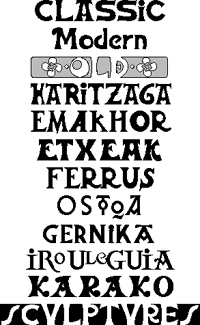
Euskara sample In 1888, Louis Colas, a schoolteacher from Baiona, begin his travels across the Basque countryside on muleback on documenting ancient Basque monuments. Colas published his research in a large, heavy volume which cost him a fortune. It initially attracted few readers.

The volume, though:

“is a genuine encyclopedia with more than 500 rough sketches and about 30 photos, tracing monuments and works since lost or destroyed. Unfortunately today, too few originals - some of them in a poor state - can be consulted as unquestioned references to the matter.” [source]

The Basques inherited their method of representing the sounds of language by literal symbols from the Romans.

“At that time, the Basque engravers knew very little about the Roman ironworks technique; their rough tools couldn’t carve deep characters like in the sculptures coming from Rome. So, instead of carving deeply, they scraped the stone around the characters which thus stuck out, creating a new technique. This explains why the Basque letters can hardly resist the passing of time: five-century-old engravings have been rubbed out, for the most part.

Moreover, very few people — such as old families of engravers — could write as well as engrave: such a treasure was to be kept secret. This explains the variety in the Basque characters. Not only did the children inherit the technique from their parents, but they also inherited the family mistakes: sometimes in a village, you may find the same misprints on the old houses fronts. The most powerful family in a valley also caught hold of all the written works. Still today, there are shapes in the carved stone which can be found only in some valleys; and it is the same for the ‘pelote Basque’, the rules of which varied according to the valleys which were the (mass) media of the time!” [source]

Later influence of the continental Celts was felt in particular on capital letters A, S, and N, and in the rare lowercase letters b, p, q, and o.
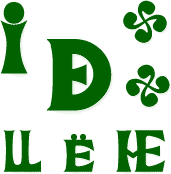
Euskara sampleDespite this influence and other printing fashions, the Roman influence predominates. There is hardly any Basque written work using cursive script. This results in part from the link between Latin and Christianity: almost all early written works in Basque were religious in content.

The Basque nationalist movement was banned and forced underground in 1923 by the Spanish military dictatorship of Miquel Primo de Reviera, but flourished after proclamation of the Second Republic in 1931 and the lifting of the ban.

Despite military uprisings that divided the Basques, following a large scale campaign for Basque autonomy and a plebiscite in 1932, the Government of the Republic granted autonomy to the Guipuzcoa and Vizcaya regions. The first Aberri Eguna was held on Easter Sunday, March 25, 1932 celebrating the Basque homeland, culture and language, and Catholicism.

In the 1930’s printers and foundries lavished much attention on Mr. Colas’s book which encouraged Euskara’s revival.

“Euskara consists of large-footed, big-eyed, Roman-styled characters. (See Some Different Basque Letters). You should not use them for a whole text because it would give a sensation of thickness: they were used on mortuary epitaphs and fronts of houses, mostly. The general pattern is rather heavy but the ten existing lowercases makes it look lighter: it seems funny that hardly any lowercase can be found in Euskara, although typically Basque letters can be found (for example, the interpenetrated DE).”

Today Euskara can be found throughout the Basque country on signage, television, newspapers, and packaging.

“Among the various Euskara characters used in offset printing, the LetraSet transfer-types are very well spread, whereas only Spanish printers have still got lead characters. Neuhaus in Hendaye is a worth-mentioning firm: their local roadsigns, printed in Basque characters, help promote tourism. Lately, a young editor from Biarritz has tried to use the Basque culture characters [for computer printing].”

But given its current status as a kind of cultural brand for consumption by tourists and others external to the Basque community, does it still retain a nationalist connotation to the community itself? Or has it become depoliticized, commodified, and folkloric?
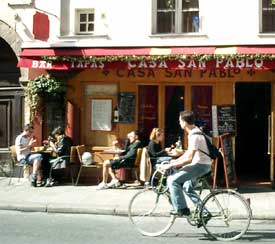
Photo of Basque Cafe


Thierry Arsaut designed the fonts displayed above.

Links to Basque fonts and more info.

>  10 October 2004 | LINK | Filed in ,

Type and Nation, 1

From Paul Shaw, “Fascism on the Facade,” in Print, May/June 2004:
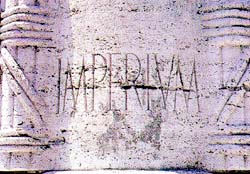
“Tourists may be unaware that Fascist architecture — fountains, monuments, public works, buildings — pervades Rome. Non-Italian guidebooks deliberately ignore these structures, and their modernism makes them seem boringly familiar — even at the most ponderous and grandiose — to anyone visiting from another large city. However, there is one thing above all else that separates Fascist architecture from modern architecture: the conspicuous presence of lettering.

Lettering, inscribed and in relief, had always been an integral part of Western architecture until the Modernists, in their drive for purity and functionality, threw it out along with ornaments, and other decorative motifs. In Italy, lettering survived and flourished in Fascist architecture because it served to advertise the regime’s aims and accomplishments.

While the Nazis settled the centuries-old fraktur oder antiqua (blackletter versus roman) debate in favor of the former, the Fascists never had an official policy regarding letterforms. ‘The idea of an “art of the State” was rejected not only by Mussolini and his minister Giuseppe Bottai, but also by all the official representatives of the regime,’ wrote Rossana Bossaglia in Ritratto di un’Idea (2002). Instead, beginning in 1926, the regime spoke of Fascist art as work that interpreted and represented the spirit of the Fascist movement. But no precise style was defined until the late 1930s. Often overlooked and mistaken for lettering of other periods, the visual language of the Fascists still permeates many of Rome’s most historic buildings.”

>  7 October 2004 | LINK | Filed in ,

B is for Bribes, Boycotts, and Boxing

olympic_hostbirbe.png

Host Country Bribes

olympic_slavelabor.png

Stadium Built with Slave Labor

olympic_drowning.png

Drowing in Advertising

One of the best, and funniest, critiques of the Olympics I’ve seen this season is in the form of a font. The font is a collection of ‘real’ pictograms, lampooning the icons used by Olympics organizers to indicate sporting events without language.

Designed by Jonathan Barnbook and Marcus McCallion, the pictograms follow the style of the hugely influential sign system developed by Otl Aicher for the 1972 Munich Olympics.

View the complete font or download a copy here.

Via a comment at Design Observer

>  24 August 2004 | LINK | Filed in ,

Type and Empire, 2

All the News that's Fit to PrintI don’t ascribe much significance to the names of typefaces. The style names are not what determine the meanings of letterforms.

But this was just so rich. From The New York Times’ note on last fall’s typographic overhaul:

“The [New York] Times’s text typeface, for news and editorials, remains Imperial, designed in the 1950’s by Edwin W. Shaar and adopted by the newspaper in 1967.”

The shape of the News, the shapes of Truth are inscribed in Empire.

>  15 May 2004 | LINK | Filed in ,

Type and Empire, 1

From an interview with Hrant H Papazian designer of typefaces for Latin, Armenian, Georgian, Cyrillic, Arabic, and Hebrew scripts:

Nour Yerevan“But virtually everything I complain about in type (even the stuff I take action on) is essentially trivial in the context of the needs of the world. Except for one thing: increasingly I become more worried about Latinization — the imposition of Latin alphabetic ideals on other scripts. It’s really nothing short of cultural imperialism, even cultural genocide. To me Latinization is a henchman of globalization, and anybody who feels that cultural variety is a central pillar of life being worth living needs to fight it.”

>  14 May 2004 | LINK | Filed in ,

Women Set Type!

Being a historical account of women in printing, publishing, and typographical compositing in these United States of America and Western Europe.

The text below is assembled from Unseen Hands, Women Printers, Binders & Book Designers (Princeton University Library, 2003), Women in Printing & Publishing in California, 1850-1940 (California Historical Society, 1998), and Epochal History of the International Typographical Union (I.T.U., 1925.) Other sources are indicated where used.

“Women have been involved in printing and the making of books ever since these crafts were first developed. Even before the advent of movable type, there was a strong tradition of women producing manuscripts in western European religious houses. In the Convent of San Jacopo di Ripoli in Florence, we find the first documented evidence, in 1476, of women working as printers. Girls and women were often trained by their fathers or husbands to assist in printing businesses, and there are many instances from the fifteenth to the eighteenth centuries of women taking over and managing these enterprises upon the early demise of their male relatives.... Many, certainly, only managed the business, while others were more directly involved. Estellina, wife of the printer Abraham Conant, proudly stated in a Hebrew book, Behinat `olam (Mantua, ca. 1477) that ‘she, together with one man, did the typesetting.’ [source]

In the 19th century, a limited number of occupations were open to women — teaching, needlework, domestic service, etc. Male-only unions ruled the printing business. Women, where employed at all, were relegated to certain low-paying jobs considered best suited for the weaker sex, such as dressing (polishing imperfections) from metal type, folding printed sheets, and sewing bindings. Yet there were exceptions — a few women were also employed in typesetting. Women who were widows or daughters of printers often learned typesetting out of necessity.

James Franklin, brother of Benjamin Franklin, taught something of the art to his two daughters prior to his death in 1835, and when he died he left his printing plan at Newport, R.I. to his widow and family. They operated it successfully for many years.

A woman’s typographical union was formed in France with a journal entitled La Compositrice, and the first major woman’s journal edited by a woman, Godey’s Lady’s Book, was published in Philadelphia from 1830-1858, edited by Sarah Josepha Buell Hale. [source]

...

Women were employed in the Day Book office in New York in 1853, while a strike was in progress against that office. This inspired a determined campaign against women printers. Union leaders inveighed against employment of women and urged the National Typographical Union to do something about it. The National wisely disclaimed any desire to interfere in treatment of the issue by local unions. Horace Greely, celebrated editor of the New York Tribune and a former president of Typographical Union No. 6 of New York, took up his redoubtable pen....

‘Your fears that women will supplant you, or seriously reduce your wages, Messrs. Compositors, are neither wise nor manly. The girls who marry and have families to look after will stop setting type — never doubt that — unless they are so luckless as to get drunken, loafing, good-for-nothing husbands, who will do nothing to keep the pot boiling, and then they must work, and you ought not to be mean enough to stop them, or drive them back to making shirts or binding shoes at three or four shillings a day.

If you find yourselves troubled with too strong a competition from female workers just prove yourselves worthy to be their husbands; marry them, provide good homes and earn the means of living comfortably, and we’ll warrant them never to annoy you thereafter by insisting on spending their days at the printing office setting type. But waxing theologic and pious, you tell us of the sphere of action God designed women to occupy —of her ‘purity’ and of the ‘immorality and vice’ she must inevitably sink into, should she be admitted into the composing room to set type beside you. We feel the force of these suggestions — we admit the badness of the company into which unregulated typesetting would sometimes thro her — but did it ever occur to you that this is her lookout rather than yours? It is perfectly fair of you to apprise her beforehand of the moral atmosphere to which promiscuous typesetting would expose her, but when you virtually say she shan’t set type because if she did your society and conversation would corrupt her you carry the joke a little too far.’

By 1864, due in large part to the depletion of the male work force during the Civil War, additional workers were needed in trades which were previously thought of as ‘male’ trades — one of these being typesetting. The number of newspapers and the demand for printed materials was on the increase, and women began to step into jobs in both the printing and publishing fields.

The National Typographical Union permitted women to form unions and to join existing unions in 1869, the same year it was renamed the International Typographical Union. Augusta Lewis Troup, journalist and typesetter for Susan B. Anthony’s newspaper The Revolution, was elected corresponding secretary of the International Typographical Union in 1870. She became the first woman to hold any national union office. [source]

...

Women Set Type!After hearing of the role of women in the 15th century printing industry, Emily Faithful decided to set up her own firm in Edinburgh in 1857 employing women only. In 1859 she founded the Victoria Press in London and employed men to do the heavy work. This met with a lot of hostility with the print unions which said that it encouraged immorality. In 1862 she earned the title of Printer and Publisher in Ordinary to the Queen, moved to an office in Farringdon Street and then to Praed Street, Paddington, where she remained until 1881. She was also a writer and poet and was involved in some of the publications produced by her firm such as the feminist English Woman’s Journal and the Victoria Magazine. [source] While her journal was established as a general literary magazine it provided a strong feminist emphasis on suffrage, married women’s property, education, employment and all of the other feminist/women’s concerns of the day. [source]

During the late 19th century, women writers often moved into positions as editors of newspapers or small journals. At this same time, the Woman’s Suffrage Movement was gaining momentum and the women-edited journals were the obvious choices in which to further their cause. Spiritualism was also a popular movement at the turn of the century among women — largely because it did not discriminate by gender or ethnic background — and the women publishers felt a kinship because of this non-discriminatory nature. Journals such as The Carrier Dove, The Spiritualist, and The Golden Dawn were all journals edited by women and devoted to not only Spiritualism but in some cases, also to the Suffrage Movement.

Other women publishers and editors followed a more literary angle, publishing journals which featured articles on a wider variety of topics. In 1863, Lisle Lester took charge of the Pacific Monthly, a woman’s literary magazine previously known as the Hesperian. It had a rocky career as was the career of Ms. Lester — who was widely known for her strong opinions on many topics and her tussles with the male typographical unions. Another woman, Emily Pitts Stevens, gained prominence when she transformed the Sunday Evening Mercury — which was known as ‘a Journal of Romance and Literature’ — into the premier voice for woman’s suffrage in the West. She hired women to set type for her newspaper and in 1869 changed its name to The Pioneer — as ‘a name that more nearly covers our thought and tells the nature of our object and ambition.’ She became a major force in the founding of the California Woman Suffrage Association on January 28, 1870.

...

Women's Printing CooperativeIn San Francisco, which was becoming a center for printing and publishing in the West, women-run printing offices appeared in the 1870s and 1880s. The Women’s Union Job Printing Co., the Woman’s Publishing Company, Amanda B. Slocum and Jennie Patrick were a few either woman-run and/or -staffed printing offices of this period. The most prominent and prolific was The Women’s Co-Operative Printing Union, established in 1868 on Clay Street by Mrs. Agnes Peterson, followed in 1873 by Mrs. Lizzie G. Richmond. Early 1870 billheads produced by the WCPU proudly proclaimed, ‘Women set type! Women run presses!’ So confident was Lizzie Richmond that her billheads and advertisements often stated, ’We invite criticism.’ These printing offices produced a variety of printed materials for the public — books, commercial catalogs, corporate annual reports, legal briefs, [as well as] invitations, broadside advertisements, and handbills.

The many journals, newspapers, books, and even billheads that were printed during the late 19th and early 20th centuries used mainly one method of illustration — that of the wood engraving.... Leila S. Curtis and Eleanor P. Gibbons were two women who started up and ran successful engraving businesses in San Francisco. Both were trained in engraving and design. Their designs were found on billheads, business cards, and stationery, as well as in book illustrations, commercial catalogs, and innumerable other small printed items. Magazines published during this period often used the technique of the woodcut — rather than a wood engraving — to illustrate their pages. The technique used in producing a woodcut allowed for larger more fluid compositions. Lucia Mathews cut the designs for Philopolis (1906-1919) — a magazine published by Arthur, her husband, and herself during the early part of the 20th century. Florence Lundborg, an artist influenced by both Art Nouveau and the Arts and Crafts movement of the early part of this century, produced woodcut images for The Lark, the San Francisco literary magazine published by Bruce Porter and Gelett Burgess from 1895-1897. [source]

...

The turn of the century saw an increased interest in the aesthetic aspects of printing — now that women were an accepted part of the work force — and many fine presses sprang up throughout the state [of California]. A fine or ‘private press’ is generally understood to be a small printing house which issues for public sale limited editions of books which have been carefully made on the premises.

By the 1920s a tradition of fine printing was well under way in San Francisco, with Taylor and Taylor, John Henry Nash and the Grabhorns already fairly well established. These printing houses encouraged printing by women.... Other women with their own presses were Rosalind Keep of the Eucalyptus Press, Helen Gentry, and Jane Grabhorn at Colt Press, which was founded along with William Matson Roth and Jane Swinerton. In southern California, private presses were often a husband and wife team. The Saunders Studio Press of Claremont was founded in 1927 by Lynne and Ruth Thompson Saunders. The Plantin Press in Los Angeles was established in 1931 by Saul and Lillian Marks, Saul being in charge of design and layout and Lillian responsible for composition. Women such as Virginia Woolf and Elizabeth Yeats also founded private presses that produced handsome limited editions of the work of contemporary authors and artists. [source]

Women were notably successful at bookbinding, both ‘on the line’ — producing factory bindings — and in the creation of splendid examples of hand binding, particularly during the Arts and Crafts Revival of the late nineteenth and early twentieth centuries.

With the dawn of the 20th century and the emergence of women’s rights, women in printing and publishing entered more seamlessly into the work force. Finally, with the advent of fine press printing, the women printers in the 1920s and 1930s emerge as figures who achieved their goals to work at a skilled occupation that offered them not only an honest living but also a chance to use their creative instincts and skills.”

>  14 April 2004 | LINK | Filed in , , ,

Read Regular

Juanjo Seixas writes in about Read Regular, a typeface designed specifically to help people with dyslexia read more effectively.

From the Read Regular Web site:

“Britain has two million severely dyslexic individuals, including some 375,000 schoolchildren. 10% of people using ‘Romance’ languages are coping with a reading difficulty. Dyslexia is a combination of abilities and difficulties that affect the learning process, displaying a wide range of difficulties. Dyslexia can occur despite normal intellectual ability and teaching, and it is independent of socio-economic or language background. The British Dyslexia Association

Read RegularThere has been growing innovation to combat dyslexia, especially for children, in the form of computer software. However, relatively little design research has been done in the area of typography and type design that might support dyslexics. Read Regular is a typeface designed specifically to help people with dyslexia read and write more effectively.

Read Regular aims at preventing a neglect of dyslexia, creating a more confident feeling regarding the problems that occur with dyslexia.

Read Regular is designed with an individual approach for each of the individual characters, creating difference in the actual characters of b & d itself (not mirroring the b to make the d), to create a large character differentiation.

The character shapes are simple and clear, creating consistency. The characters have been stripped down from all unnecessary details — such as a two storey a and a two eyed g.

The individual approach creates striking outlines that make sure that each character stands on its own and works together with its previous or next character. Used in the content of words, sentences and text, the following or the previous character does not try to interfere in its readability process. Ascenders (bdfhkl) and descenders (gjpqy) are long to ensure their legibility. Inner shapes for example within the o, e, a, u and openings in e and g are kept open to prevent from visually closing in. This makes Read Regular a friendly character and a pleasant balance between black and white.”

This story from Wired News talks a bit more about the genesis of the project.

>  26 October 2003 | LINK | Filed in

Captions, Television and its Double

The year 1960 marks a turning point in the history of technology and politics. The Kennedy-Nixon presidential debate was the first to be broadcast live on television. Kennedy’s telegenic composure and appeal is credited with tipping the vote in his favor. In 1960 ninety percent of U.S. households owned a television. For the first time, Americans in 1963 say that they get more of their news from television than newspapers. Television becomes an increasingly important source of information and enormous cultural force in the United States marking the assassination of President Kennedy, the rise of the Beatles, landing a man on the moon and returning him safely to Earth, I Love Lucy, Sesame Street, the Olympics, news of the war in Viet Nam, the Watergate hearings, the Watts riot, Star Trek, and the mini-series Roots. [source]

However, it would be at least another decade before millions of deaf and hard-of-hearing Americans could begin to participate.


From the National Captioning Institute:

Closed Captioned“The first innovators were not thinking about a captioning system for deaf and hard-of-hearing people. In 1970 the [U.S.] National Bureau of Standards began to investigate the possibility of using a portion of the network television signal to send precise time information on a nationwide basis. The Bureau believed that it could send digitally encoded information in a part of the television signal that is not used for picture information. The ABC-TV network agreed to cooperate. This project didn’t work, but ABC suggested that it might be possible to send captions instead.

This led to a preview of captioning at the First National Conference on Television for the Hearing Impaired in Nashville, Tennessee, in 1971. Two possible technologies for captioning television programs were demonstrated that would display the captions only on specially equipped sets for deaf and hard-of-hearing viewers.

A second demonstration of closed captioning was held at Gallaudet College on February 15, 1972. ABC and the National Bureau of Standards presented closed captions embedded within the normal broadcast of Mod Squad.

As a result of the enthusiasm these demonstrations created in the deaf and hard-of-hearing community, the National Association of Broadcasters studied the technical and economic factors involved in establishing a captioning service. The Association concluded that this captioning system was technically possible, but certain steps had to be taken before it could become a reality. The federal government then said it would fund the development and testing of this system. The engineering department of the Public Broadcasting System started to work on the project in 1973 under contract to the Bureau of Education for the Handicapped of the Department of Health, Education and Welfare (HEW).

While the closed-captioning service was being developed, there were some programs with ‘open’ captions airing on PBS. In 1971, The French Chef became the very first television program that was accessible to deaf and hard-of-hearing viewers. The ABC News was rebroadcast on PBS five hours after its broadcast on ABC-TV. From the time the captioned ABC News was first produced in 1973, it was the only timely newscast accessible to deaf and hard-of-hearing people until NCI’s real-time captioning service started in 1982....

Toward the end of the technical development project at PBS, it became clear that in order to get the cooperation of the commercial television networks, it would be necessary to establish a nonprofit, single-purpose organization to perform this captioning. And so in 1979, HEW announced the creation of the National Captioning Institute. The mission and importance of NCI was clear from the beginning. It was to promote and provide access to television programs for the deaf and hard-of-hearing community through the technology of closed captioning.

On March 16, 1980, NCI broadcast the first, closed-captioned television series. The captions were seen in households that had the first generation of closed caption decoder.

A silence had been broken. For the first time ever, deaf people across America could turn on their television sets — with a caption decoder — and finally understand what they had been missing on television.

The closed-captioned television service was an overnight sensation. Suddenly, thousands of people who had been living in a world of silence could enjoy television programs along with hearing people....

NCI ensured a bright future for closed-captioned television by partnering with ITT Corporation in 1989 to develop the first caption-decoding microchip, which could be built directly into new television sets at the manufacturing stage. This led to the introduction and subsequent passage of the Television Decoder Circuitry Act, which mandated that, by mid-1993, all new television sets 13 inches or larger manufactured for sale in the U.S. must contain caption-decoding technology. Now, millions of people have access to captions with the push of a button on their remote controls.”

From a more recent Captioning FAQ:

“On August 7, 1997, the FCC unanimously approved new regulations which will mandate captioning on virtually all television programming in the United States. Section 305 of the Telecommunication Act of 1996 is being implemented as a new section (Section 713) of the existing Communications Act. On September 17, 1998, the FCC modified their rules, in what can be considered a victory for caption viewers. The ruling took effect on January 1st, 1998, and it phases in requirements separately for ‘old’ and ‘new’ programming.”


Though numerous studies have shown that mixed-case text is easier to read than all uppercase, virtually all captioning in North America is done in uppercase only. The resolution of NCSA television and caption decoders generally results in ugly and illegible lowercase letters.

“[However,] mixed-case text is often used to indicate whispering, and is also often used for text that needs to be set apart, such as comments by an off-screen announcer (voice-over), or sound effects.

Caption decoders and televisions were not required by law to support lowercase letters at all until just a few years ago. There are, therefore, some televisions that will change mixed-case text to all uppercase.” [source]


Now, with the introduction of digital television, the design of the typeface for subtitling is no longer constrained by the technology of analog television.

This new digital environment provides for larger screens, higher screen resolutions, enhanced closed captions, and higher transmission data rates for closed-captioning.

TiresiasEnter Tiresias Screenfont, a typeface for television subtitling designed for maximum legibility. Development of the typeface included extensive user testing with viewers that had a wide range of visual abilities and viewing habits.

The Tiresias Screenfont was originally designed by a team led by Dr. John Gill, Chief Scientist for the Royal National Institute for the Blind.

“The typeface Tiresias Screenfont was originally designed for subtitling on UK digital television in 1998.... It has been specifically designed for screen display and has been adopted by the UK Digital Television Group as the resident font for interactive television. Screenfont is now being adopted for European digital television. Its use is also being considered in the USA.

Tiresias Screenfont has been designed to have characters that are easy to distinguish from each other. The design was carried out, with specific reference to persons with visual impairments, on the philosophy that good design for visually impaired persons is good design for everybody.”


Both font and philosophy have been taken from the television screen and applied to the public terminal, the built environment, and the printed page.

Other variations of Tiresias Screenfont have since been designed, each optimized for a specific purpose:

Tiresias PCfont is a typeface designed to display clearly on screen based systems, such the information displayed on TV monitors on public transport, at airports, railways or ferry terminals. Building societies and banks use screens to display information on cash dispensers. Many governments are now introducing screen-based public information systems in libraries and government offices. Tiresias PCfont makes these services and facilities more accessible.

Tiresias Infofont is designed to improve the legibility of information labels on public access terminals, ticket machines, telephone booths. The characters and letterforms have been designed to provide maximum legibility at a reading distance of around 30 to 100 cm. Infofont is not designed for large quantities of text.

Tiresias Signfont is for fixed (not internally illuminated) signage. The recommended usage is white or yellow characters on a dark background. Tiresias Signfont has a different level of boldness than Screenfont and PCfont, and has more open spacing than conventional type. Signfont is designed to provide maximum readability at longer distances.

Tiresias LPfont is designed for use in large print publications, and to be more legible than the standard typefaces that are currently in large print publications.

The Tiresias family of fonts are available for sale from Bitstream.


Update October 1, 2003: A couple of hard-of-hearing friends have brought up the petition campaigns that they, their friends, and parents participated in. The text above does understate the grassroots campaign.

>  21 September 2003 | LINK | Filed in , , , , , ,

The Typography of News

From Peter Hall:

“The news has become a worrisome visitor in our lives over the last few months, and it arrives in an ever-increasing variety of forms. TV news, according to one recent survey, still reaches most households, but text-based news provides the supplementary information — on web sites, newspapers, email, palmtop bulletins and even zipper signs. A cursory glance at this particularly rich array of printed and transmitted words reveals a genre of media in flux — the typography of news. Typography was never more important to us, and yet never less noticed.”

See also The News Aesthetic.

Found via xblog.

>  18 June 2002 | LINK | Filed in , ,

The New Typography

Jan Tsichold’s Die neue Typographie appeared in Weimar Berlin in 1928. An English translation was published in 1995. The book, one of the founding documents of Modern design in the Machine Age, caused an uproar in the world of design. Starting first with some historical context, Tsichold describes the principles of the new typography as a revolutionary movement towards clarity and readability; a rejection of superfluous decoration; and an insistence on the primacy of functionality in design. A critque of its populist rhetoric in the journal of the bauhaus challenged him “to address not just the visual appearance of advertising but the very existence of such advertising.”

>  7 May 2002 | LINK | Filed in ,


page 3 2 1