



sustainability
It’s the Politics, Stupid
I’m still new to the literature of sustainable design, but I find again and again that much of the writing consistently ignores the political, addressing the social only peripherally, usually in the analysis but not in the response. Instead the authors pursue solutions based on individual design and purchasing choices or through technological fixes — creating cool new materials or processes — hoping the market will sort things out once the ‘good’ is cheaper than the ‘bad.’
Is this a matter of expedience? Cynicism? Organizing to set standards or pass legislation is messy and slow and often involves other people.
And yet so many materials and processes already exist around us. Why they are not used more pervasively is, I think, a political problem.
The same technologies are generally available in the U.S. as the E.U. And there’s no doubt the E.U. is light-years ahead of us down the path towards sustainability.
And yet, even among those pursuing “market” oriented solutions, folks seem focused on making new, better, cheaper things rather than intervening in the market to, say, make the polluting more expensive. The former approach ignores the huge subsidies and political weight of industries invested in the old ways of doing things.
Still, if one wanted to pursue a market-based solution, why not require the Federal Government to purchase such products — say, requiring all government printing use a percentage of recycled paper. This would create an enormous demand for ecological goods and ultimately lower the prices of such.
But folks seem to focus on individual choice rather than industrial requirement, ignoring the power of the State altogether. Yeah, cleaner technology is cool and good, but I’m not convinced we we can just invent ourselves out of, say, deforestation without shaping the force of law.
And how to pressure the State? Building a movement is hard. Grassroots organizing is slow. And battling clients every day certainly makes me want to focus on making things instead of dealing with other people. But something’s got to give.
Words in Print
Just when you’re pounded by clients and far too busy to think about updating your blog, Print magazine publishes a nice little write-up pointing readers your way:
“Most designers agree, even insist, that design is more than clever imagery selling goods and services — it also influences how societies function. Social Design Notes, a remarkably informed and highly useful blog edited by John Emerson, explores design’s sociopolitical power and inspiration. A New York activist and designer who oversaw Web sites for Amnesty International USA and Human Rights Watch, Emerson launched his blog is 2002 as a ‘bridge between design activism — to push designers to think about acting in the public interest and to help activists see how design can facilitate their campaigns.’ Emerson explores how design is used to support and challenge the status quo, posting one historical note about the ‘Black Panther Coloring Book’ created by the FBI during the civil-right movement, and another about South Africa’s use of the comic book to prepare its citizens for their first election. Emerson also discusses the built environment, praising former New York mayor Rudolph Giuliani for having championed design to improve the lives of the disabled. And Social Design Notes’ Resource page contains tools — such as free stock photos — designed to convert readers into true reformers.”
The July/August 2005 issue also has a several excellent articles on sustainable design, and is worth checking out for this alone.
But it makes you wonder — why doesn’t the magazine itself use recycled paper? Despite the “In Print” column which touts the magazine’s “early environmental outlook,” this is not addressed. So, do they care about sustainability or not? I know design magazines are hardly a lucrative venture, but the article “Fiber Optimistic” on page 57 points out that cost differences between recycled paper and not are nowadays “negligible.”
But then why not take it a step further. If toxic printing processes and non-recycled paper are harmful to the environment, why not consider sustainability as a criteria for your annual design competition?
Imagine what a massive force the AIGA could be if they required printed entries to their annual showcase use recycled paper.
Would this punish designers for the choices of their clients? Perhaps, but then why shouldn’t judging the beauty of a product take into account the nature of physical object itself? If designers care about competitions, why shoudn’t they push their clients that much harder? Why don’t all design competitions consider sustainability as a criteria? Does this impose some kind of “political” viewpoint? One could argue that not requiring this broadcasts a political viewpoint just as clearly.
Would the AIGA’s dues paying members revolt? Certainly some, but as the issue of Print notes (p. 11):
“This year the AIGA formed a national task force to develop policies and programs for the organization in support of sustainability. Following a poll revealing the environment to be the profession’s most pressing concern, the Worldstudio Foundation and the AIGA, through their ‘Design Ignites Change’ collaboration addressing social issues on a local level, made sustainability the focus of their first project.”
Hell, the AIGA’s last national conference was largely devoted to discussion of sustainability.
So at what point does sustainable design cease to be a “special issue”? When does it become incorporated as a fundamental part of what we do? And when do our design institutions take a stand and show some leadership? When do we start demanding it?
Is this all unreasonable? I would point out that it’s already happened once before. The American Institute of Architects, another national design association, went through a very similar internal debate years ago and came out embracing the green.
...
Update July 18, 2005 — Print responds:
“It’s true, Print does not currently use recycled paper, but we are looking into doing so as soon as our current supply of paper is fully depleted. It has been an economic issue in the past, but we are hoping to persuade our publishers to spend a little extra on this aspect of responsibility.”
 17 July 2005 | LINK | Filed in
africa, aiga, election, org, publishing, recycle, self, standards, sustainability
17 July 2005 | LINK | Filed in
africa, aiga, election, org, publishing, recycle, self, standards, sustainability
Green Map Turns Ten
Mentioned here last year, the Green Map project is an international network of autonomous, collective design projects, promoting local action and environmental resources around the world. They just celebrated their ten year anniversary.
Via email:
March 25, 2005 marks the 10th anniversary of Green Map System, a network of locally-led projects building healthier, more sustainable communities by charting the natural and cultural environment. In a decade, the global Green Map movement has spread to 45 countries, sparking public involvement and encouraging fresh perspectives on familiar landscapes. In nearly 300 diverse cities, towns and rural locales, we’re charting the good life, celebrating community and engaging the future.
 Collectively, Green Mapmakers have published 201 Green Maps — 60 are online and 3 million copies are in use, serving as guides to ecological living. Click GreenMap.org for an update on each map - these are beautiful portraits of place that ignite hope and caring for our beloved hometown environments.
Linking all projects are the Green Map Icons — the world’s only universal symbol set for maps — and a flexible framework for mapmaking. Practical, effective Green Mapmaking tools and resources are being created all the time, based on local experience. Our recent milestones include:
- Green Map Atlas
In 2004 Green Map System produced its first collection of mapmaking stories. Illustrating the origins, methods and local impacts of 10 projects in Asia and North America, the Green Map Atlas is a multimedia anthology — order the book or CD-ROM, or download it at GreenAtlas.org. Written for the public, it was conceived to catalyze action for community sustainability around the world — 100,000 English/Japanese readers have downloaded it already! - Lift-off in Taiwan
Taiwan’s Society of Wilderness has practiced Green Mapmaking since 2000, leading successful workshops across the country. Published in March 2005, their “Energetic Green Map Movement” book features 135 pages of in-depth methodology and colorfully illustrated vignettes on Taiwanese and international Green Maps (including sections of the Green Map Atlas), in Chinese. - Japan’s Networked Accomplishments
Some of the most inclusive Green Map projects are in Japan. Capturing this creative energy and fostering new developments, the GreenMap Japan network has just published a 40 page “Green Map Activity Guide” (English edition expected in August). Their national summer homework challenge in 2004 yielded expressive outcomes, dozens of which can be seen at GreenMap.jp (English Intro). - EXPO 2005 — Nature’s Wisdom
Today, 52 communities in Japan have projects underway. More than 16 of these are creating a citizens’ participation project for Aichi EXPO 2005, under the umbrella of GreenMap Aichi/Chubu Recycle. Opening today, EXPO’s Aichi Prefecture Pavilion features the debut of 30 diverse, local Green Maps. EXPO continues for 6 months, with international Green Maps featured in August. Find out more here. The impacts of this mega event will continue to be charted through 2010 by GreenMap Aichi! - Crossing the Divide
It’s not only in affluent regions that Green Mapmaking is thriving. Indonesia has 8 far-flung projects underway which have published 10 popular maps to date, and Jakarta’s story in the Green Map Atlas has been downloaded 20,000 times. Our 2004 Chinese Initiative has yielded the first 2 mainland projects underway in Beijing and Hangzhou. In the West, Mapa Verde Cuba is thriving as an education and social resource in 12 provinces across the island, plus they are collaborating on the tri-lingual Mapa Verde Americas Community Green Mapping Booklet, due out later this year. From Uruguay to Uganda, Netherlands to New Zealand, Green Mapmakers have honed their communication skills with this community media vehicle. - And at Home
Our New York global headquarters is a catalyst for new projects, a resource and outreach center, archive and connecting point; we also “seed” local youth projects and create new editions of NYC’s original Green Apple Map. Currently, we’re piloting a new mapping concept with our 5th city-wide edition, which will focus on Energy and aim to build the buzz for efficiency and renewables. Beyond the maps, we embrace the challenge of working globally every day with a wonderful, creative alliance dedicated to building sustainable communities. - Our 10th Anniversary Year
Celebrate this important milestone with us! Our 10th anniversary year starts today, so congratulate your local Mapmakers or send your thoughts (and support!) directly to Green Map System. A non-profit 501c3 organization since 2000, Green Map System welcomes your tax-deductible donation online or by mail (PO Box 249, New York, NY USA 10002-0249). Visit our online Store for Green Maps, Atlases, T-shirts and more. With your help, we will develop a new online system that will improve public access to Green Maps and foster collaboration throughout the movement. Your support will also help us build capacity globally and locally, as we prepare to gracefully expand our eco-cultural service for the next 10 years!
Green Map Systems
Graphic designer Wendy Brawer produced her first Green Map in 1991. The Green Apple Map of New York City charted 143 ecologically and culturally significant sites: community gardens, parks, greenmarkets, eco-centers, green businesses and buildings, transportation options, and toxic hot spots. It was well received and quickly inspired a second edition. Wendy writes:
“This Map encourages people to explore and understand out city — helping expand our community of environmental stewards who understand the interconnections between the natural and built environments. It can help build a network of links among people of different ages and backgrounds by highlighting places that are important to our common future. It promotes and fosters replication of successful projects. Moreover, it challenges the assumption that this intensely urban setting has little redeeming ecological value.”
Activists and designers in other cities, particularly colleagues in the o2 Global Network, were eager to make their own Green Maps.
Green Map Systems was born in 1995 and became a U.S. registered not-for-profit organization in 2000.
Wendy and her team produced a shared set of icons, and a Mapmakers’ Agreement which sets some parameters and includes small royalty based on the proceeds — 1% to 3% depending on if the project is all volunteers or has paid staff, and 1% of printed maps. Some “scholarships” are available where needed.
After that, the projects are fairly autonomous. Each Green Map is locally organized and designed, and independently produced. The maps may highlight parks and green spaces, bike paths, gay and lesbian resources, notes on wheelchair accessibility, recycling centers, or sites of energy production and consumption.
“Printed and digital Green Maps identify, promote and link eco and social resources. Each merges the ancient art of map making and new media in creating a fresh perspective that helps hometown residents discover great ways to get involved with the urban environment, and guides tourists (especially virtual ones) to special places and successful greening initiatives they can experience, and then replicate back home.
The maps are generated with a wide range of techniques, from GIS to Illustrator, to simple drawings by hand.
As of this writing, there are now there are now 241 Green Map projects, including 45 by youth. 151 different Green Maps have been completed in 39 countries. The maps are listed here.
Map makers can also develop local variations on global set of Green Map Icons (a shrine icon for Japan, a Capoira icon for Brazil.) After a global discussion on the Green Map email list, several of these have been incorporated into the global set. The set of 125 icons and 50 youth icons have been released as digital fonts for easy placement.
Launched on February 29, 2004, the Green Map Atlas highlights the ten map making projects in Asia and North America. With the goal of promoting sustainability and greener living worldwide, the Green Map Atlas showcases the work of diverse Mapmakers in Tokyo, Toronto, Jakarta, Pune (India), Kyoto, Hiroshima and Hakodate (Japan), Robeson County, NC, Milwaukee, and New York City.
It’s the Architecture, Stupid!
From Turning Down the Global Thermostat by Christopher Hawthorne in the October 2003 issue of Metropolis:
“Traditionally assessments of U.S. energy consumption have been broken down into four categories: industry, which consumes about 35 percent of the total each year; transportation, 27 percent; residential, 21 percent; and commercial, 17 percent. Significantly energy consumption usually tracks pretty closely with carbon dioxide production because most of the energy consumed is in the form of fossil fuels, which release greenhouse gases — primarily carbon dioxide, methane, and nitrous oxide. Thus a pie chart showing carbon dioxide divides along roughly the same ratios as one showing energy use. ‘In every study it’s always broken down the same way,’ [Edward] Mazria says, ‘so when you look at it and ask who the bad guy is — it’s industry.’
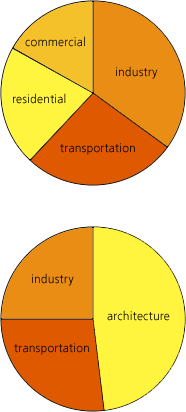 Mazria’s eureka moment came when he decided to redraw that pie chart with a separate slice just for architecture. He did this by combining the residential and commercial sectors, and then adding the portion of the industry sector that goes to the operation of industrial buildings and their construction. To get this last group of numbers Mazria used estimates of the so-called ‘embodied energy’ of industrial buildings. A key statistic for anybody hoping to build in a sustainable way, embodied energy is a measure of the total energy required to produce a particular material or building component and get it to a building site.
Mazria’s new math brought the architectural sector to a whopping 48 percent of total U.S. energy consumption. A similar rearranging of the chart for carbon dioxide production left architecture with 46 percent of the total. ‘I rounded the numbers down,’ he says. ‘I want to be careful about my numbers because people are going to attack them.’
What all of this means for Mazria is that the environmental movement has been scapegoating the wrong targets. ‘Look at SUVs,’ he says. ‘All the cars and trucks on the road account for about 6.5 percent of energy consumption in this country. If you figure SUVs as half of that, that’s 3, maybe 3.5 percent. So even if you doubled the gas mileage of every single SUV on the road, you’re talking about a marginal impact in a marginal area, all things considered. That kind of misguided focus actually keeps us from addressing the real issue.’ In other words, we’re worrying about cars when we should be worrying about buildings....
But is it fair to make architects responsible for the damage caused by the entire building industry? Mazria thinks so. He cites figures suggesting that architects design 77 percent of all nonresidential buildings, along with 70 percent of all multifamily and 25 percent of all single-family construction. And he argues that the percentage of architect-designed buildings is in fact higher than that because, as he writes, those figures ‘do not account for owner-supplied plans that were originally from architecture firms, designs by staff architects employed by building owners and developers, and single-family houses designed (but not stamped) by architects and interns.’
In Mazria’s mind, then, the architect is a perfectly legitimate new poster child for global warming: the leading part of the problem as well as, potentially, the solution. ‘Architects — and the government tends to forget this — specify every single material that goes into a building, from faucets to paint to carpet to wall materials to finishes to windows to roofing,’ he says. ‘Architects have the ability to change entire industries with the stroke of a pen. If we specify a material with low carbon dioxide emissions in its fabrication — say, floor tile, carpet, gypsum board — industry will respond. This is the American way. Architects are consumers; they’re not always aware of the incredible power they have to change the way products are manufactured.’...
He writes in his white paper: ‘We already know that buildings can be designed today to operate with less than half the energy of the average U.S. building at no additional cost. The design information needed to accomplish this is freely available.’...
The approach has also led the architect to criticize more quantitative and regulatory green initiatives, including the U.S. Green Building Council’s LEED certification program, which is currently the most expansive one in use in this country. ‘LEED-type programs can actually be damaging,’ Mazria says, ‘because they shift decisions about sustainability out of the realm of design at the workplace and put it in a separate, purely technical category. So every firm needs to get one person LEED certified, and they usually send the technical guy, not a design guy. And then that technical guy becomes the guy who has to get your design in shape for LEED, and that process becomes divorced from design.’”
See Edward Mazria’s original article from Solar Today (1MB PDF).
page 2 1

