

gov
 17 February 2010 |
  “Where does the food in your bodega come from? Who decides whether to stock tortilla chips or salad greens, and how much they’ll cost? How come it’s easier to find fresh fruits and vegetables in Brooklyn Heights than in the South Bronx? What’s the connection between the incidence of diabetes and the food market supply chain?” Bodega Down Bronx is a 30-minute video produced by Jonathan Bogarín, a group of Bronx students and the Center for Urban Pedagogy. Interviewing residents, bodega owners, distributors, politicians, and health professionals, it’s a fantastic, holistic breakdown of the day-to-day realities that flow from public policy, and what you can do about it.
Reframing
In my consulting, it’s often useful to reframe questions about design or technology as political matters. A given feature set is rarely limited by technology — just about anything can be built — it’s more a matter of institutional priorities. Outside of this, I’m also finding many apparently technical issues can be better understood when reframed politically. Two via Mike:
The Decline of the Landline: “In many ways the landline network is still an essential utility. Maintaining landline networks provides thousands of jobs (the landline operators support more pensioners than even the car industry does). Landlines are the platform for many public services, such as emergency response. And taxes on landlines are the basis of the complex system of subsidies to ensure universal service, meaning an affordable phone line for all. The phone network is thus not just a technical infrastructure, but a socioeconomic one.”
On Reinventing the Firm “As I argue, drawing on Ronald Coase, a firm is a political response to an economic problem: managerial power and hierarchy is one efficient way of dealing with the uncertainties attached to the employment relationship. But this doesn’t prevent us from considering alternative political settlements, that are potentially more democratic and more productive.”
Hunger is not a lack of food:
Ending Africa’s Hunger: “Conventional wisdom suggests that if people are hungry, there must be a shortage of food, and all we need do is figure out how to grow more. This logic turns hunger into a symptom of a technological deficit, telling a story in which a little agricultural know-how can feed the world.... But there's a problem: the conventional wisdom is wrong. Food output per person is as high as it has ever been, suggesting that hunger isn’t a problem of production so much as one of distribution.“
Interview with Devinder Sharma: “Hunger in India is at a level today that it very shameful. We have this hunger existing at a time when we have a mounting food surplus. We have an unmanageable food surplus, which is a record in history, and we also have a record number of hungry with us today. This paradox forced me to get into this issue of hunger. There are two ways of looking at it. One, of course, is the grassroots effort that one can do to bring people out of hunger. The other, to my understanding, is that hunger is the result of policies, national and international. The basic idea, or the basic focus, today, is to keep one half of the world hungry, because you can only exploit the hungry stomach. You cannot exploit a full stomach, somebody who is very happy and fed.”
Maternal mortality is not just a medical issue:
A Tipping Point on Maternal Mortality?: “During World War I, more American women died in childbirth than American men died in war. Then, after women’s suffrage became a reality, maternal mortality fell sharply. It seems that when women were accepted fully into the political system, then resources were also made available in the health system and they, less marginalized, were able to take advantage of them.”

Più design può
 Nearly a year ago, SocialDesignZine (SDZ) published a blog item about design and the city that found its way to the folks in the Provincial Office of Florence. They were intrigued. So what would you like to do about it? they asked. Send us a proposal.
Gianni Sinni and Andrea Rauch, the team behind SDZ proposed a modest conference: a few critics, a few practitioners discussing design for democracy, society and the city. Then silence for eight months.
Finally, two months before the proposed date, funds were approved and the SDZ team swung into action. Both studios engaged their staff: the hall booked, website designed, print materials designed and produced, travel coordinated, and on May 22 and 23 they hosted Più Design Può, more design can. Attendance was free of charge and over 200 students and designers turned up to hear the lineup of Italian and international speakers. No one from the Office of Florence attended.1
The intersections and gaps between designers, the state, and the public ran throughout the discussions. Renewed attention to public utility graphics in the 1970s helped public offices use design in a more consistent way. Design, they realized, characterizes the relationships between citizens and public administration. Now the emphasis has been turning to how cities can facilitate citizen-to-citizen communication in an accessible, inclusive and sustainable way, to promote and enable participation in both social life and public affairs.
 Roger K. Lewis in The Washington Post: “The Wall Street Journal got into the game recently with a report on concepts by four architectural firms that the newspaper asked to imagine the ‘Green House of the Future.’… Speculating about visionary green houses is tantalizing, but much greater benefits accrue at a larger scale.… Focusing on hypothetical designs of free-standing houses can even be a distraction.… No matter how green individual homes are, suburban sprawl is intrinsically anti-green. It generates infrastructure inefficiency; car dependency and rising fossil fuel demand; carbon-emitting, time-wasting road congestion; and, despite availability of inexpensive land at ever-greater distances from jobs, escalating development, construction and public service costs.… Transforming neighborhoods, buildings and infrastructure to accommodate new functions may be the best way for architects and the real estate industry to help create a greener planet.”
Vendor Power!
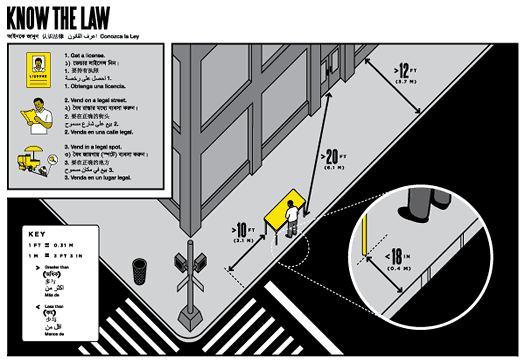
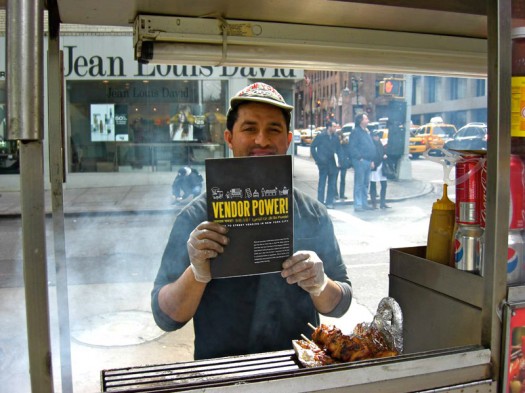
Candy Chang has written up an excellent overview of her process producing a visual policy brief for Making Policy Public. Street vendors in New York City can be hit with a $1,000 fine for such minor infractions as not displaying their badge prominently enough, or for not placing their cart precisely in relation to the curb or store fronts. To clarify the confusing regulations from multiple NYC agencies, the Street Vendor Project and Center for Urban Pedagogy worked with Candy to create this visual, multi-lingual fold-out poster that demystifies vendor rights and regulations (along with a few fun facts.) Check out Candy’s write-up and download a PDF of the poster. Knowing one’s rights can potentially make a big difference in the lives of street vendors and their families.