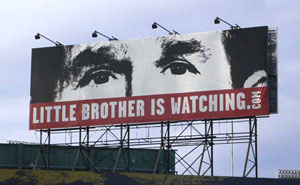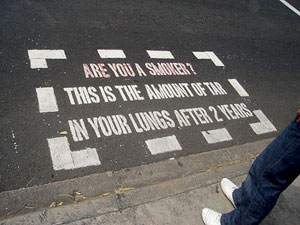

DesignCares.com is a site collecting current examples of graphic projects in the public interest. Some nice elegant work, thus far mostly from Canada and mostly printed matter for non-profits and “children’s charities,” along with an occasional “random act of graphic vigilantism.”
From the site:
“We are collecting professional acts of social responsibility, as an inspiration for those looking for ideas, and as a celebration of the role designers are taking in helping repair the world....
Inspired by the Design Cares Web site, in 2001 the GDC Vancouver Island Chapter created the Design Cares Exhibit and Forum (with the generous support of Sappi Fine Papers, Adobe Systems, and others), and has published a travelling poster exhibit from the juried show. The Design Cares travelling exhibit is a celebration of the role designers are taking in helping to improve the world and shows the breadth and depth of how they use their creative skill to improve the human condition, save the environment or assist with a myriad charitable causes. The show has travelled internationally, including Slovenia, Qatar, Hungary, and Bahrain.”
DesignCares was started by members of the Society of Graphic Designers of Canada, a non-profit professional trade assocation:
The Society of Graphic Designers of Canada (GDC), a non-profit organization of design practitioners and educators. The GDC is concerned with standards of professional conduct, practice and integrity; education and professional development; and information about the profession. The organization was founded to promote and develop a defined, recognized and competent body of graphic designers and to encourage high standards of graphic design for the benefit of Canadian industry, commerce and community. The national goals of the Society include a commitment to improving the human environment by improving the quality of life and fostering public awareness of design expertise. Members share a code of ethics stating that we must take a responsible role in the visual portrayal of people, the consumption of natural resources, and the protection of animals and the environment.
Like the U.S., Australia has a growing problem of fundamentalists in politics.
In response, graphic designer, artist, and activist Deborah Kelly has undertaken a large scale public art project in the streets (skies and train stations) of Sydney. From bewareofthegod.com:
“This site intends to be a resource of diverse material documenting, analyzing, and musing upon the impacts and aspirations of religious literalists in the public sphere. It is being produced in Australia, in 2005, so that is its first focus. However, you will also find here information, ideas and reportage from other places, because even though context is everything, a global phenomenon is also something.”
The project incorporates multiple media, including:
A 30 second film shown every ten minutes on 42 billboard screens in Sydney train stations, viewable in miniature here [Quicktime 874 Kb]
Projections onto clouds over Sydney Harbor:

Distribution of 40,000 free postcard/stickers (you can mail or peel the front off and stick to your door.)

And essays and analysis posted on the project Web site. On the site is an open call for further cultural and analytical material.
The effort is backed by the Museum of Contemporary Art in Sydney as part of their biennial Contemporary Australian Art show, this year called Interesting Times.
Related projects from Kelly include a series of posters designed with Tina Fiveash satirizing the right wing regime of “compulsory heterosexuality”.

And a series of illustrated matchboxes satirizing the Christian right push in Australia to have muslim women and girls banned from wearing hijab “because they might be hiding bombs.” Kelly and friends made thousands of satirical matchboxes and left them lying around.

Kelly is also involved in a collective challenging the rhetoric of politicians calling refugees ‘boat people.’ See more at http://www.boat-people.org/
Though not aligned with a specific organizing campaign, I think such cultural work is important in the battle for hearts and minds.
While Google Print and the Open Content Alliance have recently been the subject of big headlines about their plans to digitize old books, the David Rumsey Map Collection already has 12,600 historic maps online:
“The collection focuses on rare 18th and 19th century North and South America maps and other cartographic materials. Historic maps of the World, Europe, Asia and Africa are also represented. Collection categories include antique atlas, globe, school geography, maritime chart, state, county, city, pocket, wall, childrens and manuscript maps.”
One can search, view, and juxtapose maps on the Web, as well as download high resolution images in MrSID format. The images are posted under a Creative Commons license. Read more from Rumsey on oreilly.net.
Yesterday saw a hit to this entry in my referer log from ‘ombpxy.nyc.gov’ using a Google Blog search for ‘nypd.’ Is that the NYC Office of Management and Budget?
Given the petty things friends have been arrested for lately, I should probably be more paranoid than I am, but I think this is a good thing.
Not quite eDemocracy (and who knows how the information will be used) but it’s nice to know at least someone’s checking the comments and complaints box.
At least amongst bloggers.
What’s the best online donation service for non-profits and activist groups?
This is one of those simple questions that seems to come up again and again.
At last, the LINC project has posted a nice comparison of four options.
(This does not address tax-deductible status, which is another matter entirely.)
Is it still news that grassroots protest movements are using electronic media to facillitate political change? Here are two stories from the same week.
Ecuadoreans rebelled by radio, e-mail and text, Reuters, April, 23, 2005:
“Fed up with politicians, Ecuadoreans turned to local radio, text messages and the Internet to whip up a street rebellion this week that helped push their president Lucio Gutierrez out of office.
Gutierrez, a former army officer elected in late 2002, was waiting in Quito’s Brazilian embassy residence on Saturday for safe conduct to asylum in Brazil, three days after intense protests played their part in forcing him from office.
Buoyant protesters, including businessmen, housewives and students, described the demonstrations as a popular rebellion that grew through word of mouth, cellular telephone text messages and broadcasts on La Luna, a local radio station.
Many said the week-long rallies were a spontaneous reaction to frustration with what they saw as the government’s abuse of power and disappointment with leaders of all political colours....
Quito protesters took their name — the Forajidos, or the outlaws in Spanish — from criticism Gutierrez fired at them when demonstrators rallied outside his family home.
Car windshield stickers and T-shirts carrying the logo soon appeared on Quito’s streets.
When momentum started to build last week, La Luna began broadcasts calling for peaceful pan-banging demonstrations, protests with balloons and even demonstrations by lobbing rolls of paper towels.
One distributed e-mail showed an animated image of pots banging on the screen.
La Luna, a small independent Quito FM radio station that has a history of questioning the government, was key in mobilizing the rallies.
‘People came here to denounce things. When it started to get big the politicians turned up, but the people just shouted at them to get out,’ Tobar said.
As protests grew the Gutierrez government blocked La Luna’s signal, Tobar said, a charge the former government dismissed. Demonstrators began sending text messages with details of rallies when La Luna went briefly off the air.
Outside the Brazilian embassy residence, protesters have rallied for three days to demand their new government stop Gutierrez leaving the country. Many want to see him jailed.
La Luna blasted this week from the radio of a car parked outside the residence, keeping protesters up to date on new developments.
Gutierrez, who was jailed before for leading a coup, came to office with the popular support of the poor and Indian groups after promising populist reforms. But many said they felt betrayed by his tough economic policies.
The former government blamed Radio La Luna for fomenting violent protests on the streets and threatened legal action. But the radio station insists on its independence though manager Tobar acknowledged its open opposition to Gutierrez.”
Note the emphasis on a strong brand here, too.
Chinese cellphones fuel protest, NY Times, April 24, 2005:
“The thousands of people who poured onto the streets of China this month for the anti-Japanese protests that shook Asia were bound by nationalist anger but also by a more mundane fact: they are China’s cellphone and computer generation.
For several weeks as the protests grew larger and more unruly, China banned almost all coverage in the state media. It hardly mattered. An underground conversation was raging via e-mail, text message and instant online messaging that inflamed public opinion and served as an organizing tool for protesters.
The underground noise grew so loud that last Friday the Chinese government moved to silence it by banning the use of text messages or e-mail to organize protests. It was part of a broader curb on the anti-Japanese movement but it also seemed the Communist Party had self-interest in mind....
‘Chain letter’ e-mail and text messages urged people to boycott Japanese products or sign online petitions opposing Japanese ascension to the United Nations Security Council. Information about protests, including marching routes, was posted online or forwarded by e-mail. Banned video footage of protest violence in Shanghai could be downloaded off the Internet.
‘Text messages, instant messaging and Internet bulletin boards have been the main channels for discussing this issue,’ said Fang Xingdong, chairman of blogchina.com, a Web site for China’s growing community of bloggers. ‘Ten years ago, this would have been unthinkable.’
In Shanghai, the local police even sent out a mass text message to cellphone users the day before that city’s raucous protest. ‘We ask people to express your patriotic passion through the right channel, following the laws and maintaining order,’ the message said. Some marchers saw the message as a signal to proceed, while others took it as a warning.
In early 2003, text messaging and the Internet played a major role in helping people pass reliable information - and also unfounded rumors - about the outbreak of SARS at a time when the government was covering up the disease.
In the anti-Japan protests, people have sent old-fashioned chain letters to friends via e-mail or text message. Typical is a 23-year-old professional in Shanghai who asked to be identified for this article by her English name, Violet. She uses an instant messaging service on her work computer to communicate with 50 people on her ‘contact list.’...
About 27 percent of China’s 1.3 billion people own a cellphone, a rate that is far higher in big cities, particularly among the young. Indeed, for upwardly mobile young urbanites, cellphones and the Internet are the primary means of communication.
‘If people can mobilize in cyberspace in such a short time on this subject," said Wenran Jiang, a scholar with a specialty in China-Japan relations, "what prevents them from being mobilized on another topic, any topic, in the near future?’”
The protests eventually wrung an apology from the Prime Minister of Japan.
Oddly, while the China story made the NY Times. The Ecuador story was hardly picked up at all — and has disappeared from the swissinfo site where I first caught it. Is independent radio in Latin America not as “sexy” as cellphones in China?
Click-and-drag, or click on a state or icon to zoom in. Click on the water, or use the right-click menu to zoom out.
Based on the poster produced by the NYC Independent Media Center.
Built using DIY Map, with a little help from google-latlong.
I’m collecting some principles, techniques, and examples of electronic advocacy into a brief introduction and overview of uses of the Internet for advocacy.
I’ve posted my draft online at http://backspace.com/action and am soliciting comments from the public.
If you’re interested, do check it out and let me know what you think. You can post comments directly to the site.
And do please circulate this Web address as you see fit.
Update February 16, 2004: I’ve revised the text, incorporated some of the feedback, and removed the DRAFT label.
Many thanks to everyone who commented. If I incorporated your comments, I added your name to the acknowledgments page.
The comments form will remain open a while longer.
Pyramid of Capitalist System, issued by Nedeljkovich, Brashich, and Kuharich in 1911.
Just one of the graphics available at http://www.iww.org/graphics/