



video
Voters Unmoved by Presidential Campaign Ads
From AdAge, May 24, 2004, “Consumers Largely Unmoved by Presidential Campaign Ads”:
“More than half the consumers queried in a new Advertising Age poll conducted by Lightspeed International Research said the blitz of presidential campaign ads had not influenced them and in total, 92% said the ads had not swayed them to change their prospective votes....
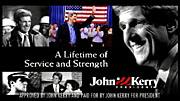 The online poll, conducted among 1,653 respondents nationally who have seen ads for both candidates, also breaks out eight battleground states. In those states, which are carrying the bulk of the presidential hopefuls’ advertising, both candidates’ ads are viewed as even less persuasive....
The majority, 60%, of national respondents said Mr. Bush’s ads aren’t focusing on issues they care about, and even more, 69%, said Mr. Kerry’s ads don’t address issues they care about....
To no one’s surprise, two out of three respondents — regardless of state or party — view political ads for the presidential race overall as too negative. And that could work against the candidates, as one-third of respondents said a candidate’s negative ads — rather than sway them to vote for that candidate — may actually influence them to avoid voting for them.
Oddly, while ads from the Bush campaign have mostly attacked Mr. Kerry, who has been running mainly biographical spots, poll respondents saw the challenger’s ads as more negative than Mr. Bush’s. A full 61% of those surveyed said Mr. Kerry’s ads were more negative in the national sample vs. 54% for Mr. Bush.
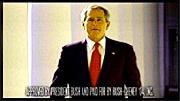 The reason may be that Democratic groups such as Media Fund and MoveOn.org have been running anti-Bush attack ads and the comments about the negative Kerry ads apparently reflect those ads rather than those from the campaign itself. In fact, among the general population, respondents were equally split on whether they could distinguish ads between candidates or public interest groups. (Respondents in Florida and Ohio were more likely to be able to distinguish the two.)
In some battleground states, however, the results ran counter to the national results. In Michigan and Minnesota, more people found Mr. Bush’s ads negative than they did Mr. Kerry’s.
Even though the election is a little over five months away, already 55% of respondents believe there is too much political advertising.
They are also largely unimpressed with the largesse. Half of respondents on a national basis said Mr. Bush’s ads don’t clearly state his position; Mr. Kerry fared worse, with 70% responding that his ads don’t clearly do so.”
From the data, it seems voters are craving more information and less rhetoric. And might MoveOn’s celebrated Bush in 30 Seconds ads be doing more harm than good? (Though, might Ad Industry professionals have something against ads produced by “amateurs”?) I wonder how these figures compare with past presidential elections.
Still even 8% of several million is several thousand voters who might tip a another close election. But then we also that know what users say is not always what users do.
The article does not elaborate on the methodology or link to an example of the online poll. I’m wonder how the poll addresses ads that put forward a substantive critque of the candidates — in other words “negative” ads that do address issues.
But really, “voters” as “consumers”? Wow.
Ill Communication
In the same sitting, I stumbled into two articles on the use of cellphones to coordinate street protest in real time. One in La Paz, the other in London, the former well organized, the latter ad-hoc. One from the country, the other from the city.
From Anarchogeek:
“The use of cell phones is interesting in how it relates to transforming the rural/urban power divide within the developing world. This isn’t something entirely new, rural community radio stations have played very large roll in communication and social transformation. In Bolivia, the revolution of 1952 lead by the miners unions, was coordinated by a network of rural community radio stations. With high illiteracy, little infrastructure, very poor communities these communities have relied on radio as the primary form of mass media.
In the last decade there has been an upsurge in the political power of indigenous movements in the Andes who have their power base in rural mostly disconnected communities. A lot of that upsurge is due to the many years of organizing by indigenous leaders, social movements, and NGO’s. That said, cell phones have acted as a major amplifier of their work. Increasing the ability for people to coordinate their actions and build robust social networks.
Unfortunately, I’ve not seen much written about the use of cell phones and other communications technology in the general strike and ‘Gas War’ in Bolivia last month. From my working with the rather small group of indymedia people in Bolivia I’ve heard some of how cell phones transformed the conflict. It helped people lay a more than week-long siege to La Paz. It also helped coordinate the marches of people from other parts of the country to the capital. When women went on hunger strike in churches the communications network made it a coordinated act, not simply the act of a few brave women in one location.
I think what happened in Bolivia is quite different than the much talked about ‘smart mobs’ as there were relatively few people will cell phones. The groups were not flexible, but rather quite well organized with cell phones used to coordinate between the leadership of existing organizations and networks. The use of cell phones facilitated the biggest indigenous siege of La Paz in almost 300 years.
Other important factors was Pios Doce and other community radio stations which played a vital mass media roll during the crisis. The Pios Doce transmitter in Oruro was bombed, by people who clearly didn’t expect the police to investigate anything. What the government didn’t figure out how to do was shut off the cell phones of known organizers, or towers which serve indigenous communities. My guess is the reason they didn’t shut them down was in part because cell phones were a vital communications tool for the police and army. Even the US Army in Iraq makes extensive use of consumer walkie talkies and unencrypted Instant Messenger. In India texting has been shut off at critical points to stem the spread of rumors and coordinated race riots during communalist uprisings in the last year. I expect as social movements turn to using cell phones and related technology as a tactical tool during protests and uprisings the governments will eventually learn how to turn off the ability to communicate at will.”
This last point is also noted in the BBC article about protestors chasing Bush in London:
“Some newspapers and websites were reporting mobile phone signals could be blocked for fear they could remote-control a bomb. But Scotland Yard has denied reports that police were considering shutting mobile phone masts during protests.”
In contrast to the Bolivia protest which shut down the capitol, the UK protests are intended to be a media hack and an adjunct to the big, organized, legally-sanctioned anti-war march on Thursday.
 “The Chasing Bush campaign is asking people to ‘disrupt the PR’ of the visit by spoiling stage-managed photos.
They are being encouraged to send location reports and images by mobile to be posted on the Chasing Bush site....
Technologies like text messaging and weblogs have been successfully used in the past to co-ordinate routes and meet-up points for mass protests.
But the gadgets are now being used more proactively to make protests more visible and disrupt any potential stage-managing of the President’s visit.
‘We are trying to spoil the PR, so we are not doing anything directly, but encouraging people to protest by turning their backs in press photos so they can’t be used.’
The campaign organisers have also asked people to go into protest ‘exclusion zones’ to send SMS updates and on-location reports about his appearances, and events at protests.”
See this previous post for more notes on electornic advocacy.
Captions, Television and its Double
The year 1960 marks a turning point in the history of technology and politics. The Kennedy-Nixon presidential debate was the first to be broadcast live on television. Kennedy’s telegenic composure and appeal is credited with tipping the vote in his favor. In 1960 ninety percent of U.S. households owned a television. For the first time, Americans in 1963 say that they get more of their news from television than newspapers. Television becomes an increasingly important source of information and enormous cultural force in the United States marking the assassination of President Kennedy, the rise of the Beatles, landing a man on the moon and returning him safely to Earth, I Love Lucy, Sesame Street, the Olympics, news of the war in Viet Nam, the Watergate hearings, the Watts riot, Star Trek, and the mini-series Roots. [source]
However, it would be at least another decade before millions of deaf and hard-of-hearing Americans could begin to participate.
From the National Captioning Institute:
 “The first innovators were not thinking about a captioning system for deaf and hard-of-hearing people. In 1970 the [U.S.] National Bureau of Standards began to investigate the possibility of using a portion of the network television signal to send precise time information on a nationwide basis. The Bureau believed that it could send digitally encoded information in a part of the television signal that is not used for picture information. The ABC-TV network agreed to cooperate. This project didn’t work, but ABC suggested that it might be possible to send captions instead.
This led to a preview of captioning at the First National Conference on Television for the Hearing Impaired in Nashville, Tennessee, in 1971. Two possible technologies for captioning television programs were demonstrated that would display the captions only on specially equipped sets for deaf and hard-of-hearing viewers.
A second demonstration of closed captioning was held at Gallaudet College on February 15, 1972. ABC and the National Bureau of Standards presented closed captions embedded within the normal broadcast of Mod Squad.
As a result of the enthusiasm these demonstrations created in the deaf and hard-of-hearing community, the National Association of Broadcasters studied the technical and economic factors involved in establishing a captioning service. The Association concluded that this captioning system was technically possible, but certain steps had to be taken before it could become a reality. The federal government then said it would fund the development and testing of this system. The engineering department of the Public Broadcasting System started to work on the project in 1973 under contract to the Bureau of Education for the Handicapped of the Department of Health, Education and Welfare (HEW).
While the closed-captioning service was being developed, there were some programs with ‘open’ captions airing on PBS. In 1971, The French Chef became the very first television program that was accessible to deaf and hard-of-hearing viewers. The ABC News was rebroadcast on PBS five hours after its broadcast on ABC-TV. From the time the captioned ABC News was first produced in 1973, it was the only timely newscast accessible to deaf and hard-of-hearing people until NCI’s real-time captioning service started in 1982....
Toward the end of the technical development project at PBS, it became clear that in order to get the cooperation of the commercial television networks, it would be necessary to establish a nonprofit, single-purpose organization to perform this captioning. And so in 1979, HEW announced the creation of the National Captioning Institute. The mission and importance of NCI was clear from the beginning. It was to promote and provide access to television programs for the deaf and hard-of-hearing community through the technology of closed captioning.
On March 16, 1980, NCI broadcast the first, closed-captioned television series. The captions were seen in households that had the first generation of closed caption decoder.
A silence had been broken. For the first time ever, deaf people across America could turn on their television sets — with a caption decoder — and finally understand what they had been missing on television.
The closed-captioned television service was an overnight sensation. Suddenly, thousands of people who had been living in a world of silence could enjoy television programs along with hearing people....
NCI ensured a bright future for closed-captioned television by partnering with ITT Corporation in 1989 to develop the first caption-decoding microchip, which could be built directly into new television sets at the manufacturing stage. This led to the introduction and subsequent passage of the Television Decoder Circuitry Act, which mandated that, by mid-1993, all new television sets 13 inches or larger manufactured for sale in the U.S. must contain caption-decoding technology. Now, millions of people have access to captions with the push of a button on their remote controls.”
From a more recent Captioning FAQ:
“On August 7, 1997, the FCC unanimously approved new regulations which will mandate captioning on virtually all television programming in the United States. Section 305 of the Telecommunication Act of 1996 is being implemented as a new section (Section 713) of the existing Communications Act. On September 17, 1998, the FCC modified their rules, in what can be considered a victory for caption viewers. The ruling took effect on January 1st, 1998, and it phases in requirements separately for ‘old’ and ‘new’ programming.”
Though numerous studies have shown that mixed-case text is easier to read than all uppercase, virtually all captioning in North America is done in uppercase only. The resolution of NCSA television and caption decoders generally results in ugly and illegible lowercase letters.
“[However,] mixed-case text is often used to indicate whispering, and is also often used for text that needs to be set apart, such as comments by an off-screen announcer (voice-over), or sound effects.
Caption decoders and televisions were not required by law to support lowercase letters at all until just a few years ago. There are, therefore, some televisions that will change mixed-case text to all uppercase.” [source]
Now, with the introduction of digital television, the design of the typeface for subtitling is no longer constrained by the technology of analog television.
This new digital environment provides for larger screens, higher screen resolutions, enhanced closed captions, and higher transmission data rates for closed-captioning.
 Enter Tiresias Screenfont, a typeface for television subtitling designed for maximum legibility. Development of the typeface included extensive user testing with viewers that had a wide range of visual abilities and viewing habits.
The Tiresias Screenfont was originally designed by a team led by Dr. John Gill, Chief Scientist for the Royal National Institute for the Blind.
“The typeface Tiresias Screenfont was originally designed for subtitling on UK digital television in 1998.... It has been specifically designed for screen display and has been adopted by the UK Digital Television Group as the resident font for interactive television. Screenfont is now being adopted for European digital television. Its use is also being considered in the USA.
Tiresias Screenfont has been designed to have characters that are easy to distinguish from each other. The design was carried out, with specific reference to persons with visual impairments, on the philosophy that good design for visually impaired persons is good design for everybody.”
Both font and philosophy have been taken from the television screen and applied to the public terminal, the built environment, and the printed page.
Other variations of Tiresias Screenfont have since been designed, each optimized for a specific purpose:
Tiresias PCfont is a typeface designed to display clearly on screen based systems, such the information displayed on TV monitors on public transport, at airports, railways or ferry terminals. Building societies and banks use screens to display information on cash dispensers. Many governments are now introducing screen-based public information systems in libraries and government offices. Tiresias PCfont makes these services and facilities more accessible.
Tiresias Infofont is designed to improve the legibility of information labels on public access terminals, ticket machines, telephone booths. The characters and letterforms have been designed to provide maximum legibility at a reading distance of around 30 to 100 cm. Infofont is not designed for large quantities of text.
Tiresias Signfont is for fixed (not internally illuminated) signage. The recommended usage is white or yellow characters on a dark background. Tiresias Signfont has a different level of boldness than Screenfont and PCfont, and has more open spacing than conventional type. Signfont is designed to provide maximum readability at longer distances.
Tiresias LPfont is designed for use in large print publications, and to be more legible than the standard typefaces that are currently in large print publications.
The Tiresias family of fonts are available for sale from Bitstream.
Update October 1, 2003: A couple of hard-of-hearing friends have brought up the petition campaigns that they, their friends, and parents participated in. The text above does understate the grassroots campaign.
 21 September 2003 | LINK | Filed in
accessibility, gov, health, standards, typography, video, war, www
21 September 2003 | LINK | Filed in
accessibility, gov, health, standards, typography, video, war, www
Stop Bankrolling Bulldozers
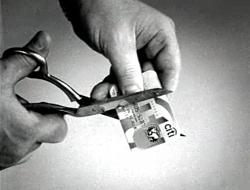
Undermining labor, devastating the envrionment, preying on inner cities, profiting from prisons, and backing biotech companies like Monsanto, Citibank is the target of a new TV spot and campaign by the Rainforest Action Network.
In the commercial, Ali MacGraw, Ed Asner, Darryl Hannah and Susan Sarandon read the names of some of the of thousands of people who have cut up their Citi cards to protest the financial giant’s practice of using its customers’ dollars to fund the world’s most environmentally destructive projects.
The Committee to Help Unsell the War
In 1969, Arkansas Senator J. William Fulbright, announced the results of his investigation into the Defense Department’s lavish spending on propaganda and self-promotion during the Vietnam War.
Mitchell Hall writes in Unsell the War: Vietnam and Antiwar Advertising, (Historian, Autumn 1995):
“From 1959 to 1969, the Pentagon’s public relations expenditures increased 1,000 percent to an acknowledged $27.9 million, a figure Fulbright called ‘conservative.’ With this financing and a full-time public information force of 2,800 people, the military enjoyed overwhelming access to the public. In 1968 the navy and marines sent over 2.8 million news releases to 12,000 print and broadcast media outlets, in 1969 armed forces performances ranging from musical groups to aerial demonstrations played to audiences estimated at 20 million, and over 360 commercial and educational television stations used the U.S. Army-produced TV show ‘Big Picture.’ The potential influence on public opinion and foreign policy was enormous.
U.S. presidents from Harry Truman to Richard Nixon had also tried to persuade the public that events in Indochina demanded a U.S. military presence. Their efforts initially succeeded, but by the late 1960s millions of Americans had publicly demonstrated their rejection of a policy that had brought increasing sacrifice, destruction, and stalemate. Nixon’s Vietnamization policy, which gradually removed U.S. ground troops but escalated the bombing, partially defused antiwar activity by early 1971. Decreasing U.S. casualties convinced many people that the war was winding down. Although massive public demonstrations occurred less frequently than before, citizens in the early 1970s continued to work to end the war in numerous and creative ways.
On February 23, 1971, CBS broadcast the documentary “The Selling of the Pentagon.”
“Reiterating many of the points addressed in Fulbright’s report, this hour-long program examined the Defense Department’s public relations efforts that, in addition to recruiting volunteers and providing information, marketed a specific interpretation of the Vietnam War and the cold war to the U.S. public....
The military establishment annually arranged hundreds of public contacts that included shopping mall exhibits, Green Beret hand-to-hand combat demonstrations, and tours by flight teams such as the Thunderbirds. In clear violation of regulations, a select group of colonels avidly promoted the U.S. presence in Vietnam in speeches they gave around the country. The Defense Department also provided weekend guided tours of military installations to VIPs, who could observe war games from a grandstand and personally fire tank guns and artillery.
Films also propagated the military’s ideology. The Pentagon cooperated with Hollywood producers who portrayed the military favorably and had celebrities and journalists narrate some of its own movies....
The Defense Department achieved its widest exposure through the news media. Daily briefings to the national press yielded only carefully selected information from the Pentagon’s public relations division. The armed forces also maintained their own media arm, producing over two million press releases each year. Local newspapers generally snapped up uncritically this flood of news about the awarding of medals and promotions. Military television crews provided combat footage to supplement network coverage but often staged the action. Similarly military officials frequently held pre-interview briefings with soldiers in the field to ensure a standard acceptable story before allowing network TV reporters access to them. CBS questioned the impact on a democratic society and free press of a vast military information system that portrayed violence as glamorous, advertised expensive weapons like cars, and presented biased opinion as fact.”
Ira Nerken, a junior at Yale University studying political science, missed the initial broadcast of ”The Selling of the Pentagon” but read about the controversy it provoked. He decided that the war could be ‘unsold’ to the American public. Print ads had occasionally appeared in leading newspapers, and ad hoc groups produced some radio and television spots, but the advertising world had never been tapped on a large scale.
After discussing his ideas with an instructor at Yale, the instructor introduced him to David McCall, president of LaRoche, McCaffrey & McCall, an ad agency in New York. McCall and James McCaffrey, the agency’s chair, quickly organized a team that produced a poster and letter of explanation seeking support for a campaign to unsell the war. These were sent to 80 executives in 60 agencies.
The initial poster featured a drawing of the Pentagon and the headline, “Help unsell the war.” It read:
“C.B.S. recently devoted an hour to documenting the enormous advertising and public-relations job the Pentagon has done to sell the American public its version of the war. A group of students and faculty at Yale University are asking the men and women of the advertising agency business who disagree with the Pentagon’s version of the war to create advertising in all forms that will help unsell the war.”
The letter closed:
“Needless to say, we are not interested in cheap, superficial, anti-American work, we are interested in thoughtful and honest advertising, created by people who love their country.
I hope you will agree with me that this is a vital contribution which our business can make. If you do not agree, I can understand that, too. But the Pentagon’s side of the story has been ably and massively told. Ours has not.”
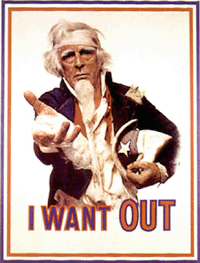 Interested ad executives were invited to briefing at Yale University on April 3, 1971.
“Over two hundred New York advertising people attended the early April briefing at Yale’s law school auditorium. Paul Warnke, former assistant secretary of defense, and Morton Halperin, former deputy assistant secretary of defense, explained Nixon’s Vietnam policies, and both urged setting a deadline for total withdrawal of U.S. troops. A representative of Vietnam Veterans Against the War discussed war crimes and problems veterans faced. A member of Concerned Asian Scholars described corruption within the Saigon government and the spreading antiwar feeling in South Vietnam. A person from the Herbicide Assessment Commission to South Vietnam showed slides of defoliation and crop destruction, and a former ABC correspondent in Vietnam detailed the strained relationship between the press and the military. Perhaps the most influential speaker was Milton Rosenberg, professor of social psychology from the University of Chicago. He identified the constituencies most ambivalent about the war and the arguments most likely to turn them against it: the deaths of U.S. troops, the economic consequences for the United States, and the creation of national discord.”
After the briefing, the attendees were asked to produce ads to be reviewed on May 1 by a panel that included Kingman Erewster, president of Yale; Mort Halpern, former Deputy Assistant Secretary of Defense; Dr. Edwin Reischauer, former Ambassador to Japan, and Gen. David M. Shoup of the United States Marine Corps (retired.) The panel would evaluate the ads and eliminate those that were inaccurate, unfair, or inferior.
On Memorial Day, May 31, the ads and commercials were to be displayed and distributed to the media to run as a public service.
Over 300 writers, artists, directors, and producers from nearly 50 ad agencies contributed an estimated $1 million of time and expenses. As of June 8, 1971, 125 print ads, 33 TV commercials and 31 radio spots had been produced. Given the expense of reproducing the ads, only a handful were sent to media outlets.
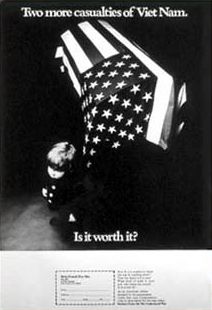 Though the Committee never did convince the major broadcast networks to air the ads, over 100 TV stations and 350 locally owned radio stations around the U.S. did run the spots. During the summer of 71, Nerken was able to arrange free time on 285 billboards around the country. Many of the ads urged people to elect representatives who would vote to end the war by the end of the year.
“With its attention focused on production rather than marketing, Unsell encountered additional problems inherent in the campaign. It lacked a built-in constituency or the organizational resources to conduct a national distribution effort. Local media felt little pressure to run ads offered by mail from New York. The result was a relative lack of success in getting messages on the air and in print. Because many ads focused on U.S. casualties, the sell became harder as Vietnamization brought more U.S. troops home in favor of an escalated air war, diluting one of the Unsell campaign’s central themes.”
In 1972, the expense and demands of the campaign ultimately led to its transfer to Clergy and Laymen Concerned, the nation’s largest religiously oriented antiwar organization. The focus of ad production also shifted from New York City to Hollywood. The CALC’s network of local chapters were also able to decentralize the task of contacting local media for free time and space. National organizations such as the American Friends Service Committee, Another Mother For Peace, and the Fellowship of Reconciliation also urged their members to get involved in the campaign.
In addition to the decline in U.S. casualties, the ongoing financial burden of the campaign and the 1972 presidential election slowed the momentum of the project which ultimately ended after the reelection of President Nixon and his announcement in January 1973 of an accord with North Viet Nam to end American involvement in Indochina.
The Library of Congress has several thumbnail images of posters produced by the Committee. Click on ‘Preview Images.’
Anti-War TV
Anti-War Group Revives “Daisy” Ad Campaign, January 15, 2003
From AP:
“Revisiting one of the most effective television commercials in the annals of U.S. politics, a grassroots anti-war group has produced a remake of the ‘Daisy’ ad, warning that a war against Iraq could spark nuclear Armageddon.
The provocative 30-second commercial - released to the media Wednesday and appearing in 12 major U.S. cities on Thursday at a cost of $400,000, was prepared with the help of thousands of donations to the Internet-based group MoveOn.org.
 The original Daisy ad aired only once, during the 1964 presidential race. Produced by the campaign of incumbent Lyndon B. Johnson, it depicted a 6-year-old girl plucking petals from a daisy - along with a missile launch countdown and then a nuclear mushroom cloud. The suggestion was that if elected president, Republican Barry Goldwater might lead the United States to a nuclear war with the Soviet Union. Goldwater lost by a wide margin.
The 2003 version follows the same format, with an added montage of scenes of military escalation: burning oil wells, tanks in the battlefield, wounded soldiers, chaotic protests in a foreign city and an ambulance racing through U.S. streets. Then, a similar mushroom cloud, and the screen goes to black, with a dire warning: ‘War with Iraq. Maybe it will end quickly. Maybe not. Maybe it will spread. Maybe extremists will take over countries with nuclear weapons. Maybe the unthinkable.’
Then, another ‘10... 9... 8...,’ countdown, and a final message: ‘Maybe that’s why the overwhelming majority of Americans say to President Bush: let the inspections work.’
MoveOn.org’s leaders hope the ad will enliven the debate on the specter of war - and persuade Americans to oppose a military solution in Iraq.
‘We’re playing with matches in a tinderbox,’ Eli Pariser, MoveOn.org’s international campaign director said. ‘We wanted to run an ad that would highlight that very real possibility and help encourage a national discussion about the consequences of war.’”
MoveOn was started in 1998 by a couple of guys in Silicon Valley as an online petition encouraging Congress to resolve the long running investigation and impeachement proceedings of President Clinton. Their email list has since grown to 600,000 users, and the org now solicits contributions for its Political Action Committee, MoveOnPAC, whose campaign contributions “provide financial support to congressional candidates who embrace moderate to progressive principles of national government. Our intention is to encourage and facilitate smaller donations to offset the influence of wealthy and corporate donors.”
On the ad:
“In December, we asked members to contribute $27,000 for a print ad in the New York Times. Within days, we had more than $400,000 committed to our ad campaign. This allowed us to do several print ads, including an ad in USA Today. To follow up, we ran a radio ad created by Betsey Binet, one of our members. But once we saw the avalanche of support, we knew it was time to go to TV. Over the holidays, we worked on the spot you’ll see today. Our goal is to underline the risk of war and we’ve created a piece intended to provoke discussion and controversy....
The ad is airing on TV stations in Washington, DC, Los Angeles, San Francisco, Philadelphia, Chicago, Dallas, Miami, Boston, Minneapolis, Phoenix, Cleveland, Portland and Seattle. The ad buy is largely on cable networks, and will show heavily on public interest shows on channels such as CNN and MSNBC for the next week. At 10am today in each of these media markets, MoveOn volunteers will be running press conferences for the local media.”
A RealVideo version of the ad is up on their Web site.
It’s great to see the anti-war message breaking through the virtual ban on dissent in the mainstream media. I hope this will help create a space for the media to cover this weekend’s protests in D.C. and around the world.
The ad is also a good effort to try to show some of the consequences of the war on TV, but images of mushroom clouds don’t quite evoke the human cost for me. Cinematic explosions are pretty cheap these days. I suppose the zoom on the little white girl tries to do this by implication.
The message of the ad also seems a bit muddled. The ad urges Bush to “let the inspections work.” But then is it OK to go to war if the inspectons do in fact show Iraq in violation of UN resolutions? Wouldn’t the same costs apply if the U.S. attacked Iraq with the approval of the UN?
Underexposed
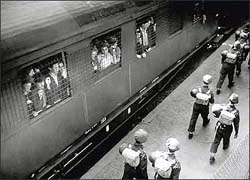 The people in the black and white photo behind the bars of the boxcar in the 1940’s German train station are not Jews off to the camps to be killed. They are indeed German Jews off to a camp, but the photo was taken after the end of war, the soldiers on the platform are British, and the passengers are survivors of Nazi concentration camps, denied entry into Palestine. Here, they are being transported from Hamburg docks to the Poppendorf detention camp.
The photo and its story are reproduced in Underexposed. From Vision On Publishing:
“Underexposed tells the stories behind the photographs which determine our view of history, providing a reality check on alleged events from the last hundred years and documenting the struggle of the powerful to contend with rival cultural forces of media and information. Reclaimed from the trash cans of the Second World War. From the cruelty of Stalin’s Russia and fundamentalist chaos in Iran to the horrors of the Gulf war and perspectives on September 11th — even Hitler’s preening speech rehearsals come back to argue with his self-made myth. Via disgruntled starlets, ecological destruction and US nuclear tests, Underexposed gathers together some of the most ideologically dangerous photographs ever taken and releases them to haunt the increasingly manipulated, re-touched present.”
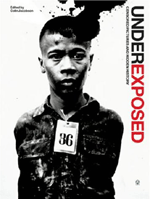 I found the book on the front table at St. Mark’s Books, mixed with the latest compilations on cyber-typography, club flyers, erotica, and graphic novels. The juxtaposition is continued on the publisher’s Web site. Among the publisher’s list of glossy photo books of rock stars, fashion, erotica, and a celebration of the Manchester City Football Club (and its fans), Underexposed seems a bit like war porn. The design of the book is certainly less than sober, full of dramatic, oversized, full-bleed spreads and a hip sans serif typeface. Each photo is provided with some background, but the captions only allow so much space.
The bottom line: photographs can lie. Particularly those that purport to be objective. Taken out of context, they are cropped, altered, and framed by the context at hand and by cultural assumptions. And page after page, the flouting of taboo and power starts to flatten out. Like all the speakers in the corner of Hyde Park, all ideologies become equivalent.
That said, the book does rouse a healthy dose of skepticism. It also crosses into the terrain of Barthes’s Mythologies, an examination of connections between language, imagery, ideology, and power and a wandering interrogation of “the obvious.”
From a review in The Guardian:
“In one of the most shocking images, taken from the Sudanese famine of 1984, Wendy Wallace photographed the photographers at work snapping an emaciated child who had been brought out to sit in the dirt precisely for that image.
It is a theme that recurs in Alex Webb’s pictures of the American invasion of Haiti. A line of US troops lies dramatically - heroically - on the Tarmac at Port au Prince airport aiming their weapons at an unseen enemy. Most media organisations showed this image. Webb’s version shows the reality: the only figures are half a dozen and more photographers and cameramen crouched in front of the soldiers, puncturing the dramatic image in a campaign that was to see virtually no opposition to US troops.”
See an excerpt from the forward to the book, some photos from the book, or listen to an audio interview with Colin Jacobson, former photo editor for a number of British news magazines and editor of Underexposed.
...
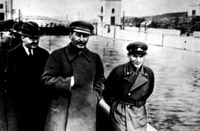
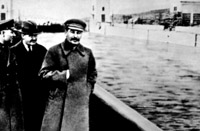
Also of note, The Commissar Vanishes: The Falsification of Photographs in Stalin’s Russia, an small online exhibit of doctored photos and propaganda posted by the Newseum. Shown here, Stalin with Nikolai Yezhov, commissar of water transport, before and after he was purged.
2002 MacArthur Fellows
The 2002 MacArthur Fellows were announced today. Here are a couple of bios of folks involved in projects I’d consider “social design”:
“Camilo Jose Vergara is a photographer-ethnographer who uses time-lapse images to chronicle the transformation of urban landscapes across America. Trained as a sociologist, he reaches into the disciplines of architecture, photography, urban planning, history, and anthropology for tools to present the gradual erosion of late 19th- and 20th-century architectural grandeur in urban neighborhoods, their subsequent neglect and abandonment, and scattered efforts at gentrification. Repeatedly photographing, sometimes over the course of decades, the same structures and neighborhoods, Vergara records both large-scale and subtle changes in the visual landscape of cities and inner cities in the United States. Sequences reveal, for example, trees growing in abandoned libraries and decrepit laborer housing swallowed by advancing foliage. Over the years, Vergara has amassed a rich archive of several thousand photographs that are a rare and important cache of American history. These images, monuments to the survival and reformation of American cities, are a unique visual study; they also inform the process of city planning by highlighting the constant remodeling of urban space.”
See some of his World Trade Center related photos on the New York Historical Society site or a couple of photos from the New American Ghetto series.
“Paul Ginsparg is a theoretical physicist widely known for creating a computer-based system for physicists and other scientists to communicate their research results. Ginsparg’s document server represents a conscious effort to reorganize scientific communications, establishing a marketplace of ideas of new submissions with minimal editorial oversight and abundant opportunity for commentary, supporting and opposing, from other investigators. Ginsparg circumvented traditional funding and approval mechanisms by developing the software in his spare time and running it on surplus equipment. This system [is] informally known as “the xxx archive,” currently hosted at Cornell University at http://arxiv.org.... All documents are available without charge worldwide through the internet, making the latest results available even for those without access to a good research library. Ginsparg has deliberately transformed the way physics gets done — challenging conventional standards for review and communication of research and thereby changing the speed and mode of dissemination of scientific advances.”
See some remarks about the project he delivered in 1994.
“David B. Goldstein is a physicist with a passion for... improving global energy efficiency. His work, which consistently refutes suggestions of inherent conflict between economic growth and environmental quality, touches on a broad spectrum of energy-related issues — from appliance design, to building construction, to governmental policies in developing industrial nations, to housing and transportation planning — and on developing effective policies to address these issues. Goldstein recognized, for example, that early refrigerators wasted a significant fraction of U.S. electrical output due to poor design. He led the effort to hold an efficiency design contest and then successfully lobbied regional and national regulatory agencies to establish energy consumption standards based on the new design, thus creating a market for the more efficient devices. More recently, he has initiated a project to encourage people, through mortgage lending incentives, to minimize the amount of energy they waste driving unnecessarily. Over the last decade, moreover, he has sought to influence and improve building efficiency standards in Russia and China. Throughout his work, Goldstein draws from his scientific training to eliminate political and economic obstacles to greater energy efficiency, with constant attentiveness to the environmental penalties of energy waste....
Since 1980, he has co-directed the Energy Program at the Natural Resources Defense Council (NRDC) in San Francisco.... In addition to his work at the NRDC, Goldstein serves on the boards of the Consortium for Energy Efficiency, the Institute for Market Transformation, the New Buildings Institute, the Appliance Standards Awareness Project, and the Institute for Location Efficiency.”
The mortages mentioned above are run through the Institute for Location Efficiency. The Location Efficient Mortgage is designed for “people who would like to purchase a home in an urban neighborhood and who would be willing to rely on public transportation and to use locally available services and amenities rather than own a personal vehicle.” Definitely not your typical envrionmental NGO.
“Brian Tucker is a seismologist whose work focuses on preventing readily avoidable disasters in the world’s poorest countries by using affordable civil engineering practices. He founded GeoHazards International (GHI) after recognizing that multi-story residences, schools, hospitals, stores, and offices built from adobe, stone, or unreinforced masonry in many regions of the world are death traps when earthquakes strike. GHI is the only not-for-profit, non-governmental agency dedicated to preventing structural failures in developing countries. Tucker works on-site with local governments, artisans, and citizens to implement cost-effective measures to construct or upgrade schools and other public service buildings and to educate residents about damage-prevention measures. He is an expert at adapting techniques used by developed countries in risk-mitigation projects so that they fit within the social, political, and economic constraints of at-risk communities in the developing world. GHI’s principal focus on schools is particularly important because their typically poor construction makes them a common source for earthquake casualties. His current work to develop and apply a Global Earthquake Risk Index is designed both to estimate risk and to motivate risk-reduction measures. His efforts have dramatically reduced the potential for death and injury to children and others from earthquakes in vulnerable cities around the world.”
Stanley Nelson is a documentary filmmaker with over 20 years’ experience as a producer, director, and writer.
“His award-winning film, The Black Press: Soldiers without Swords, synthesizes biography and history, bringing clarity and dimension to the often neglected role of black journalists in chronicling American history. In Marcus Garvey: Look for Me in the Whirlwind, Nelson examines an enigmatic African-American icon, illuminating character and cultural context. With Puerto Rico: Our Right to Decide, he probes still farther afield, considering the implications for political democracy arising from the historical trajectory of confluence and conflict among Anglo, Spanish, African, and indigenous social structures. He is currently working on a documentary about the murder of Emmett Till; other projects include the heritage of the African-American middle class on Martha’s Vineyard and on the international anthropology of the transatlantic slave trade.”
More of his film credits are listed here.
Smokey, the Forest Fire Bear
“Created in 1944, the Smokey Bear campaign is the longest running public service campaign in US History. Smokey’s forest fire prevention message remained unchanged for 50 years until April 2001, when the Ad Council updated his message to address the increasing number of wildfires in the nation’s wildlands. As one of the world’s most recognizable fictional characters, Smokey’s image is protected by US Federal Law and is administered by the USDA Forest Service, the National Association of State Foresters and the Ad Council.”
The site features notes on the history and real-life inspiration for the character as well as vintage audio and imagery from the campaign. Yet, despite public education to prevent forest fires, fires have become more frequent and more severe. In fact, because of U.S. forest policy. From the U.S. Bureau of Land Management:
“Fire suppression had been the general Government policy for most of this century. A series of very destructive fires from 1871 until about 1945 had a powerful impact on the public, which was alarmed by the destruction of human life, property, and resources (like forest products and livestock food) caused by the conflagrations. The fact that loggers carelessly ignited most of these fires had little sway on public opinion. The Government policy, then, generally called for fires to be suppressed, despite the fact that as early as 1933 research was showing the absolute necessity of periodic fire for ecosystem health. This policy was effectively reinforced by the familiar icon of Smokey the Bear admonishing that ‘only you can prevent forest fires’, and by such potent images as Bambi fleeing from fire.
Yet despite determined efforts over the years to suppress naturally ignited fires, wildfires have become more numerous, severe and difficult to control. Wildland fire experts contend that this is the inevitable result of well-intended but misguided fire suppression efforts, which consequently have created vast tinderboxes in many parts of the West.
Fire ecologists say they expect many more seasons of severe wildfires because there are millions of acres that have been affected by our management actions that have not yet burned. Managers can intervene and begin restoring the natural fire regime. They have two principle tools: letting naturally-caused fires burn, and deliberately setting ‘prescribed’ fires.”
Prevention, of course, is the reason George W. Bush is easing restrictions on logging to “give loggers greater leeway to cut larger, more commercially valuable trees... and deny environmentalists legal tools they have used to block such logging.”
Smokey site found via MetaFilter.
A Sesame Street between Israel and the Palestinian Authority
From the New York Times:
“Four years ago that children’s television show began broadcasting an Israeli-Palestinian co-production, conceived in the afterglow of the 1993 Oslo accords. The collaboration produced 70 half-hour shows, each one containing Hebrew and Arabic segments.... Under a new co-production agreement, which now includes Jordanians, the project has run into difficulty. The name ‘Sesame Street’ has been changed to ‘Sesame Stories’ because the concept of a place where people and puppets from those three groups can mingle freely has become untenable. The original shows were built around the notion that Israeli and Palestinian children (as well as puppets) might become friends. Now, reflecting the somber mood in the Middle East, producers see their best hope as helping children to humanize their historic enemies through separate but parallel stories.”
The segreation strikes me as a failure. The article also mentions various travel restrictions that are hampering production.

