
print

Sappi: Ideas That Matter. Papermaker Sappi again offers cash grants for designers working with non-profits. In their words: “Sappi invites graphic designers from Europe, North America and Southern Africa, to create printed communication campaigns for causes they want to support.” Apply here. See the 2004 winners. (via)
>  1 March 2006 | LINK | Filed in
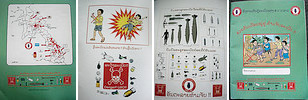
Not a Toy. Adam’s posted a few images of an illustrated guide for children about the dangers of touching or playing around unexploded munitions. The illustrations cover free, blank softcover notebooks produced by the US Army for distribution in Laos as part of the UNDP UXO program in the 1990’s.
UXO Laos
>  28 February 2006 | LINK | Filed in
A Basic Guide to Printing & Having a Successful Press Check. Some things to look for. And note, “The average number of press sheets it takes to get to final approval is 2 to 3.” Also, be nice. (via)
>  9 February 2006 | LINK | Filed in ,

Cut and Paint

Liberation Stencil

Cut&Paint is a zine of stencil templates, ready to cut, ready to paint.

Volume two is in the works with a deadline for submissions on February 20, 2006. In addition to stencils, the issue will include a how-to section, photos of stencils on site, and articles on stenciling, public space, and politics. Check the submission criteria.

The first issue is nearly sold out of its run of 400 copies, so I helped the team post the stencils online. It’s a quick and basic site for now, but will evolve as we add more images. The first 41 stencils are up and ready for download at http://cutandpaint.org.

>  6 February 2006 | LINK | Filed in , , , , ,

Canada Out of Haiti!

Reader dru writes in about this graphic campaign around the upcoming elections in Canada:

“In February 2004, Canada backed a coup that removed Haiti’s democratically elected president (Aristide) and the entire elected government. Since then, they’ve been training police that have been shooting demonstrators, and propping up a ‘justice’ system that is systematically jailing political dissidents (the ones that aren’t in hiding or dead).

PettigrewA bunch of Haiti solidarity activists are trying to unseat the Foreign Minister, Pierre Pettigrew (who had a brief cameo in The Corporation as a corrupt international trade minister), who played a key role (and continues to) in backing the post-coup government.

In the last election, he won by a very small margin in his riding of Papineau in north Montreal, which has a high population of Haitians.

In conjunction with groups in the Haitian community there, we're waging an all-out propaganda battle to unseat Pettigrew. Thousands of these posters: http://outofhaiti.ca/pettigrew/

Similar flyers have been distributed in the riding, and we hope to get a few thousand more out before election day (Jan. 23). Because the riding is such a hotspot, our posters have appeared on two nationally-broadcast TV news shows (in French and English).

Posters have also been created for the Prime Minister and his special advisor on Haiti and are going up in cities all across Canada.”
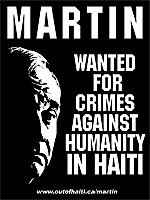
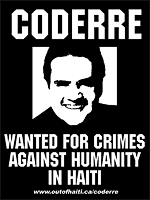
Martin Coderre

Read more about the campaign at http://outofhaiti.ca/

>  13 January 2006 | LINK | Filed in ,

Where It’s At

On the west coast last month, I had a chance to visit the amazing folks of the Desgin Action Colletive in Oakland. Talking process and vision, something Innosanto Nagara said really stuck with me. It was something like:

“The challenge for progressives is not a lack of ideas. The models exist. The arguments exist.

But when you ask someone on the street if they want universal health care tomorrow, they say ‘Oh, that’s communism.’

The problem is a failure to communicate. And visual communications is a powerful tool that we need to learn to use better.

I strongly believe that on-the-ground organizing is where it’s at. And the communications work we do is to augment that.”


Now there’s a concise manifesto.

>  11 December 2005 | LINK | Filed in

Guide to Recycled and Ecological Papers

Green Paper IconVia that same issue of Print I found this interesting matrix of recycled and tree-free papers assembled by Celery Design. About the guide:

“Most graphics professionals are searching for a few simple things in a paper the highest quality, the easiest functionality, and the lowest price. The goal of this guide is to help you add one more critical consideration to the decision making process: the environmental impact of the paper you specify.

Through your paper choices, you are directly connected to the preservation or the degradation of land, water, air, and the creatures that dwell therein. Paper reps and printers provide guidance on finding the best quality, functionality and price, but often can’t help when it comes to preserving the environment. This guide fills that information gap and points you to the very best recycled and tree free papers on the market today. You will discover that most of these papers are also very competitive in terms of quality, functionality, and price.

The recycled and tree-free papers listed here generate fewer toxins and impact the environment far less than typical virgin wood, chlorine-bleached papers. There are options here in nearly every grade, format and price category. We encourage you to contact the paper manufacturers for samples, pricing, and ordering information, and work with your clients and printers to specify these papers. We developed this guide as an easy-to-use, practical tool that makes it simple to change old paper-buying habits. Use it and share it with your friends. With the right information and a bit of initiative, each of us can reach a higher standard for our graphics projects.”

It’s not clear when the guide was last updated, but do bookmark the page at http://www.celerydesign.com/paper/matrix.html

What’s missing from the list are more tree-free, “synthetic” alternatives to paper like:

  • TerraSkin, a biodegradable paper made of mineral powder.
  • Yupo, made of 100% polypropylene. Not biodegradable, but easy to reconstitute.
  • NatureWorks PLA, a biodegradable corn-derived polymer, primarily used for packaging.

Anyone know of other good resources on alternatives to paper?

...


Update July 27, 2005:

More suppliers of tree-free and recycled papers are listed at Rainforest Web


Update August 28, 2005:

The San Francisco AIGA’s Ecological Guide to Paper lists 20 papers that are either 100% recycled, tree-free, or some combination of both


Update October 31, 2005:

Conservatree has lots of good information:

They also offer consulting services.

For more on changing your organization’s paper policy, see the Environmental Paper Network’s Environmentally Preferable Paper Purchasing Guidance (436 Kb PDF).

>  26 July 2005 | LINK | Filed in , , , ,

Fill in the Blank

From an interview with Dan Bar-On, co-founder of the Peace Research Institute in the Middle East:

Blank BookOne of our projects is to develop a new school textbook with a group of Palestinian teachers and Israeli teachers and two historians. We suggested that they take some dates from the history of the conflict... there were three dates: 1917, the Balfour Declaration, 1948, and the First Intifada. Each teacher should write his own narrative about these dates. Then they read each other’s narratives, they commented on them, and they asked questions. Finally, they were written up as two separate narratives. The task of the teacher is to teach both narratives to the pupils, and thereby to make the pupils aware, and to respect and acknowledge the fact that there are different narratives, that it’s not one legitimate and one not, and not that one are facts and one are propaganda, like the public says. These are two different perspectives, two different understandings of what happened in the history of the conflict.”

The book itself is a physical model of the divide — one half tells the Israeli story, flip it over and the other half tells the Palestinian story, with blank pages between the two.

>  22 June 2005 | LINK | Filed in ,

Design Planning for Activists

A few places to start:

>  1 March 2005 | LINK | Filed in , ,

Guns, Butter, and Ballots

An article of mine is running in January/February 2005 issue of Communication Arts.

If any of you were wondering what all that Nixon bit on the Federal Design Assembly was about, it was background research for this.


Guns, Butter and Ballots

Citizens take charge by designing for better government

What did the President know and when did he know it? In April 2004, the White House declassified one of the President’s daily intelligence briefs issued just a month before September 11, 2001. The brief specifically states that Al-Qaeda and Bin Laden were planning attacks on the United States with hijacked airplanes.

Graphic designer Greg Storey was horrified. Not just because the information was all right there, but by the design. It’s no wonder the information could be ignored. The document is an uninflected, grey mash of sans serif type. Might thousands have been saved if the information design had been better?

“Nothing in the text is emphasized, making it difficult to scan,” Storey noted on his Weblog. “It would be much better if keywords, names and places were in bold and/or in a different color. Make it so that within seconds the President can see how serious of a threat it is.” Mouse in hand, Storey created a redesigned brief of his own (below right), adding a larger headline, highlighted key terms and, most prominently, a large colored number indicating the level of the threat.

Though no one in government ever contacted Storey, readers of Storey’s blog clamored for a document template they could use themselves. He dutifully responded. (Visit http://airbagindustries.com/archives/002868.php.) “My intentions were nothing more than to rant about what I saw to be a problem with how our government works day to day,” he wrote. “I thought I would spend a few minutes in front of Photoshop to see what I could come up with.”

Alas, President Bush does not actually read the daily briefs, the Director of Intelligence summarizes them to him out loud. Nonetheless, Storey’s redesign is a dramatic example of how information design might affect the government and the public.

But the truth is, graphic designers across the country are already hard at work collaborating with local, state and national government officials to harness the power of design in the public interest. Their work affects the lives of millions of Americans by improving public safety, promoting public health and facilitating democracy on a massive scale — often at the initiative of the designers themselves.

That government agencies use graphic design is nothing new. From posters to packaging, identity and, of course, forms, the federal government is one of the largest purchasers of design services in the world. But much of this work is less than inspiring — even obscure or downright misleading. For a variety of reasons, government designers may be stifled by bureaucrats and lawyers. And sometimes it seems like the lawyers and bureaucrats do the designing themselves.

The late 1960s and 1970s, however, saw a number of seminal graphic design projects sponsored by the U.S. Government. To name just a few: Vignelli Associates’s graphic standards for National Park Service publications; Danne & Blackburn’s NASA “worm” logo; and Chermayeff & Geismar’s logos for the Park Service, Environmental Protection Agency and U.S. Bicentennial.

Continuing a wave of public art initiatives at the time, Richard Nixon even asked Congress to triple the budget of the National Endowment for the Arts and created the Federal Design Improvement Program to help upgrade government architecture and graphics.

But by the end of the 1970s, faced with an energy crisis and an economic recession, the new leadership shifted the government’s priorities. By the 1980s, a backlash raged against public arts funding. Budgets were cut and interest in public design projects waned.

Still, during this period, two masterpieces of modern infor- mation design were developed, both of which have had a demonstrable impact on public safety.

Burkey Belser’s company usually designs communications materials for law firms and other services companies. But in 1978, he was asked to design the EnergyGuide label for the Federal Trade Commission. The frustrated regulators had become desperate after a top-shelf New York design firm had failed — and submitted a hefty bill in the process. The EnergyGuide that Belser designed is a bright yellow informational sticker that must be displayed by retailers on all major appliances (like air conditioners, refrigerators and washing machines). The Guide shows the estimated yearly operating cost and energy consumption on a scale from least to most efficient. Consumers actually used it to consider not just purchase price, but cost over the life of the appliance. The success of the label convinced government regulators that you could modify consumer behavior through clear, friendly information design, gently pushing them towards more environmentally friendly, if slightly more expensive, purchases. Multiplied by millions of refrigerators, the energy savings have been enormous.

Belser’s 1994 redesign of the Nutrition Facts label also attempts to influence consumer decisions. But the label, the most widely reproduced graphic in the world, very nearly had no designer at all.

In 1991, Congress mandated that the science behind the label be revisited. Originally developed in the 1960s, the previous label was based on a culture of famine during the Great Depression and two World Wars. Hunger was an epidemic. Food was scarce and the country lacked an interstate highway system to move fresh fruits and vegetables to market. The government’s priority in the first label design was to fend off malnutrition, rickets and scurvy, and so the label highlighted essential vitamins and minerals. In 1991, Congress realized we were living in a different culture — a culture of plenty...and of fat. They tasked the Food and Drug Administration (FDA) to develop a new labeling scheme to fend off an epidemic of obesity.

The Center for Food Safety and Applied Nutrition at the FDA was well equipped with top scientists, nutritionists and epidemiologists, but lacked experience in public communication. The Center had hired another big New York design firm, but was dissatisfied with the results. And so they prepared to go it alone.

Sharon Natanblut had a background in marketing and public relations, and had just started at the FDA as advisor to the Commissioner for strategic initiatives. When she found out that the scientists were designing the label themselves, she intervened. “The scientists saw graphic design as a trivial thing,” she recalls. “They thought more information is better. But ultimately, it is the design that helps you understand it.”

Natanblut knew Belser from his work on the EnergyGuide and knew he could communicate with both scientists and government officials, and would ensure that the design reflected the goals of the project.

Belser offered to do the job for free (though was able to charge for some expenses.) “If ever there was a call for pro-bono work,” says Natanblut, “this was it.” Belser comments, “Designers should really take on public projects as a part of citizenship. That’s why we did it. How often do you get a chance to affect so many people? Anyway, I didn’t want to mess with the government procurement process at the time.”

Belser and his staff put in countless hours and, after designing 30 variations, learned there is no such thing as a universal symbol. They found that literacy is more complex than they had imagined. The label had to be accessible to both poor and fluent readers. They found that poor readers stumbled over commas, dashes and semicolons, and that graphs, icons, pie charts are more sophisticated than they’d thought, requiring a relatively high degree of visual literacy. In focus groups and in public comment, designs that used these elements were slaughtered.

Eventually Belser and his team developed the current layout. The generic and anonymous looking design is anything but. The placement and grouping of information and the use of boldface create a visual hierarchy. To combat increasing obesity, the new design highlights calories, fat and cholesterol. And the resulting label is used by health-conscious shoppers to count calories and monitor their cholesterol intake. As former FDA Commissioner David A. Kessler recalled, “The nutrition facts label has within the space of a few years become a standard that many Americans use to make basic decisions about their diet and nutrition.”

The apparent lack of “marketing devices” is also misleading. The space is branded with a kind of “look of truth” — neutral, scientific, institutional and authoritative.

Nonetheless, obesity continues to rise at a dangerous rate — fast becoming the number one cause of death in the United States. In response, Belser is currently working with concerned advisors to government to further modify the design.

One might argue that it’s not the government’s place to interfere with people’s behavior or engage in “social engineering.” Belser responds, “I don’t think that there’s any government, corporation, or anybody that is not trying to influence somebody else. We have a Constitution and body of laws that say certain areas are off limits...But what the government is willing to do, and what, I believe, has a perfect right to do is to manage issues of public health and safety.”

Citizen action

The Nutrition Facts and EnergyGuide labels show the reach of government sponsored information design. Recently, however, the design process seems to be shifting.

Whether designers are tired of commercialism or were awakened by the 2000 butterfly ballot fiasco, there seems to be increasing interest in civic engagement. As portrayed in the 2000 reissue of the First Things First Manifesto and the AIGA’s recent Voice conference, designers are increasingly thinking about social responsibility and looking for ways to get involved.

In fact, several recent government design projects have been driven from the bottom up rather than the top down. Redesigns of the 2000 census, voting materials, New York City’s ubiquitous choking victim poster and the 1040 tax form were all initiated by designers themselves. In some cases starting out as class projects.

Continue reading "Guns, Butter, and Ballots" »

>  21 January 2005 | LINK | Filed in , , , , , , , ,


page 13 12 11 10 9 8 7 6 5 4 3 2 1