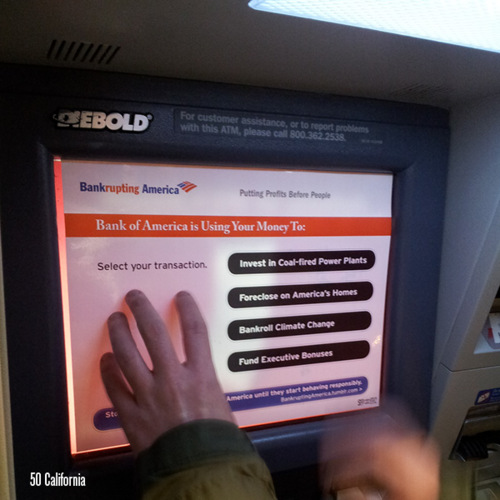
interface

Barriers for Disability at Work. “Most disabled people would tell you that the bigger concerns they have around the workplace are not around physical accessibility,” said Andrew Imparato, president of the American Association of People with Disabilities. “They’re more around attitudes. I think it’s easier to legislate and see change around bricks and mortar than it is around attitudes.” Half of the employers surveyed said workplace adjustments for accessibility came at no expense. 43 percent reported a one-time cost that averaged around $600.
>  16 March 2006 | LINK | Filed in ,
Numbers of Fruit. Fruit Label“Here in the US, fruit often comes with stickers on it, sometimes telling you where it’s from and/or what it is. There’s also a number, but I never paid attention to that. But on p. 72 [of April’s Food & Wine] I spotted this interesting bit of information:
‘[T]he sticker labels on fruit: The numbers tell you how the fruit was grown. Conventionally grown fruit has four digits; organically grown fruit has five and starts with a nine; genetically engineered has five numbers and starts with an eight.’”
(via)
>  14 March 2006 | LINK | Filed in , ,
Cooperative Housing for and by the Aging. “Opting for old age on their own terms, they were starting a new chapter in their lives as residents of Glacier Circle, the country’s first self-planned housing development for the elderly — a community they had conceived and designed themselves, right down to its purple gutters. Over the past five years, the residents of Glacier Circle have found and bought land together, hired an architect together, ironed out insurance together, lobbied for a zoning change together and existentially probed togetherness together.” (via)
>  2 March 2006 | LINK | Filed in , ,
APHont: A Font for Low Vision. “APHont was developed by the American Printing House for the Blind specifically for low vision readers. APHont embodies characteristics that have been shown to enhance reading speed, comprehension, and comfort for large print users.” The APHont Suite is available for free on the APH web site.
>  14 February 2006 | LINK | Filed in ,

Humanism

“To design is to give shape, structure and form to an idea.”

Jennie Winhall, Design Strategist with the UK Design Council, floats a draft definition of design for comment.

It seems reasonable enough, and I’m particularly attracted to the notion of participatory design that includes users in the design process.

But its focus on reason, practicality, and business strategy misses one dimension: the human.

Design proceeds not just from the knowledge of the designer, but from experience. Design is not just an expression of ideas in physical form, but a concrete embodiment of assumptions, values, desires, ideals, dreams, expectations, and prejudices.

Wiebe E. Bijker and John Law put it concisely, “Our technologies mirror our society. They reproduce and embody the complex interplay of professional, technical, economic, and political factors.”

Design is an expression of what (and who) we believe are “normal” of how much we value certain costs over others — financial, social, and political.

But there’s also that additional feedback loop. To paraphrase Winston Churchill, we shape our design, and thereafter our design shapes us. Design both reflects and creates relationships of power and authority — and can be a vehicle for change.

With regards to design as creative problem solving, I would point out that there’s almost always more than one solution to a problem — more than one way to do it, always another world possible. Design shapes the manufacture of the physical world, our interface with it, and, where mediated, with each other. It is formed by and gives form to the culture and images that frame our understanding of the world. Why one solution is picked over another is often as revealing as the solution itself.

>  11 October 2005 | LINK | Filed in

Papers in the Dark

OurMoneyToo.org is a grassroots campaign to alter the design of U.S. currency to make denominations recognizable without purely visual cues:

“Can you tell the difference between a one dollar and a twenty dollar bill in the dark?

Dim BillsBlind people use money just like everyone else, but since American paper currency is all the same size and texture, blind people can’t tell the bills apart independently. We all deserve the personal security of knowing what’s in our wallets.

Even those with sight would benefit from making paper money accessible by feel

  • It would simplify paying the bill and counting change in a dark restaurant
  • It would make it safer to get out money for an upcoming toll while driving
  • It would allow everyone to count money more discreetly in public

Please write or call your Congresspeople now! Our Contact Congress Tool makes this fast and easy.

...

OurMoneyToo.org is an independent volunteer organization committed to the dream of having currency that all Americans can use safely and independently. Our first job is to educate the public about the positive effects of being able to differentiate between bills without having to look at them. We hope that one day we all will be able to count the money in our wallets more discreetly, no matter who we are or where we are, without the fear of being cheated or robbed.

The U.S. Treasury Department doesn’t have to invent any special technology to make our currency more accessible. In fact, they’ve already done it in roughly 100 countries around the world, including Canada, Great Britain, and the countries of the European Union (see http://books.nap.edu/html/currency/appendixd.html). The American dollar is one of the most powerful currencies in the world. We are committed to making it safer and easier for everyone to use.

We are not affiliated with any other organization. We do not actively solicit donations.

...

In 2002, the American Council of the Blind (ACB) filed a lawsuit against the Treasury Department demanding that U.S. paper money contain features that will enable blind people to independently distinguish between denominations. The government is continuing to fight the suit, claiming that such modifications would be too expensive.

The Treasury protested that this would cost too much because it would require redesigning the currency — but in the meantime, they have spent millions of dollars to redesign nearly all of the denominations in circulation! As the Treasury continues to develop new bill designs with new anti-counterfeiting features, they should include accessibility features useful to blind people, people with dyslexia, and people who work with cash in low light.”


Making design usable by a differently-abled minority (old, young, tall, short, sighted, not, or otherwise physically different) often makes it more usable by all.

>  18 September 2005 | LINK | Filed in , , ,

Texting for Change

Is it still news that grassroots protest movements are using electronic media to facillitate political change? Here are two stories from the same week.

Ecuadoreans rebelled by radio, e-mail and text, Reuters, April, 23, 2005:

“Fed up with politicians, Ecuadoreans turned to local radio, text messages and the Internet to whip up a street rebellion this week that helped push their president Lucio Gutierrez out of office.

Gutierrez, a former army officer elected in late 2002, was waiting in Quito’s Brazilian embassy residence on Saturday for safe conduct to asylum in Brazil, three days after intense protests played their part in forcing him from office.

Buoyant protesters, including businessmen, housewives and students, described the demonstrations as a popular rebellion that grew through word of mouth, cellular telephone text messages and broadcasts on La Luna, a local radio station.

Many said the week-long rallies were a spontaneous reaction to frustration with what they saw as the government’s abuse of power and disappointment with leaders of all political colours....

Quito protesters took their name — the Forajidos, or the outlaws in Spanish — from criticism Gutierrez fired at them when demonstrators rallied outside his family home.

ForajidosCar windshield stickers and T-shirts carrying the logo soon appeared on Quito’s streets.

When momentum started to build last week, La Luna began broadcasts calling for peaceful pan-banging demonstrations, protests with balloons and even demonstrations by lobbing rolls of paper towels.

One distributed e-mail showed an animated image of pots banging on the screen.

La Luna, a small independent Quito FM radio station that has a history of questioning the government, was key in mobilizing the rallies.

‘People came here to denounce things. When it started to get big the politicians turned up, but the people just shouted at them to get out,’ Tobar said.

As protests grew the Gutierrez government blocked La Luna’s signal, Tobar said, a charge the former government dismissed. Demonstrators began sending text messages with details of rallies when La Luna went briefly off the air.

Outside the Brazilian embassy residence, protesters have rallied for three days to demand their new government stop Gutierrez leaving the country. Many want to see him jailed.

La Luna blasted this week from the radio of a car parked outside the residence, keeping protesters up to date on new developments.

Gutierrez, who was jailed before for leading a coup, came to office with the popular support of the poor and Indian groups after promising populist reforms. But many said they felt betrayed by his tough economic policies.

The former government blamed Radio La Luna for fomenting violent protests on the streets and threatened legal action. But the radio station insists on its independence though manager Tobar acknowledged its open opposition to Gutierrez.”

Note the emphasis on a strong brand here, too.


Chinese cellphones fuel protest, NY Times, April 24, 2005:

“The thousands of people who poured onto the streets of China this month for the anti-Japanese protests that shook Asia were bound by nationalist anger but also by a more mundane fact: they are China’s cellphone and computer generation.

For several weeks as the protests grew larger and more unruly, China banned almost all coverage in the state media. It hardly mattered. An underground conversation was raging via e-mail, text message and instant online messaging that inflamed public opinion and served as an organizing tool for protesters.

The underground noise grew so loud that last Friday the Chinese government moved to silence it by banning the use of text messages or e-mail to organize protests. It was part of a broader curb on the anti-Japanese movement but it also seemed the Communist Party had self-interest in mind....

‘Chain letter’ e-mail and text messages urged people to boycott Japanese products or sign online petitions opposing Japanese ascension to the United Nations Security Council. Information about protests, including marching routes, was posted online or forwarded by e-mail. Banned video footage of protest violence in Shanghai could be downloaded off the Internet.

‘Text messages, instant messaging and Internet bulletin boards have been the main channels for discussing this issue,’ said Fang Xingdong, chairman of blogchina.com, a Web site for China’s growing community of bloggers. ‘Ten years ago, this would have been unthinkable.’

In Shanghai, the local police even sent out a mass text message to cellphone users the day before that city’s raucous protest. ‘We ask people to express your patriotic passion through the right channel, following the laws and maintaining order,’ the message said. Some marchers saw the message as a signal to proceed, while others took it as a warning.

In early 2003, text messaging and the Internet played a major role in helping people pass reliable information - and also unfounded rumors - about the outbreak of SARS at a time when the government was covering up the disease.

In the anti-Japan protests, people have sent old-fashioned chain letters to friends via e-mail or text message. Typical is a 23-year-old professional in Shanghai who asked to be identified for this article by her English name, Violet. She uses an instant messaging service on her work computer to communicate with 50 people on her ‘contact list.’...

About 27 percent of China’s 1.3 billion people own a cellphone, a rate that is far higher in big cities, particularly among the young. Indeed, for upwardly mobile young urbanites, cellphones and the Internet are the primary means of communication.

‘If people can mobilize in cyberspace in such a short time on this subject," said Wenran Jiang, a scholar with a specialty in China-Japan relations, "what prevents them from being mobilized on another topic, any topic, in the near future?’”

The protests eventually wrung an apology from the Prime Minister of Japan.


Oddly, while the China story made the NY Times. The Ecuador story was hardly picked up at all — and has disappeared from the swissinfo site where I first caught it. Is independent radio in Latin America not as “sexy” as cellphones in China?

>  10 May 2005 | LINK | Filed in , , , ,

Crosswalk Usability

Old New York City crosswalk signal

Everyone knows that New Yorkers pay attention to crosswalk signals... right?

So if you live in New York City, you may or may not have noticed that all the old crosswalk signals are gone. Instead of the spelling out WALK and DON’T WALK in type, the new signals use pictograms of a big red hand and walking person in a dotted outline of bright LED’s.

The new signal displays fit into the old, existing signal housing. And, by switching from incandescent bulbs to light-emitting diodes, the City notes, the new signals will both last longer and use less energy.

New New York City crosswalk signal

This piece in the New Yorker provides some hard numbers:

“The city is changing all eighty-five-thousand signs, at a cost of $28.2 million. The job started in 2000, in Queens; by February [2004] the [job] should be complete....

The idea is that the new ones, which rely on dozens of light-emitting diodes, or LEDs, will last six times longer than the old ones, which relied on two bulbs, and will save two million dollars a year in maintenance and electricity costs....

The brighter signs should be more visible to persons with partial sight. But, the author notes, the signals do have detractors:

“Among them many children, who sense that there is something patronizing about the hieroglyphs....

‘First of all, they’re really bright,’ Jacob said. ‘They hurt my eyes, even from, like, a block away. They make my eyes water. And, also, the first thing my sister could read was Walk/Don’t Walk.’ The three of them came to a corner: across the street, an upraised hand. They took a look, then crossed anyway. ‘The old one is just more original,’ Jacob went on. ‘Almost every other place has the Man and the Hand. Whenever I go anywhere else, it’s the Man and the Hand. Italy, France—they always have that. It’s un-unique. So I don’t really like it. Actually, most of my friends don’t like it.’”

The NYC page also claims that switching to “internationally recognized symbols” will make the signs “easily recognized by non-English speaking pedestrians.” I applaud the recognition and accomodation of non-English speakers in such a massive, city-wide initiative, but while the symbols may be “internationally recognized” in Western Europe, an open palm has different meanings in different cultures. For instance:

  • In Japan an open palm in front of one’s face means “I don’t know,” “I don’t understand,” or “I am undeserving,” [source]
  • In Greece, “extending the arm and hand (palm open) as if pushing something away from you is an age-old form of insult. In wars, Greeks would humiliate their prisoners by rubbing mud or fecal matter into their faces.” [source]
  • And in Nigeria, pushing the palm of the hand forward with fingers spread is a vulgar gesture. [source]

Male iconWith closs-cropped hair and boot-cut pants, the figure in white resembles other symbols used around here to indicate “male.”

The NYC page doesn’t mention it, but new crosswalk symbols are nationally mandated in the Manual of Uniform Control Devices published by the U.S. Department of Transportation. The Manual sets forth detailed design standards for traffic signage around the United States.


Recently, in San Francisco I discovered another variation I’d never seen before. In addition to the white man and red hand, the signals there feature a red countdown indicating the number of seconds remaining to cross the street. It turns out the countdown option was added to the Manual in 2000, and is slowly gaining popularity across the country. I was struck by the simple brilliance of it. The additional information is much more useful than the simple flashing hand or DON’T WALK. The latter always seemed to start flashing when one was halfway across the road. This calls to mind the scene from Rain Main when the austistic character stops walking in the middle of the road.

San Francisco countdown crosswalk signal

But that, apparently, is exactly when it is supposed to start flashing. The period of the countdown, flashing hand, and flashing DON’T WALK is known as the “pedestrian clearance interval”, the time for pedestrians to finish crossing, not to start crossing.

Local studies around the U.S. are finding that the countdown signals come at a price. While the countdown reduces the number of pedestrians who start running when the flashing DON’T WALK signal appears, the countdown seems to be interpreted to mean that it is OK to cross the street if there are enough seconds on the clock. Pedestrians are more likely to start crossing the street during the countdown than during the flashing DON’T WALK. This is contrary to the intent of the designers, and of the law.

Significant data has not yet been gathered on the countdown signal’s effect on the overall number of pedestrian fatalities.

>  8 April 2004 | LINK | Filed in , , , , ,

Captions, Television and its Double

The year 1960 marks a turning point in the history of technology and politics. The Kennedy-Nixon presidential debate was the first to be broadcast live on television. Kennedy’s telegenic composure and appeal is credited with tipping the vote in his favor. In 1960 ninety percent of U.S. households owned a television. For the first time, Americans in 1963 say that they get more of their news from television than newspapers. Television becomes an increasingly important source of information and enormous cultural force in the United States marking the assassination of President Kennedy, the rise of the Beatles, landing a man on the moon and returning him safely to Earth, I Love Lucy, Sesame Street, the Olympics, news of the war in Viet Nam, the Watergate hearings, the Watts riot, Star Trek, and the mini-series Roots. [source]

However, it would be at least another decade before millions of deaf and hard-of-hearing Americans could begin to participate.


From the National Captioning Institute:

Closed Captioned“The first innovators were not thinking about a captioning system for deaf and hard-of-hearing people. In 1970 the [U.S.] National Bureau of Standards began to investigate the possibility of using a portion of the network television signal to send precise time information on a nationwide basis. The Bureau believed that it could send digitally encoded information in a part of the television signal that is not used for picture information. The ABC-TV network agreed to cooperate. This project didn’t work, but ABC suggested that it might be possible to send captions instead.

This led to a preview of captioning at the First National Conference on Television for the Hearing Impaired in Nashville, Tennessee, in 1971. Two possible technologies for captioning television programs were demonstrated that would display the captions only on specially equipped sets for deaf and hard-of-hearing viewers.

A second demonstration of closed captioning was held at Gallaudet College on February 15, 1972. ABC and the National Bureau of Standards presented closed captions embedded within the normal broadcast of Mod Squad.

As a result of the enthusiasm these demonstrations created in the deaf and hard-of-hearing community, the National Association of Broadcasters studied the technical and economic factors involved in establishing a captioning service. The Association concluded that this captioning system was technically possible, but certain steps had to be taken before it could become a reality. The federal government then said it would fund the development and testing of this system. The engineering department of the Public Broadcasting System started to work on the project in 1973 under contract to the Bureau of Education for the Handicapped of the Department of Health, Education and Welfare (HEW).

While the closed-captioning service was being developed, there were some programs with ‘open’ captions airing on PBS. In 1971, The French Chef became the very first television program that was accessible to deaf and hard-of-hearing viewers. The ABC News was rebroadcast on PBS five hours after its broadcast on ABC-TV. From the time the captioned ABC News was first produced in 1973, it was the only timely newscast accessible to deaf and hard-of-hearing people until NCI’s real-time captioning service started in 1982....

Toward the end of the technical development project at PBS, it became clear that in order to get the cooperation of the commercial television networks, it would be necessary to establish a nonprofit, single-purpose organization to perform this captioning. And so in 1979, HEW announced the creation of the National Captioning Institute. The mission and importance of NCI was clear from the beginning. It was to promote and provide access to television programs for the deaf and hard-of-hearing community through the technology of closed captioning.

On March 16, 1980, NCI broadcast the first, closed-captioned television series. The captions were seen in households that had the first generation of closed caption decoder.

A silence had been broken. For the first time ever, deaf people across America could turn on their television sets — with a caption decoder — and finally understand what they had been missing on television.

The closed-captioned television service was an overnight sensation. Suddenly, thousands of people who had been living in a world of silence could enjoy television programs along with hearing people....

NCI ensured a bright future for closed-captioned television by partnering with ITT Corporation in 1989 to develop the first caption-decoding microchip, which could be built directly into new television sets at the manufacturing stage. This led to the introduction and subsequent passage of the Television Decoder Circuitry Act, which mandated that, by mid-1993, all new television sets 13 inches or larger manufactured for sale in the U.S. must contain caption-decoding technology. Now, millions of people have access to captions with the push of a button on their remote controls.”

From a more recent Captioning FAQ:

“On August 7, 1997, the FCC unanimously approved new regulations which will mandate captioning on virtually all television programming in the United States. Section 305 of the Telecommunication Act of 1996 is being implemented as a new section (Section 713) of the existing Communications Act. On September 17, 1998, the FCC modified their rules, in what can be considered a victory for caption viewers. The ruling took effect on January 1st, 1998, and it phases in requirements separately for ‘old’ and ‘new’ programming.”


Though numerous studies have shown that mixed-case text is easier to read than all uppercase, virtually all captioning in North America is done in uppercase only. The resolution of NCSA television and caption decoders generally results in ugly and illegible lowercase letters.

“[However,] mixed-case text is often used to indicate whispering, and is also often used for text that needs to be set apart, such as comments by an off-screen announcer (voice-over), or sound effects.

Caption decoders and televisions were not required by law to support lowercase letters at all until just a few years ago. There are, therefore, some televisions that will change mixed-case text to all uppercase.” [source]


Now, with the introduction of digital television, the design of the typeface for subtitling is no longer constrained by the technology of analog television.

This new digital environment provides for larger screens, higher screen resolutions, enhanced closed captions, and higher transmission data rates for closed-captioning.

TiresiasEnter Tiresias Screenfont, a typeface for television subtitling designed for maximum legibility. Development of the typeface included extensive user testing with viewers that had a wide range of visual abilities and viewing habits.

The Tiresias Screenfont was originally designed by a team led by Dr. John Gill, Chief Scientist for the Royal National Institute for the Blind.

“The typeface Tiresias Screenfont was originally designed for subtitling on UK digital television in 1998.... It has been specifically designed for screen display and has been adopted by the UK Digital Television Group as the resident font for interactive television. Screenfont is now being adopted for European digital television. Its use is also being considered in the USA.

Tiresias Screenfont has been designed to have characters that are easy to distinguish from each other. The design was carried out, with specific reference to persons with visual impairments, on the philosophy that good design for visually impaired persons is good design for everybody.”


Both font and philosophy have been taken from the television screen and applied to the public terminal, the built environment, and the printed page.

Other variations of Tiresias Screenfont have since been designed, each optimized for a specific purpose:

Tiresias PCfont is a typeface designed to display clearly on screen based systems, such the information displayed on TV monitors on public transport, at airports, railways or ferry terminals. Building societies and banks use screens to display information on cash dispensers. Many governments are now introducing screen-based public information systems in libraries and government offices. Tiresias PCfont makes these services and facilities more accessible.

Tiresias Infofont is designed to improve the legibility of information labels on public access terminals, ticket machines, telephone booths. The characters and letterforms have been designed to provide maximum legibility at a reading distance of around 30 to 100 cm. Infofont is not designed for large quantities of text.

Tiresias Signfont is for fixed (not internally illuminated) signage. The recommended usage is white or yellow characters on a dark background. Tiresias Signfont has a different level of boldness than Screenfont and PCfont, and has more open spacing than conventional type. Signfont is designed to provide maximum readability at longer distances.

Tiresias LPfont is designed for use in large print publications, and to be more legible than the standard typefaces that are currently in large print publications.

The Tiresias family of fonts are available for sale from Bitstream.


Update October 1, 2003: A couple of hard-of-hearing friends have brought up the petition campaigns that they, their friends, and parents participated in. The text above does understate the grassroots campaign.

>  21 September 2003 | LINK | Filed in , , , , , , ,

Recall Design

On September 15, 2003, the Ninth Circuit Court of Appeals reversed a lower court ruling and ordered the California gubernatorial recall election postponed.

Whitney Quesenbery, Director of Outreach, of the Usability Professionals’ Association Voting and Usability project has posted some selected excerpts from the text of the decision relating to design, voting systems, effectiveness, and usability:

“In this case, Plaintiffs allege that the fundamental right to have votes counted in the special recall election is infringed because the pre-scored punchcard voting systems used in some California counties are intractably afflicted with technologic dyscalculia. They claim that the propensity for error in these voting systems is at least two and a half times greater than for any other voting technology used in California. The effect is not trivial....

Voting InstructionsThese counties [using the old machines] comprise 44% of the total electorate. They include the most populous county in the State and the county in which the state capitol is located.

Plaintiffs tendered evidence showing that 40,000 voters who cast ballots in these counties would not have their votes counted because of technological defects in the pre-scored punchcard voting system. It is perhaps ironic that the sitting governor could well cast a vote on his own recall that would not be tallied. Many candidates seeking to replace him would face a similar risk. Plaintiffs also allege that the affected counties contain a significantly higher percentage of minority voters than the other counties, causing a disproportionate disenfranchisement of minority voters....

Plaintiffs argue that the use of defective voting systems creates a substantial risk that votes will not be counted. In addition, they claim that the use of defective voting systems in some counties and the employment of far more accurate voting systems in other counties denies equal protection of the laws by impermissibly diluting voting strength of the voters in counties using defective voting systems. In short, the weight given to votes in non-punchcard counties is greater than the weight given to votes in punchcard counties because a higher proportion of the votes from punchcard counties are thrown out. Thus, the effect of using punchcard voting systems in some, but not all, counties, is to discriminate on the basis of geographic residence....

No voting system is foolproof, of course, and the Constitution does not demand the use of the best available technology. However, what the Constitution does require is equal treatment of votes cast in a manner that comports with the Equal Protection Clause. Like the Supreme Court in Bush, “[t]he question before [us] is not whether local entities, in the exercise of their expertise, may develop different systems for implementing elections.” 531 U.S. at 109. Rather, like the Supreme Court in Bush, we face a situation in which the United States Constitution requires “some assurance that the rudimentary requirements of equal treatment and fundamental fairness are satisfied.”...

Independent research confirms the error difference between pre-scored punchcard systems and others in use. The July 2001 Report of the Caltech-MIT Voting Technology Project (“Caltech-MIT Report”) studied the residual vote rates of different voting systems from 1988-2000 in the entire country, and found that punchcards lose significantly more votes than optically scanned paper ballots.

The district court discounted the impact of voting systems on the special election, relying in part on the Secretary of State’s attestation that he would “be undertaking extensive voter education efforts that could have the effect of lowering the residual rate in the upcoming election.” However, Plaintiffs effectively countered this unsupported assertion with statistical evidence showing that voter education was ineffective in counteracting the error rates inherent in the use of prescored punchcard voting systems....

Further, as we shall discuss later, the Secretary of State has already missed statutory deadlines for submitting educational information to voters concerning the initiatives on the ballot....

The State has an interest in holding a fair election – one trusted by the candidates and the voters to yield an accurate and unbiased result. The high error rate associated with the decertified machines to be used by 44 percent of the voters in October would undermine the public’s confidence in the outcome of the election. The margin of victory could well be less than the margin of error in the use of punchcard technology. This would not be the case in an election held in March 2004, when all the obsolete machines will have been totally withdrawn from use. Avoiding an election that promises to dilute the votes of any particular community – let alone communities with a disproportionately high concentration of minority voters – firmly promotes the public interest in a fair election....

There are also some unique pragmatic problems associated with this election that may be alleviated by a short postponement. For example, because of the short timetable established for this election, approximately a quarter of California’s polling places – 5,000 of 20,000 – will not be ready for use and voters will be forced to vote at a different polling place. This has the potential of creating substantial voter confusion on election day. Further, the sheer number of gubernatorial candidates — there are currently 135 names on the October 2003 ballot — will make operation of the plastic guide substantially more cumbersome to use, potentially compounding the inherent problems in its use....

In addition to the public interest factors we have discussed, we would be remiss if we did not observe that this is a critical time in our nation’s history when we are attempting to persuade the people of other nations of the value of free and open elections. Thus, we are especially mindful of the need to demonstrate our commitment to elections held fairly, free of chaos, with each citizen assured that his or her vote will be counted, and with each vote entitled to equal weight. A short postponement of the election will accomplish those aims and reinforce our national commitment to democracy....

A desire for speed is not a general excuse for ignoring equal protection guarantees.”

>  16 September 2003 | LINK | Filed in , , ,


page 6 5 4 3 2 1 Older »