



January 2010
Howard Zinn
Yesterday, Howard Zinn passed away. A former World War II bombardier turned life-long activist, teacher, and radical historian, Zinn inspired and touched the lives of many. His watershed book A People’s History of the United States told the stories of atrocities and brutality, activism and organizing often ignored by mainstream accounts of US history. His anthology of primary sources, Voices of a People’s History of the United States led to the founding of a non-profit organization that holds dramatic readings of the works across the US: “By giving public expression to rebels, dissenters, and visionaries from our past—and present—VOICES seeks to educate and inspire a new generation working for social justice.”
Democracy Now! aired an hour-long tribute this morning. If you subscribe to Netflix, you can watch this documentary on his life and work. There’s more audio, video, and text at howardzinn.org.
 28 January 2010 |
  The Society of Typographic Aficionados is calling for designers to submit a black and white "ampersand" icon to build a collaborative font that will be sold to raise funds for relief efforts in Haiti. Previous Font Aid fonts have benefitted UNICEF to help war and disaster refugees, victims of the September 11 tragedies in the US, and relief efforts in countries affected by the Indian Ocean earthquake and tsunamis.
Update 3/21/2010: the open source project Ushahidi has had some good press lately about its role in the Hatian and Chilean earthquake relief efforts, mapping the crisis and response with text-messages.
Political Power of Data Visualization
Breezy, enjoyable 20 minute talk on competing infographics in the US health care debate, as well as a few graphical tricks and traps.
Bricks and Mortars

While the conflict in Israel and Palestine is a war for dominance, territory, hearts and minds, it is also a war on, and of, the built environment: bulldozing and bombing homes, laying and rerouting roads, checkpoints, the separation wall, and, of course, the settlements.
After the Israeli assault on Gaza that began in December 2008, the Israeli army banned the import of cement. This is particularly pressing since homes, hospitals, schools, water networks cannot be rebuilt.
While some are designing around the ban, developing mud brick architecture and off-grid lighting systems, other activists have flouted the ban sending Gaza cement themselves. And though Israel eased a total ban on construction materials in late July, only 41 truckloads of construction materials were allowed to enter Gaza in 2009. Thousands more are needed.
Last week, on the anniversary of the assault, a group of sixteen human rights and humanitarian organizations accused the international community of betraying the people of Gaza by failing to end the Israeli blockade. Meanwhile, the Western media has not only ignored demonstrations within Israel and without, but even softened the impact of the blockade.
Update 1/6/10: Al Jazeera has another angle on design, the blockade, and the built environment: a write-up of graffiti culture in Gaza. Without access to uncensored news, some activists have turned to graffiti — and were even occasionally sponsored, supplied, and trained by Hamas or Fatah. (via)
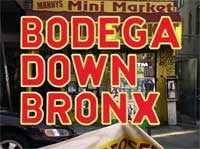 “Where does the food in your bodega come from? Who decides whether to stock tortilla chips or salad greens, and how much they’ll cost? How come it’s easier to find fresh fruits and vegetables in Brooklyn Heights than in the South Bronx? What’s the connection between the incidence of diabetes and the food market supply chain?” Bodega Down Bronx is a 30-minute video produced by Jonathan Bogarín, a group of Bronx students and the Center for Urban Pedagogy. Interviewing residents, bodega owners, distributors, politicians, and health professionals, it’s a fantastic, holistic breakdown of the day-to-day realities that flow from public policy, and what you can do about it.
International Year of Cooperatives
Get ready! The United Nations General Assembly just declared 2012 as the International Year of Cooperatives. A cooperative is an organization owned and governed by its workers or members. The Assembly noted that cooperatives impact poverty reduction, employment generation and social integration. The brief press release includes some amazing statistics: agricultural cooperatives account for 80 to 99 per cent of milk production in Norway, New Zealand and the United States; 71 per cent of fishery production in the Republic of Korea; and 40 per cent of agriculture in Brazil.
In case you missed it, check out my article on design cooperatives that ran in the September 2005 Communication Arts.

