

July 2009
Why
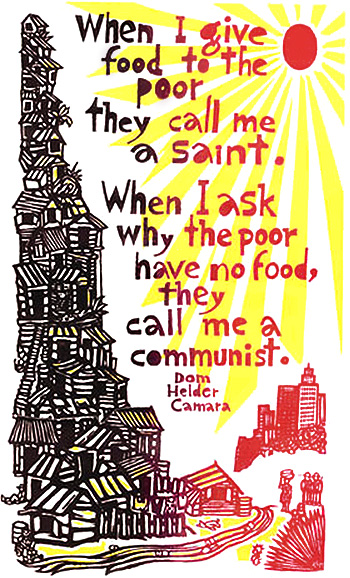
Poster design by Ricardo Levins Morales and the late great Northland Poster Collective.
 31 July 2009 |
 Good vs Power
From Orion Magazine:
“Would any sane person think dumpster diving would have stopped Hitler, or that composting would have ended slavery or brought about the eight-hour workday, or that chopping wood and carrying water would have gotten people out of Tsarist prisons, or that dancing naked around a fire would have helped put in place the Voting Rights Act of 1957 or the Civil Rights Act of 1964? Then why now, with all the world at stake, do so many people retreat into these entirely personal ‘solutions’?”
Via Design Action and Design Activism I found this essay by Derrick Jensen on the polite activism of personal consumption and “living ethically.” Though Jensen doesn’t direct it at designers specifically, he identifies a strong trend in contemporary activism that’s pervasive amongst designers, particularly in the whole sustainable design movement. I’ve noted this before, as have others: after a hard strategic review last year, the World Wildlife Fund published a major report attacking green consumerism and “behaviour-change” strategies, calling instead for radically different approach to environmentalism.
 Sometimes constructing alternatives can be an effective way to go, the Free Software movement being one shining example. But at the risk of spoiling his punch line, Jensen points to successful political struggles of the past: “We can follow the example of those who remembered that the role of an activist is not to navigate systems of oppressive power with as much integrity as possible, but rather to confront and take down those systems.”
Which is a good segue to this excellent roundup of real-world graphic agitation by Josh MacPhee, Street Art and Social Movements in Paris in May 1968, Nicaragua in the late 1970s, South Africa in the early 1980s, and finally Argentina from 2001-04.
 The Center for Urban Pedagogy has announced a call for designers for the next round of Making Policy Public. This year’s fold-out poster designs will cover policy briefs on:
- Preserving public parks and historically safe spaces for LGBTQ teens in the context of rapid privatization of public space.
- Enabling public housing residents to become active participants in critical decisions about the developments where they live.
- Educating the public about the redistricting process and reforms that can make it less subject to political manipulation.
- Helping youth and their families navigate the juvenile justice system.
- Visualizing market forces along the tomato supply chain that give rise to sweatshop working conditions in the Florida tomato industry.
100+ Years of Design Manifestos
 Since the days of radical printer-pamphleteers, design and designers have a long history of fighting for what’s right and working to transform society. The rise of the literary form of the manifesto also parallels the rise of modernity and the spread of letterpress printing.
This list of design manifestos was buried in a previous post but deserves its own permalink. The original list was largely drawn from Mario Piazza’s presentation at the 2009 conference Più Design Può in Florence, though I’ve edited and added to it. I’ve also incorporated links where I was able to find them.
 Designer Issey Miyake on surviving the atomic bomb at Hiroshima: “I have never chosen to share my memories or thoughts of that day. I have tried, albeit unsuccessfully, to put them behind me, preferring to think of things that can be created, not destroyed, and that bring beauty and joy. I gravitated toward the field of clothing design, partly because it is a creative format that is modern and optimistic.… But now I realize it is a subject that must be discussed if we are ever to rid the world of nuclear weapons.”
Nature Morte
Gustave Caillebotte, a key patron of the Impressionists, inherited his forturne from a supplier to the French during the Franco-Prussian war. The CIA promoted Abstract Expressionism. Tobacco pusher Philip Morris sponsors art and dance. It increasingly seems that, as the saying goes, “behind every great fortune there is a great crime,” and behind every big name artist is a great patron.
And so I enjoyed this series of para-military sill lives.

Uyghurstan

The Kökbayraq is a flag without a country.
Seen at protests around the world in recent weeks, the flag is used by Uygur nationalists in the East Turkestan independence movement and the more militant East Turkestan Islamic Movement and East Turkestan Liberation Organization. The flag is banned in China.
The design has its origins in two briefly independent republics. In 1933, when the Chinese central government had de facto ceased to exist, the Islamic Republic of Eastern Turkestan declared independence. It collapsed the following year, though a second Republic won independence a decade later with Soviet support. It was crushed in 1949 by the People’s Liberation Army of Communist China, when it became designated “Xinjiang Uyghur Autonomous Region.”
Fire Engine Red
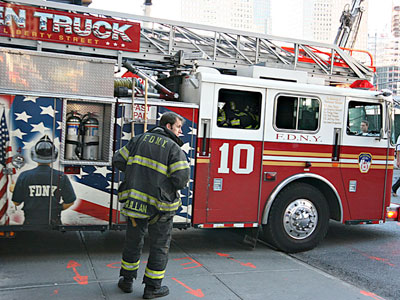
Shooting off fireworks, firing up the grill, raining fire on Charlie — there’s much collective fire-making in the name of Americanness. But in NYC at least, fire fighting has also taken this on.
It’s fairly common here to see fire houses and fire trucks decorated with Americana: all manner of murals and bas-relief flags, eagles, and slogans honoring our troops, etc. This is particularly keen where fire houses have affixed street-level memorials to the firefighters who lost their lives on September 11, 2001. In graphics and text, these both pay tribute to the fallen and position them at the front-line of American defense.
Of course there are firefighters around the world, but here in the States the idea of a bunch of brawny, self-sacrificing heros swooping in when you need them most has become particularly hyper-American, particularly in the shadow of foreign attack.
But in its messaging, it’s seldom acknowledged that this vanguard of Americanness, these rugged individualists are almost always organized as a socialist or anarchist endeavor, either funded by the city or as volunteer collectives from the communities they serve. Seldom that is, until services are cut.