



June 2003
Designing Supportive Housing
From an April 2002 interview in Metropolis Magazine:
“Rosanne Haggerty is the new landlord of the Andrews Hotel, a grim vermin-infested joint at the corner of Bowery and Spring Street on Manhattan’s Lower East Side. She is also founder and executive director of Common Ground Community, a nonprofit organization that has purchased and converted a handful of historic buildings, including the Times Square Hotel, into some of New York’s most progressive low-income housing — work that last year earned her a $500,000 ‘genius grant’ from the MacArthur Foundation.
After four years of field research that took Haggerty and her staff from the public shelters of New York to the capsule hotels of Japan, Common Ground Community is set to begin transforming the century-old Andrews into something they call First Step Housing. Working with New York architects Marguerite McGoldrick and Gans + Jelacic, and more than 150 homeless men and women who contributed feedback, Haggerty plans to combine elements of the Bowery’s dying flophouse tradition — $7 a night, no lease, no questions — with smart management, on-site social services, and space-efficient modular design. Recently she spoke with Douglas McGray about the project’s design considerations — and its lessons.”
Rosanne Haggerty:
“Social scientist Christopher Jencks zoned in on the loss of the cubicle hotels as a specific cause of the rise of single-adult homelessness. That got me thinking, Why don’t these places exist anymore? For years I’d get close to the question and then recoil because these buildings were so squalid. The quality-housing advocate in me couldn’t comprehend how one could responsibly advocate their resurgence. It finally occurred to me that until not-for-profits started working on them, single-room occupancies had also been looked at as substandard forms of housing. Then it clicked — it’s more of a failure of imagination on our part than anything embedded in the model.”
After extensive research, including two months in Osaka, Japan studying the flexible use of limited space, interviews with individuals and groups of homeless men and women, including feedback on three rounds of prototypes, Common Ground developed a design that was attractive, affortable, and secure.
“The main reason people are remaining on the streets is safety. They perceive themselves to be more secure sleeping in a public space than in the city’s shelter system. People were very keen on the idea of metal detectors, very concerned about what the roof material would look like — how secure it would be. They were concerned about the strength of the lock and the durability of the construction....
Somebody had a very good line. He said, ‘You don’t want it to be a doll house, but you don’t want it to be a cell either.’ A lot of these folks have been in psychiatric hospitals or in jail, and they don’t want an environment that reminds them of that. Things as subtle as being able to move the furniture around — not having it nailed down — being able to get control of a degree of privacy in the space, having a window that opens and closes onto a central corridor seemed to take something that could have been viewed as institutional and make it cozy....
Frankly, design makes a significant difference in terms of the atmosphere of calm and respect that you establish. People respond behaviorwise to being in that kind of environment. Keeping maintenance costs reduced is also a consideration. We need spaces that can be cleaned easily, panels that can be removed and replaced without having to trash the whole unit.”
The First Step units are prefabricated, ship nearly flat and can bolt together in almost any commercial space.
Many of the housing projects incorporate social services:
“Supportive housing is permanent housing with social services for the formerly homeless, people with mental and/or medical disabilities, the elderly, and individuals with low-income. Supportive housing combines affordable accomodations with services like mental health and drug addiction counseling, job training and placement, community activities, and help with life skills like cooking and money management.
Supportive housing was created by non-profits around the country as a more holistic response to homelessness. Approximately 70% of homeless single adults in the United States have problems like mental illness, substance abuse and HIV/AIDS — problems which contribute to their homelessness. By offering a variety of support services designed to address these issues, supportive housing has paved the way for a more effective approach to preventing homelessness....
Two long-term government studies have shown that more than 83% of the homeless individuals placed in supportive housing have remained in permanent housing and have reintegrated themselves into mainstream society.”
See the Corporation for Supportive Housing and the Supportive Housing Network of New York.
Common Ground and the Architectural League of New York are currently running an open competition to design a new “prefabricated individualized dwelling unit.” The registration deadline is July 11, 2003. The design entry submission deadline is 10 AM, August 25, 2003.
“Up to four competition winners will be chosen. Winners will each receive a cash prize of $2,000 and will be engaged to develop their proposals for manufacture and installation at the Andrews House, a lodging house on the Bowery in Manhattan, for which they will be paid a design fee. An exhibition of entries will be mounted in Manhattan in October 2003, and displayed on the competition website. A publication documenting the competition may also be produced.”
See the First Step Housing Web site for more detail.
ISO
 The International Organization for Standardization is an international non-governmental organization that coordinates the development of voluntary technical standards.
ISO is a network of the national standards institutes of 146 countries with a Central Secretariat in Geneva, Switzerland, that coordinates the system. National standards institutes, not governments themselves, are eligible for membership. Each country sends only one member, and each member has one vote.
The ISO does not regulate or legislate. It’s standards are developed by international consensus among “experts drawn from the industrial, technical and business sectors... experts from government, regulatory authorities, testing bodies, academia, consumer groups or other relevant bodies.”
“There are more than 2,850 of working groups in which some 30,000 experts participate annually. This technical work is coordinated from ISO Central Secretariat in Geneva, which also publishes the standards.
Since 1947, ISO has published more than 13,500 International Standards. ISO’s work programme ranges from standards for traditional activities, such as agriculture and construction, through mechanical engineering to the newest information technology developments, such as the digital coding of audio-visual signals for multimedia applications.
Standardization of screw threads helps to keep chairs, children’s bicycles and aircraft together and solves the repair and maintenance problems caused by a lack of standardization that were once a major headache for manufacturers and product users. Standards establishing an international consensus on terminology make technology transfer easier and can represent an important stage in the advancement of new technologies.
Without the standardized dimensions of freight containers, international trade would be slower and more expensive. Without the standardization of telephone and banking cards, life would be more complicated. A lack of standardization may even affect the quality of life itself: for the disabled, for example, when they are barred access to consumer products, public transport and buildings because the dimensions of wheelchairs and entrances are not standardized.
Standardized symbols provide danger warnings and information across linguistic frontiers. Consensus on grades of various materials give a common reference for suppliers and clients in business dealings.
Agreement on a sufficient number of variations of a product to meet most current applications allows economies of scale with cost benefits for both producers and consumers. An example is the standardization of paper sizes.” [source]
The internatinoal technical standards also include international safety standards for products including toys (ISO 8124-1:2000), camping tents (ISO 5912:1993), bicycles (ISO 4210:1996), and contraceptive devices (ISO 8009).
In 1987, the ISO expanded to develop “generic management system standards.” ISO 9000 is set of a quality management guidelines that apply to all kinds of organizations in all kinds of areas. Once the a quality system is in place, an accredited external auditor can certify that your quality system has met all of ISO’s requirements. They can then issue official certification that you can use to publicize that the quality of your products and services is managed, controlled, and assured by a registered ISO 9000 quality system.

 ISO 7001, “Graphical symbols for use on public information signs,” is a set of international symbols based on the “ISOTYPE” system of icons and pictograms introduced by Otto Neurath in the 1936. However, soon after the 7001 was published, it was determined that the standard international symbols did not have a standard meaning or clarity in every country. Published in 1989 and revised in 2001, ISO 9186 is a procedure for user testing of graphic symbols to determine which symbols communicate the intended meaning most readily to most people. There are two main test methods: a comprehensibility judgment test and a comprehension test. [source] Pictograms with exceptionally high comprehensibility in several countries can eventually become part of the ISO 7001 set.
ISO 13407 “Human centred design processes for interactive systems” provide guidelines for the planning and management of usability testing in the development of computer systems.
In 1993, the ISO established a technical committee, ISO/TC 207 to develop standards for “Environmental management.”
“This move was a concrete manifestation of ISO’s commitment to respond to the complex challenge of “sustainable development” articulated at the 1992 United Nations Conference on Environment and Development in Rio de Janeiro. It also stemmed from an intensive consultation process, carried out within the framework of the Strategic Advisory Group on Environment (SAGE). SAGE was set up in 1991 and brought together representatives of a variety of countries and international organizations — a total of more than 100 environmental experts — who helped to define how International Standards could support better environmental management.
Today, national delegations of environmental experts from 66 countries participate within ISO/TC 207, including 27 developing countries. In addition, 35 international non-governmental and business organizations participate as liaison organizations. The national delegations are chosen by the national standards institute concerned and they are required to bring to ISO/TC 207 a national consensus on issues being addressed by the technical committee. This national consensus is derived from a process of consultation with interested parties in each country.” [source]
The committee works in hand with ISO/TC 176, which develops the ISO 9000 family of standards for quality management and quality assurance.
“ISO 14000 refers to a series of voluntary standards in the environmental field under development by ISO. Included in the ISO 14000 series are the ISO 14001 EMS Standard and other standards in fields such as environmental auditing, environmental performance evaluation, environmental labeling, and life-cycle assessment. The EMS and auditing standards are now final. The others are in various stages of development.” [source]
ISO 14001 certification remains valid for three years and requires audits performed at least annually.
While U.S. environmental regulations do not apply outside of U.S. territory, ISO 14001 applies to all of your operations:
“Perhaps the most significant factor accelerating ISO 14001 compliance is the ever-increasing globalization that characterizes the auto industry. More and more, auto manufacturing is mirroring airplane manufacturing: parts and components might be manufactured anywhere, and assembly might occur anywhere.
This means that a single automaker can have multiple facilities all over the world, under the same corporate umbrella, which require a consistent EMS and measurable results in order to operate competitively. ISO 14001 is one of the best ways to ensure that these needs are met.” [source]
UPDATE: See my August 5, 2003 blog post ISO 14001 Reconsidered.
 24 June 2003 | LINK | Filed in
accessibility, gov, org, product, recycle, standards, transport, united nations
24 June 2003 | LINK | Filed in
accessibility, gov, org, product, recycle, standards, transport, united nations
Green Toyota
Via Metafilter, I caught this article in The Herald-Dispatch.
Both of Toyota’s engine assembly factories in the United States have achieved “zero landfill status,” which means that Toyota sells or gives away every waste product it produces to companies that recycle the waste: metals are melted down, plastic is mixed with sawdust to make plastic lumber, sludge from the wastewater treatment plant is sent to a company in Lima, Ohio, where it is mixed with other materials to make portland cement.
 “Toyota has an environmental action plan calling for, among other things, reducing total energy use by 15 percent by 2005. Management at the Buffalo plant decided to do better, aiming for 19 percent. The plant achieved its 2005 environmental goals late last year, [said Don Stewart, maintenance manager for Toyota Motor Manufacturing West Virginia.]
The Buffalo plant is operating on an even tougher environmental plan that is scheduled to be fully implemented by 2006, Stewart said. Among the requirements is the zero landfill plan. The plant had already managed to avoid sending any hazardous waste to landfills. The next logical step was to not send any waste to landfills, Stewart said.
Some Toyota plants in Japan had already met that goal, so it was attainable, he said.”
The process has required investment, as well as revision of the manufacturing process.
“Stewart said zero landfill makes sense financially in several ways. For one thing, it eliminates liability for the company decades from now should problems at a landfill need to be corrected. In many cases, federal regulators require companies that dump materials in a problem landfill to remove them.
The Buffalo plant more or less breaks even on its zero landfill program, Stewart said. For some materials, recycling is more expensive than using a landfill, he said.
Toyota’s plant at Buffalo is ISO 14001-certified, meaning it meets a voluntary international standard for environmental protection. The certification process requires that the plant have a formal environmental policy, a system designed to track the plant’s environmental performance and established mechanisms for continuous improvement.
 Now that the plant has attained zero landfill status, the next step is to work with suppliers to reduce the amount of waste materials coming into the plant....
Toyota is requiring that all its suppliers achieve ISO 14001 certification by the end of this year.”
In Toyota’s text about their environmental commitment is a press release on their ISO 14001 status and Toyota’s guidelines and requirements for its suppliers. Toyota sub-contracts much of its manufacturing processes, so its suppliers handle much of the waste product.
Toyota’s Policies for Global Environmental Protection Initiatives was established in 1992. The “Toyota Earth Charter,” was revised in 2000. Toyota’s Eco-project is designed to promote these policies so to the entire company, and to apply the concept of “Totally Clean” to every stage of a car’s life cycle, from development and production to use and disposal.
In 1998, Center for Resource Solutions awarded Toyota a “green e” for the use of sustainable electricity by its California operations.
In 1999, the United Nations Environmental Programme awarded Toyota their Global 500 Award, the first such award received by an automaker.
In addition to it’s green manufacturing process, Toyota also mass produces hybrid gasoline-electric vehicles. See GreenCars.org, a rating of fuel economy and emissions by the American Council for an Energy-Efficient Economy.
See this article and this definition of Toyotism (or Toyotaism) for more on the human side of Toyota’s manufacturing process.
This Wallpaper is Killing Me
Environmentalist, on the board of chemical company, peddles poison products? A 19th century scandal unfolds in the 21st.
William Morris (1834-1896) was a poet, craftsman, designer, writer, typographer, socialist, an early environmentalist and design critic, and a founder of the Arts and Crafts movement. The movement in the UK and later in the United States aimed to raise the status of decorative arts, to celebrate craftsmanship and beauty in objects and furnishings. The movement was a response to industrialization, mass-production, and the alienation of workers from their craft and creativity. The movement campaigned for ethics and aesthetics in design, and celebrated craftsmanship, quality, and service it associated with the medieval guild system. Designers were encouraged to promote spiritual and humanist rather than commercial values, and to sell their wares to the public at a low price while fairly compensating the craftsman.
However, a paper published in the June 12, 2003 issue of the journal Nature finds that Morris used arsenic in the pigments of his wallpapers, despite widespread reports of its toxicity. The findings are a shocking contradiction to Morris’s design humanism.
From Wired News:
“William Morris is famous for creating beautiful tapestry designs, full of lush green leaves and vines, in the late 19th century.
A new study shows that Morris derived the color green from a dangerous source: arsenic. His father owned the processing plant that became the major supplier of arsenic used in green pigments in 1867. Morris made his own fortune from shares in the company, Devon Great Consols, and served on the board.
The researcher who performed the study found evidence that Morris turned a blind eye to the possible danger in which he placed his customers. Ironically, Morris was outspoken about his disgust with industry’s dehumanizing and polluting practices.
‘He was on the board of directors of an arsenic mining company,’ said Andy Meharg of the school of biological sciences at the University of Aberdeen in Great Britain whose study was published in Nature. ‘It is hard to believe that the health concerns of mining and processing of arsenic were not discussed at board meetings.’
Even in the late 1800s, the danger of arsenic exposure was well established. Workers at DGC suffered from painful skin lesions known as arsenic ‘pock,’ and many died from arsenic-related lung diseases, Meharg writes.
 Yet Morris dismissed the assertion that arsenic was poisonous in letters to Thomas Wardle, his dye manufacturer. Wardle wrote Morris telling him that one of his customers was concerned that the wallpaper he had bought from Morris was making him and his wife sick.
‘As to the arsenic scare, a greater folly is hardly possible to imagine: The doctors were being bitten by witch fever,’ he wrote in a letter dated Oct. 3, 1885, according to Meharg.
The William Morris Gallery in London donated a small sample of one of Morris’ original wallpapers with the trellis design to analyze.
‘I analyzed the green pigment by energy-dispersive analysis and showed unequivocally that the coloration was caused by a copper arsenic salt,’ Meharg wrote. ‘The beauty that William Morris wallpapers brought to a room must have had a health cost, at least in damp rooms.’
In damp rooms, Mehard said, fungi living on the wallpaper paste turned the arsenic salts into highly toxic trimethylarsine. Arsenic pigments, which were also used extensively in paints and to dye clothes, paper, cardboard, food, soap, and artificial and dried flowers, were responsible for untold numbers of cases of chronic illness and many deaths.
The William Morris Society did not return phone calls requesting comment.
In addition to art and design, Morris was known for being an outspoken socialist as well as an environmentalist. He was a co-founder of the Arts and Crafts movement, and is described by art historians as someone who sought to ‘shift workers out of numbing factory jobs into uplifting crafts where a healthy mind, body and spirit could be achieved.’
So his dismissal of the misery that arsenic clearly caused workers in the factory his father owned — that gave him the means to start his firm, Morris, Marshall, Faulkner & Co. (later changed to Morris & Co) — is troubling. But Meharg tries to give Morris the benefit of the doubt.
‘In his defense, he was a product of his age, when environmentalism was in its infancy,’ he writes in the Nature paper. ‘He was actually a positive force in this movement. His political creed developed over several decades, and by the end of his life, when he was most revolutionary, his links with industry were in the past.’”
See coverage in the Independent or Nature’s own article about the paper. You can download the full text of the paper if you are a Nature subscriber or are willing to cough up $18 for the article.
California Senate Passes E-Waste Bill
On June 4, 2003 the California Senate approved a bill that would require electronics manufacturers to recycle discarded computers and electronics equipment, and to set up and fund a recycling infrastructure. From news.com:
“If the bill is signed into law [by the state assembly and Governor Gray Davis], manufacturing companies by the beginning of 2005 would have to arrange for the recovery of 50 percent of all machines sold during the preceding year. That rate would grow to 70 percent in 2007 and 90 percent in 2010. According to the bill, just 20 percent of obsolete computers and TV sets are currently recovered for recycling. Under the bill, companies could either set up and finance state-approved drop-off programs, under which people could bring their older computers, or the companies could pay the state to do it. They would also have to develop recycling plans....
Governor Davis last year vetoed a bill similar to SB 20, but that earlier bill didn’t allow high-tech companies the option to run such programs themselves, as the new one does.
Although the current bill would affect only those companies doing business in California, the state, which is home to the tech-heavy Silicon Valley, often leads the country in environmental and other trends. Similar bills have been proposed in other states and in the U.S. Congress.”
See the text of Senate bill SB 20.
Other city and county-level initiatives mandating electronics recycling and “take-back” programs are also moving forward throughout California.
The Federal National Computer Recycling Act was introduced in the House on March 6, 2003 by Mike Thompson (Democrat, Napa Valley, California). The bill proposes a fee on all computer and peripheral sales. The fee would fund local programs to collect, reuse, resell, or recycle computer equipment. Gear would be exempt from the fee if its components are likely to be reused or disposed of properly. The bill also mandates a Congressional study on the health and environmental impact of materials used in computers. The bill covers other consumer electronics that “contain a significant amount of material that, when disposed of, would be hazardous waste.”
A Game of Hearts
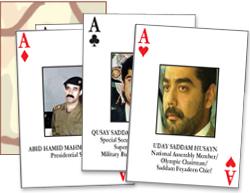 On April 11, 2003 the U.S. military released their list of most-wanted senior Iraqi government in the form of a deck of playing cards.
The cards were designed by staff of the Defense Intelligence Agency and the 3401st and 3418th Military Intelligence Detachments. One of the designers, Sergeant Scott Boehmler, 27, an Army reservist from Hazleton, Pennsylvania reports, “We understood what guys like to do on their downtime. This is an effective way of getting these images in the soldiers’ minds.”
Images can be downloaded from the Department of Defense Web site in HTML or PDF.
Production of the cards was widely covered in the U.S. mainstream media and treated as a significant event in the war. Subsequent reports of the arrest of Iraqi officials frequently refer to the list, even noting when an arrested official is not on the list. The reports are occasionally illustrated with an image of said official’s playing card.
The decks have also become enormously popular with the public. Web sites have sold hundreds of thousands of decks. As of May, one company reported $1.5 million in sales. It’s one thing to sell a war to the public. It’s whole other matter for them to buy it themselves in droves. I’ve even seen street vendors in NYC selling the decks alongside the knockoff sun glasses and watches and received a couple of unsolicited email messages offering the decks for sale.
U.S. military personnel are the world’s largest consumers of playing cards, according to Cincinnati-based United States Playing Card Company, the world’s largest playing card manufacturer. According to Time (May 12, 2003) the extreme popularity of the most-wanted cards prompted the distributor to reissue cards created for the military in earlier wars. During World War II “spotter decks” were produced for troops to distinguish between Allied and enemy aircraft. During the Vietnam War “decks containing only the ace of spades were passed out to U.S. troops, who would display a card on their helmets to scare away the Viet Cong — supposedly superstitious about the card, which fortune tellers considered a harbinger of suffering and death.”
The cards have inspired a genre of spinoffs.
GreatUSAflags.com has followed up with U.S. Military Heroes playing cards “honoring America’s servicemen and women involved in Operation Iraqi Freedom.” The deck also features images of aircraft, ships, submarines, aircraft carriers, vehicles and missiles deployed in battle.
On April 25, global justice group, the “Trade Regulation Organization,” released their U.S. Regime Change cards [image, PDF 6MB]. The group, “estimating that the U.S. governing regime is no longer consistent with world peace or prosperity, hopes that the playing cards will show the way to regime change and, eventually, large-scale war crimes proceedings.”
On May 1, Greenpeace International released a deck of “most wanted” cards depicting the nuclear powers of the world. [PDF, 96K] “This deck is designed to help delegates to the Non-proliferation Treaty meeting recognise owners of weapons of mass destruction. Packed with nuclear weapons of mass destruction facts. Fun for the whole family.” Says Tom Clements, senior campaigner with Greenpeace, “It ties the anti-war message together with the disarmament message.”
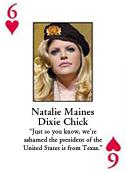 On May 7, the conservative Web site NewsMax announced the Deck of Weasels [image] which features images of anti-war celebrities and politicians includes Michael Moore, Tim Robbins, Jacques Chirac, Barbara Streisand, Teddy Kennedy, Kofi Annan, Vicente Fox, Jean Chretien,
  Senator Ted Kennedy and Robert Byrd. Each card features a quote by the celeb opposing the U.S. invasion of Iraq. Each of the photographs has been altered so each figure wears the beret of Saddam Hussein’s Republican Guard.

On May 15, the Ruckus Society released America’s War Profiteers, a deck of cards identifying 53 individuals and institutions in the oil, military, government, media, and policy sectors. “The groups’ aim is to expose, ‘The links among corporations, institutions, and government officials that profit from endless war.’” The site also features a good set of links to articles and campaign pages.
On May 23, Nitestar Productions released “The Deck of Republican Chickenhawks,” depicting the 54 Republican officials, congressmen, politicians and pundits who avoided serving their country through connections, deferments, or other excuses.” Needless to say, many of the officials vigorously supported the U.S. war on Iraq. The deck was inspired by a list maintained by the New Hampshire Gazette of Republican politicians and pundits who have never served in armed combat.
Still other decks reported in the May 18 Washington Post:
“Republicans in the Texas legislature had cards made depicting the state’s ‘most-wanted Democrats’ — the lawmakers who fled to Oklahoma to scuttle a vote on a bitterly contested Republican redistricting plan....
Inspired by the Pentagon’s cards, Frances Gomez, 23, decided to print up card sets featuring her top 55 Cuban villains. But just before the printing order was sent out, Gomez tweaked her plan in hopes of really sticking it to Fidel Castro. She decided to make the cards look like dominoes, the real king of the board games in Little Havana and just about anywhere else that Cubans gather.
So, instead of being the ace of spades — the card reserved for Saddam Hussein in the Pentagon’s deck — Fidel is the Double Nine, the domino tile that no player wants to hold at the end of a game. Gomez needed help from Cuban American groups in Miami to compile her list. She was born in the United States and says, like many Cuban Americans her age, that she knew little about the details behind the deep animosity felt toward Castro and his allies by older generations that fled the island nation.
‘It’s important to learn who these people are,’ Gomez said.”
In addition to the playing cards are recent political trading cards.
 In 1991, trading card publisher Topps (coordinating with the Pentagon and Navy Department) published 3 sets of Desert Storm Trading Cards. In 2001, they published a series of Operation Enduring Freedom Trading Cards.
An article in the Guardian notes:
“90 glossy cards featuring US political and military leaders, the patriotic response to the September 11 attacks, and military hardware.... The series also features a photograph of flowers laid outside the US embassy in Pakistan in the aftermath of the September 11 atrocities. No corresponding card shows the subsequent angry demonstrations against the US bombing campaign.... Topps would not directly respond to charges that the cards promoted an unquestioning view of the war to children.”
Kingsley Barham, publisher of marijuana trading cards that cover hemp history, politics, types, and uses, developed a set of trading cards about the September 11 attacks, Heroes of the World Trade Center. Despite approval from families of victims whose portraits are on the cards, the cards were met with outrage by politicians and the media. The New York City mayor Michael Bloomberg urged lawyers to find ways to prevent the sale of the cards.
 Satire decks of the U.S. “war on terrorism” include American Crusade 2001+, Unofficial Iraqi Freedom Action Cards, and the images of Playing the Hitler Card, a small collection of cards with images of dictators and links to pages were they have recently been compared to Hitler.
In September, 2002 Slate published the Flash animation Corporate Scandal Trading Cards, “the fastest guide to America’s top 10 business crackups” with names and photos of CEO’s along with some statistics and a brief description of the crimes and frauds of WorldCom, Enron, Global Crossing, Adelphia, Tyco, ImClone, Halliburton, Harken, Qwest, and Andersen Consulting.
In April 2000, Texans for Public Justice produced a set of Bush League trading cards. The 20 cards feature statistics and a profile of a Bush “Pioneer” who has raised at least $100,000 for Bush’s presidential election. The profiles are drawn from TPJ’s investigation into the 212 announced Bush “Pioneers.”
 On the heels of their 1989 comic book “Brought to Light: Thirty Years of Drug Smuggling, Arms Deals, & Covert Action,” in 1990 Eclipse published the original Friendly Dictator Trading Cards. The hallucinogenic artwork of Bill Sienkiewicz illustrates “three dozen of America’s most embarrassing ‘friends’, a cunning crew of tyrants and corrupt puppet-presidents who have been rewarded handsomely for their loyalty to U.S. interests.” Other political trading card sets published by Eclipse include “Drug Wars,” “The Iran Contra Scandal,” and “Rotten to the Core - New York Political Scandal,” and “Coup D’etat,” which presents theories pertaining to the assassination of President John F. Kennedy.
Douglas Rushkoff’s 1994 book Media Virus quotes journalist and Eclipse editor Catherine Yronwode:
“Our trading cards are designed so they read like Hypercard stacks. Each cross-references to other cards... They all connect, and you can rearrange them in chains of interconnectivity. Or chronologically. You can find out who someone’s boss was, how different people moved around, that this guy was in Vietnam at the same time as this guy, and then that they were both in Nicaragua at the same time, too.”
Eclipse’s “Crime and Punishment” and “True Crime” cards, which present information about serial killers and gangsters, prompted the Board of Supervisors of Nassau County to pass Local Law 11-1992 which made it illegal to disseminate “indecent crime material to minors.” From the Friendly Dictators site:
“In 1997... a U.S. federal appeals court struck down a Nassau County, New York law banning the sale of trading cards depicting ‘any heinous crime". The court found for Eclipse who had challenged the law on First Amendment grounds - cf: Eclipse Enterprises, Inc. v. Gulotta (U.S. Federal Court of Appeal, 2nd Circuit, December 1997). The expense of this court case seems to have bankrupted them - at any rate, for whatever reason, Eclipse appears to have folded. There are no web entries for the company, no listing in any of the Publishing Indexes I’ve been able to find, and all its products are out of print, as far as the big web booksellers are concerned.”
Details of the case and proceedings can be found here.
Techniques of Electronic Advocacy
This entry has been updated and incorporated into An Introduction to Activism on the Internet.
I’ve been searching for a list of excellent examples of Internet activism. I couldn’t find one, so I made my own.
I’ve structured much of this list around categories outlined by Sasha Costanza-Chock in “Mapping the Repertoire of Electronic Contention,” in Representing Resistance: Media, Civil Disobedience and the Global Justice Movement, eds. Andrew Opel and Donnalyn Pompper. Greenwood, in press. Unless otherwise indicated, the quoted text below has been taken from him.
Though I’ve added some of my own commentary, this is not intended to be a full analysis of the campaigns and organizations mentioned. I disagree with the politics of many of the examples listed, but think there is something to be learned from each of the them.

